The morning after Donald Trump reversed out of the trap he set for himself called Greenland, one person who would like to replace him in the White House warned that the emergency was not over.
“We can lose our republic as we know it,” said California’s governor, Gavin Newsom, shaking with anger in Davos. “This is America in reverse, censoring facts and history.” He was talking about a speech in which Trump told a series of untruths about Greenland, Nato troops fighting alongside the US, Europe, China, wind turbines and the North Sea. “It is code red,” he said. “That’s why I’m here.”
Afterwards, Newsom posed for pictures with expatriate Democrats imploring him to run in 2028. Merchandise available from his team included red kneepads he gives out to chief executives for kneeling before the whims of the Trump presidency. Newsom was then hustled out and down the mountain for the 12-hour flight back to Sacramento.
Trump left soon after in a squadron of helicopters, skipping a dinner to which he had been invited by Emmanuel Macron. The French president and other European leaders were due, anyway, at an emergency summit in Brussels called to handle what they feared would be a loud and rancorous breakup of the western alliance over Greenland. In the event, it was a quiet one, but no less ominous for that. The meeting lasted five hours. “When we stand together and when we are clear and strong… then results will show,” Denmark’s prime minister, Mette Frederiksen, said on her way out. “I think we have learned something in the last days and weeks.”
The immediate lesson: Trump was bluffing over Greenland. The broader one: as Russia tries to rebuild its empire to the east, Trump has picked a deeply personal fight with Europe and most of what it stands for to the west, and Europe needs to take a stand.
He may have settled on a “framework” deal on Greenland for now, said Jane Harman, chair of the US commission on the national defence strategy, but “he loves the idea of expanding the map of the United States and, to be frank, that’s how the US acquired a lot of its territory over the past 250 years”.
The moment it became clear Greenland would dominate the summit came last Saturday, when Trump threatened punitive tariffs on countries sending uniformed personnel to the island to show solidarity – among them the UK, which dispatched a single military attache.
On Monday night, it was still his position that eight European countries deserved extra tariffs for daring to oppose a US takeover. At 4.30am eastern time (ET) on Tuesday, Ursula von der Leyen, the European Commission’s president, got to her feet in Davos and said the EU’s new trade deal with South America brought together 31 countries, more than 700 million people and 20% of global gross domestic product (GDP). “Europe will always choose the world, and the world is ready to choose Europe,” she said. And Greenland’s sovereignty and territorial integrity were non-negotiable.
At 8am ET, Macron said the new tariff threat was “unacceptable”. Why was sovereignty so important, he asked? “To not totally forget what we learned from the second world war. Let’s not waste time with crazy ideas… It’s not a time for new imperialism.”
‘We can lose our republic as we know it. This is America in reverse, censoring facts and history’
‘We can lose our republic as we know it. This is America in reverse, censoring facts and history’
Gavin Newsom, governor of California
An hour later, the markets opened in New York. The S&P 500 index fell abruptly and the yield on 10-year US bonds rose, meaning their price was falling and the cost of credit for the US government was going up – the reverse of the usual dash to US debt as a safe haven in uncertain times.
Newsletters
Choose the newsletters you want to receive
View more
For information about how The Observer protects your data, read our Privacy Policy
By this point on Tuesday, retaliatory tariffs on $100bn of US goods had been discussed but not deployed. Macron had talked up the idea of using the EU’s “trade bazooka” – an anti-coercion instrument (ACI) added to the bloc’s arsenal in 2023 to hit back at serial violators of trade rules by barring access to EU markets.
The ACI has never been used but, like the US military option, it was still on the table.
At 10.30 ET, Mark Carney, Canada’s prime minister, started what many regulars say was the best speech ever delivered at Davos. There had been a rupture in the world order, not just a transition, he said. Big powers were behaving, as the Greek historian Thucydides said they would, as if “the strong can do what they can and the weak must suffer what they must”, and middle powers had no choice but to stand up to them “because if we’re not at the table, we’re on the menu”.
Carney was given a standing ovation. By close of business in New York, a little over $800bn had been wiped off the value of the S&P 500’s members. The next day, Trump opened his speech as if at a political rally. Growth was exploding, he said, inflation was defeated and the world was about to witness “the most dramatic turnaround in our history”.
Even the billionaires aren’t so sure. US growth is robust compared with Europe’s, thanks partly to sweeping new tax write-offs allowed in last year’s one big beautiful bill. But inflation is expected to go up in the next six months as tariffs bite and US companies pass on higher input costs to customers.
“The US is in a more fiscally precarious position than in decades,” the hedge fund manager Ken Griffin – net worth almost $52bn – said on Wednesday as crowds formed to get into the Trump speech. His all-in pro-growth strategy is “an experiment that started in his first term and we don’t know how it ends because Covid interrupted it”, Griffin said. “We spent as much a proportion of GDP on the pandemic as we did to win [the second world war]. In one, we saved the world. In the other, we warmed our couches.”
A Liz Truss moment was possible for the US, he said: “The bond vigilantes are back.” The US spends about $1tn a year servicing its debt. That would rise sharply if investors lost faith.
As Griffin spoke, Trump and a slimmed-down entourage were on the final approach to Zurich, having swapped the usual Air Force One for a smaller plane after an electrical fault in the middle of the night.
‘The US is in a more fiscally precarious position than in decades’
‘The US is in a more fiscally precarious position than in decades’
Ken Griffin, hedge fund manager
An hour before Trump’s speech, the holding area where Davos attendees usually network and graze on free snacks and cappuccino was already a mosh pit of technocrats. Business leaders anxious to be in Trump’s line of sight elbowed to the front, along with hundreds of reporters, the hosts of The Rest Is Politics podcast, Rory Stewart and Alastair Campbell, and at least one former UK chancellor.
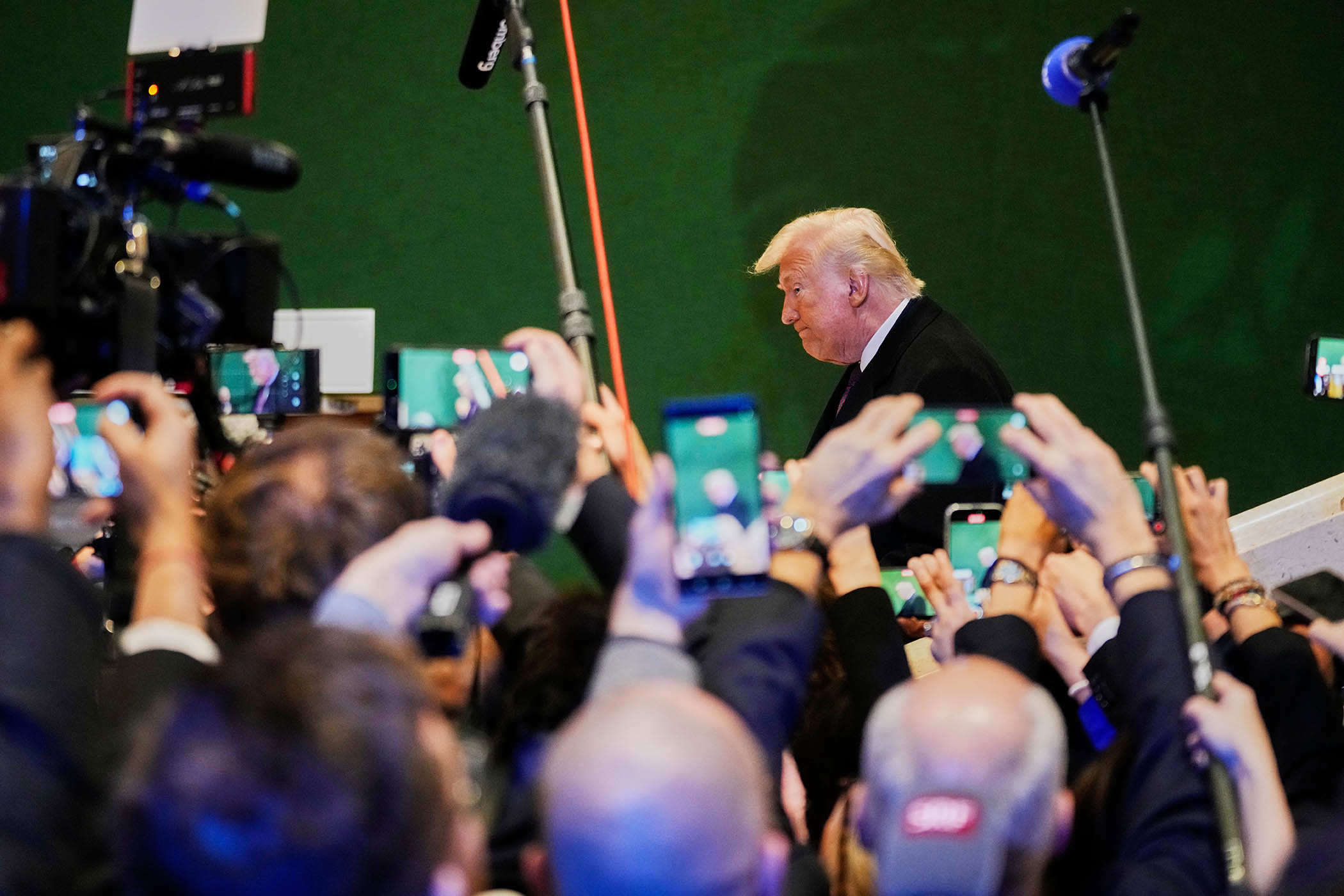
No one needed to be there but about 1,500 people wanted to be there. Last into their reserved seats were a handful of photographers from the White House press pool, predicting a bad presidential mood on account of jet lag and lack of “executive time”. (The White House has denied reports this is a euphemism for increasingly late starts to Trump’s working day, in which public appearances are often scheduled between 11am and 5pm only.)
Walking to the podium, he looked weary, and his opening remarks were sour. It was good to be among friends, he said, “and a few enemies”. It was not clear except to a tight circle whether this was to be a version of his two inaugural speeches – both crafted above all to shock – or something more emollient.
The first hint of a climbdown came half an hour in, when he said he wanted “immediate negotiations” on Greenland’s future. There was no mention of force until, returning briefly to the Autocue from his preferred mode of ad-lib, he said he would not use it. The S&P bounced up 70 points.
As the speech dragged on, a few people walked out. At the end, there was tepid applause. Trump later held an hour-long meeting with the Nato secretary general, Mark Rutte, after which he posted on Truth Social that he would be taking punitive tariffs as well as the military option off the table.
The “framework agreement” on Greenland’s future was his face-saving device; details remain unclear even to the island’s prime minister, Jens-Frederik Nielsen, who was not consulted.
What tipped the balance? “The markets were the main factor,” Harman said, “and some respect was given to some European leaders.” But not many. Macron was mocked for his eyewear (later identified as €659 iVision Tech sunglasses to hide a burst blood vessel) and accent. A former president of Switzerland was ridiculed for being “aggressive” in tariff talks.
Britain’s Labour government was singled out for a broadside on the evils of “windmills”. Parts of Europe were “not recognisable any more” because of mass migration, Trump said, and it was doubtful US allies would “be there for us” in battle.
When reminded later that they had been, he doubled down. Nato troops had stayed “a little away from the frontlines”, he told Fox News.
There were 457 British soldiers killed in Nato’s US-led international security assistance force operation in Afghanistan alone.
American delegates were keen to remind people that, this year in Davos, the United States was back. The corporate US was back mainly to do deals. One Danish investor reckoned Nvidia’s chief executive, Jensen Huang, was signing 15 of them a day in an office in the Palantir pavilion.
But political delegates were there mainly to goad. Howard Lutnick, the US commerce secretary, prompted Christine Lagarde, president of the European Central Bank, to walk out of a dinner rather than listen to him trashing Europe as “dead”.
In USA House, a converted church next to the conference centre, an AI-animated George Washington reminded visitors of the “despotic King George III” and the “wily General Cornwallis”, best known for surrendering to American forces at Yorktown in 1781.
Newsom was due to speak there the evening after Trump’s speech but the event was cancelled – he presumed, to deny him a chance to respond. “It gives you a sense of what we’re up against,” he said.
Photograph by Markus Schreiber/AP