The Observer has a new podcast series exploring the life of Asma al-Assad, Bashar’s British-born wife. Listen to We call her Emma here
Eyad Hamid has spent more than a decade in exile in London, hunting for a particular prize. From an alleged money-laundering network in Moscow and offshore tax havens, to front companies in Malta and the Seychelles, Hamid has set himself the goal of finding the former Syrian dictator Bashar al-Assad’s wealth, to ensure every penny was under sanctions and, where possible, to try to return it to his victims. But in London, Hamid has hit a stumbling block.
The latest twist in his odyssey began in September 2024. Hamid, 39, travelled to Poland to meet with lawyers and other sanctions experts in a drab white-walled hotel conference room in central Warsaw. Together, they were determined to find their way through a complex problem: how to make use of an estimated $1bn (£740m) in confiscated Syrian state assets? Rather than letting the money sit in frozen international accounts or government coffers, the group wanted to funnel it into a fund to compensate the victims of Assad’s regime.
During the years following the Arab spring in 2011, when Syrians rose up against Assad, 15,000 people are believed to have died under torture in the country’s prisons. At least 100,000 more disappeared there. In addition, hundreds of thousands are said to have died at the hands of Assad’s forces, which dropped barrel bombs, cluster munitions and chemical weapons on towns and cities that rebelled against the regime.
In 2022, Washington’s state department estimated the Assad family’s net worth as between $1bn and $2bn, much of it stemming from trafficking in weapons or the amphetamine-like drug Captagon. But even the US government called this an “inexact estimate” because of the web of shell companies, bank accounts and property portfolios hiding it, often held in offshore tax havens or under other names.
“We started working on this a year before Assad’s regime fell, inspired by what’s happened with Russian sanctions and Ukraine – repurposing funds from Russian oligarchs who support Putin to rebuild Ukraine,” Hamid said. “The idea was: why not do the same with the Syrian money from the regime, to support victims of its crimes.”
One group of lawyers, who had flown to Warsaw from Washington, presented Hamid with documents they believed could help him find some of Assad’s fortune closer to home. They had discovered court filings mentioning a single tantalising detail.
Britain’s high court had, the documents showed, discussed the idea that Assad abandoned at least £40m of his money in a branch of HSBC in London, before he left life as an ophthalmologist at the Western Eye hospital in Marylebone in 1994 for the Syrian presidency. It was estimated that millions had accrued in interest in the years since, with some reports from December 2024 putting the total at £55m.
“Everyone knew that Assad had a lot of money. It’s just we never knew where that money was,” said Hamid, who has spent the years since his escape from Damascus hunting through opaque webs of shell companies, or in notoriously impenetrable locations such as Dubai, among a group of other experts at the London-based Syrian Legal Development Programme.
The prospect of the dictator’s personal wealth sitting in a British bank account seemed to present a unique opportunity to put it to good use. Hamid and his colleagues believe the European Union sanctioned the bank account in 2011, shutting out its owner from accessing or moving the funds. But they hoped the millions gained in interest could be used to compensate Assad’s victims.
Newsletters
Choose the newsletters you want to receive
View more
For information about how The Observer protects your data, read our Privacy Policy
But getting to the money has, so far, proved impossible. HM Treasury and HSBC have both refused to even confirm the existence of the account, including to the high court in London, and when speaking to The Observer. This response has not surprised Hamid. “The UK has a reputation as a safe haven for the wealth of the global oligarchy,” he said.
In its approach to illicit funds and sanctioned assets, the UK has become an outlier. Ukrainian authorities established a legal mechanism in 2022 to seize assets owned there by prominent Russian oligarchs, funnelling the proceeds towards reconstruction. The EU followed suit, giving €1.4bn (£1.2bn) generated from interest accrued on frozen Russian central bank funds to fund the Ukrainian state and buy weaponry.
US courts have a long record of using sanctioned assets to compensate victims of state crimes; in March, the Southern District of New York awarded the $318m in proceeds from the sale of a Manhattan office tower once owned by an Iranian state bank to victims of Iran’s proxies, including victims of the bombing of a US barracks in Beirut.
Few, if any, examples exist in Britain. Unlike in Europe or the US, no mechanism is in force under UK law to seize the assets of dictators or oligarchs to repay their victims. During a discussion on how best to aid Ukraine in the House of Lords earlier this year, Jennifer Chapman, minister for international development, described the British sanctions regime as one “under which we can freeze assets but not seize them”.
In this case, the British authorities appear to feel under no pressure to confirm whether the account exists at all – not to the high court, and not to a growing list of Assad’s victims looking to use it to rebuild their country.
Reports of the HSBC bank account first surfaced during a trial about a deadly hijacking that took place in 1985 while Assad’s father, Hafez, ruled Syria. Egyptair flight 648 was hijacked by Palestinian militants shortly after it took off from Athens en route to Cairo, before being forced to land in Malta.
Testifying before a Washington court during a 2011 trial, hijacker Omar Mohammed Ali Rezaq recalled shooting two Israeli and three American passengers, killing two of them, and hurling their bodies on to the tarmac. Egyptian commandos stormed the plane in an attempt to rescue the remaining passengers, leaving another 56 dead in the ensuing violence and all but destroying the aircraft.
Rezaq was already serving a life sentence for the hijacking in a US federal prison by the time of the 2011 court case, which accused the Syrian regime of acting as a state sponsor of terrorism, finding that it helped train and finance the hijackers. The trial was seeking financial compensation for damages incurred during the hijacking. The legal action ended with the court awarding $51.5m to a somewhat unusual group of plaintiffs: a syndicate of airline insurers at Lloyd’s that had sought recompense for the damage to the aircraft.
This set off a worldwide hunt for frozen assets owned by the Syrian regime to repay the debt. Investigators soon turned their attention to London, where Assad and his wife, Asma, had lived in the early 1990s, beginning a lengthy battle between the airline insurers and the Treasury over information about Assad’s wealth in Britain.
But the Treasury stonewalled demands for information on the whereabouts of any British assets, forcing the insurers to seek answers elsewhere. High court documents from August 2020 say they “had reason to believe from private investigations back in 2009 that... the Syrian head of state, then had an account with HSBC in the UK with a balance then exceeding the amount of the judgment debt” – more than $51.5m.
But when the insurers appealed to HSBC, they were told that the bank had found nothing in Assad’s name. Experts such as Hamid believe it is likely in someone else’s name, as was often the case with the Assad family and its extended network.
The high court ruled that the Treasury “has the power to provide the information”, about where Assad’s money was held – but threw the decision of whether or not to disclose the details back to the Treasury. This, in effect, left the case in limbo.
When approached by The Observer, a spokesperson for HSBC said “we do not comment on customer relationships, even to confirm or deny that a relationship exists”, adding that it remained committed to complying with sanctions.
A spokesperson for the Treasury declined to comment “on a specific case,” and said that using frozen assets to repay victims is not currently under consideration in Britain.
This has not stopped the justice secretary, David Lammy, from making bold claims on this issue. During the launch of an initiative intended to tackle illicit finance last year, Lammy said he will ensure London no longer plays host to the ill-gotten gains of dictators, oligarchs and kleptocrats.
The Office of Financial Sanctions Implementation within the Treasury said in its annual report that the UK has frozen £37bn of assets from Russia, Belarus and Libya, and that £383.5m in sanctioned Syrian assets are sitting on British soil. The Treasury declined to provide a breakdown of where these assets are or who owned them.
Lyra Nightingale of the human rights organisation Redress, which fights for Britain to use these assets to repay victims of torture, said the government often provides little information beyond proudly releasing these large totals. “It’s a massive problem: there is a real lack of transparency,” she said.
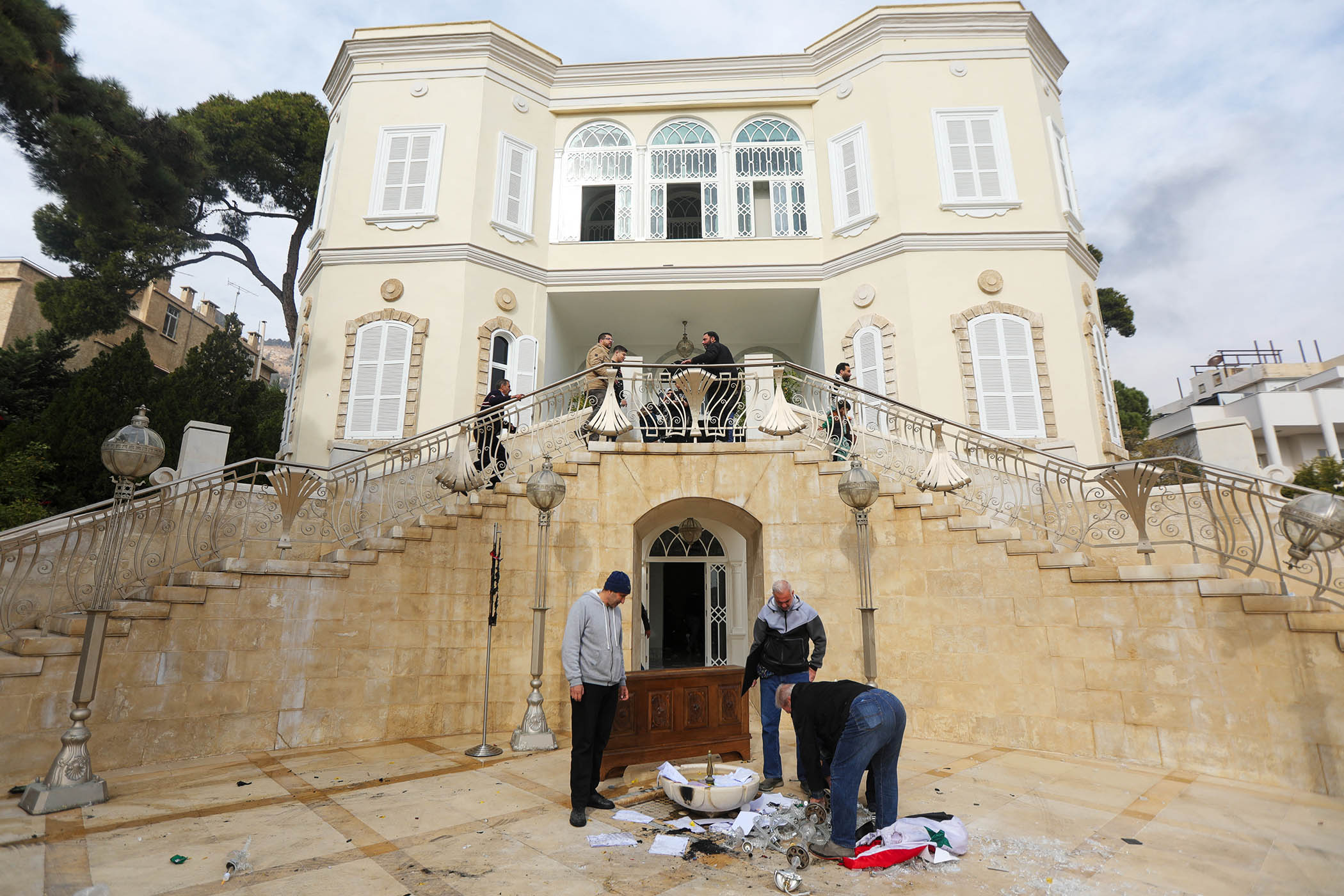
Hamid and the campaigners at Redress hoped the fall of Assad in December 2024 might change things. In the hours after the dictator fled to Moscow, as his regime crumbled, crowds in Damascus rushed into his palace and private villa. People filmed themselves taking Louis Vuitton luggage and running among rails of Dior garment bags. Others filmed rows of bright red Ferraris, inky blue vintage Cadillacs and a sleek black Lamborghini among the dozens of sports cars parked in Assad’s garage.
Even Abu Ali, a member of an elite security force that guarded Assad’s private home for decades, claimed he was shocked by the trappings of extreme wealth. He was also irritated at the idea that his former boss’s wealth might remain abroad. “That money should be returned to Syria,” he said.
There have been a few notable successes. Assad’s late uncle Rifaat, known as the “butcher of Hama” for his role in a 1982 massacre in which up to 40,000 people were killed, was convicted in France of money laundering and embezzling Syrian state funds and using them to build a European property empire.
Authorities in Paris and the new government in Damascus began talks earlier this year to transfer €32m of Rifaat’s money stemming from this ruling.
The UK, meanwhile, has done nothing. A sanctioned mansion Rifaat owned in Mayfair was identified, but Natalia Kubesch of Redress said the British government had refused to provide any information on its fate. “At the moment, it’s just sitting there with no clear strategy about what’s happening, six years later,” she said.
When Assad’s niece Anisa Chawkat was forced to forfeit almost £25,000 in a Barclays Bank account in 2019 after accusations the money was linked to criminal activity, the funds remained in Britain.
Syria’s new government remains desperate for money to fund reconstruction after years of civil war. Abdelkader Husrieh, the central bank governor in Damascus, said he would try to recover sanctioned Syrian assets in the US or Europe. “The amounts may not be large, but reclaiming them is a necessary step,” he said.
Hamid remains steadfast in his belief that a fraction of Assad’s billions is sitting in London, waiting for victims of his regime to get their hands on it – if a court allows them to.
If the bank account was under sanctions, Hamid reasoned, then that means it must exist in some form with the Treasury’s knowledge. “If this is true, then the money must be there – you can’t just move it somewhere else,” he said.
What are your thoughts on this? Send us a letter to letters@observer.co.uk
Photograph by Bakr Al Kassem / AFP via Getty Images