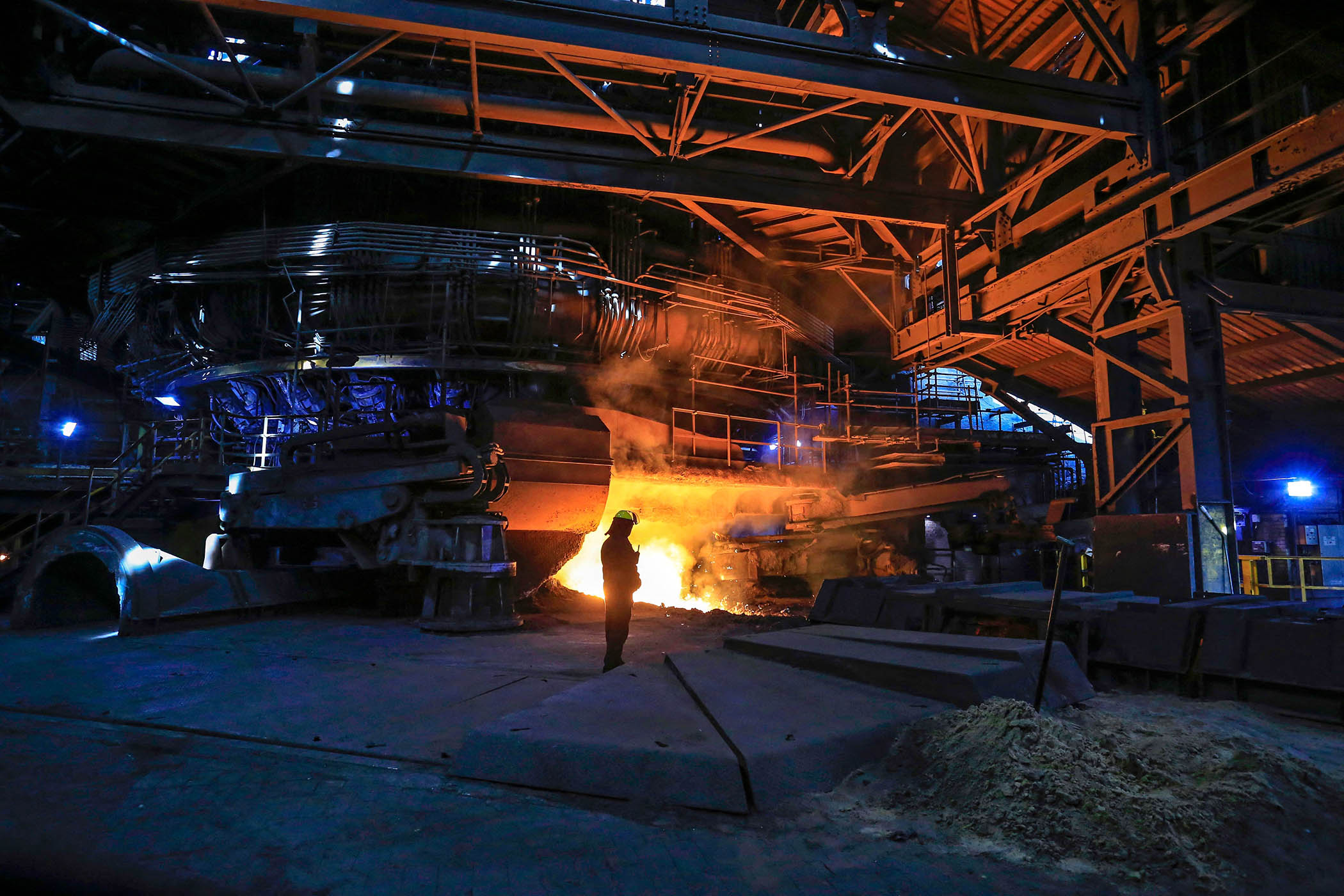

British Steel’s renationalisation this week was greeted with a telling silence. In both Britain and the US, so long the evangelists for free markets, laissez-faire has been replaced by an ad hoc state capitalism. Trump world calls this patriotic capitalism; its critics smell kleptocracy – while conceding the principle of the shift. For Britain, call it, more pragmatically, nationalisation as necessary.
British Steel’s return to public ownership follows the renationalisation of most of Britain’s railways, while Thames Water likely edges towards a similar fate under Andy Burnham. In the same period, the US government has taken stakes in a string of “strategic” companies – acquiring roughly a 10th of Intel, 15% of rare-earth miner MP Materials, and a veto-carrying “golden share” in US Steel.
The shared driver is not ideology but security. The post-Cold War bet that efficiency should trump everything is over; supply-chain resilience and rivalry with China now matter more – and left and right have each developed the same interventionist instinct. That British Steel and US Steel, two loss-making blast-furnace relics, were both rescued this year, on the identical grounds of jobs and national security, is less coincidence than convergence.
There are real risks, even so. When the state nationalises failure, the taxpayer inherits the losses: British Steel alone burns more than £1m a day. Governments seldom know when to stop subsidising a dying technology. When it takes equity, it can become owner, regulator and customer at once – an open door to cronyism. The discipline that makes private capital productive can be dulled. And almost anything may qualify as “strategic”.
If the debate about whether the state sometimes belongs in the boardroom is over, it remains an open question how far it should go, how much it will cost and who, ultimately, will pay.
Attack drone investment hits the AI heights
Helsing, a German maker of AI-guided attack drones founded only in 2021, this week raised $1.8bn at an $18bn valuation, the largest investment round so far in a European defence startup. The most striking thing is the multiple: 32 times the company’s forecast revenue.
A multiple like that is what today’s investors pay for AI (frontier labs go at 20-30 times revenue) not makers of physical things. Legacy European arms-makers such as BAE and Rheinmetall trade on low-single-digit multiples of sales, because defence has traditionally been hardware-heavy, budget-bound and cyclical. Helsing makes physical drones, yet is priced almost like Palantir, a defence-heavy software firm whose shares fetch around 40 times revenue. Its finance chief has cast the company as a peer of Palantir and Anduril rather than of drone-makers – yet Anduril, the American autonomous-weapons maker that is Helsing’s closest real peer, trades at just 13 times. Somewhere between those two multiples is well above old defence norms.
The claim that making weapons has become much like, say, writing software – scalable, recurring, high-margin – is bold, but arguably premature. Helsing’s revenue is lumpy, contract-by-contract, and comes largely from a single customer, the German state.
Yet even as the money reclassifies war as tech, some of the people who build it are in revolt. Google’s DeepMind researchers are protesting against military work and moving to unionise; Anthropic refused the Pentagon’s demand for unrestricted use of its models and was blacklisted for its trouble. Against this, Palantir’s Alexander Karp makes the ethical case for defence work as part of saving democracy – with the role of drones in helping Ukraine resist Russia’s invasion as the movement’s exhibit A. Insofar as investors weigh these ethical questions at all, a multiple of 32 suggests that, for now, it is Karp’s narrative they are buying.
Newsletters
Choose the newsletters you want to receive
View more
For information about how The Observer protects your data, read our Privacy Policy
Psychedelics takes a trip into the mainstream
Eli Lilly, the world’s most valuable drugmaker and the firm behind Prozac, last Thursday agreed to pay $2.8bn for a psychedelics company called AtaiBeckley, which has several promising products in development, including a nasal spray derived from the compound DMT that a depressed patient sniffs in a clinic before tripping, gently supervised, for a couple of hours.
While the headlines were made by controversial Silicon Valley billionaire Peter Thiel being an early investor in what was Atai, the Beckley in its name is perhaps the more telling indicator of how far psychedelics have travelled from the fringes to the business and medical mainstream.
Amanda Feilding, the late Countess of Wemyss and March, grew up at Beckley Park, a moated Tudor lodge outside Oxford. She was, by any measure, an eccentric: in 1970 she bored a hole in her own skull with a dental drill, filmed the result and twice stood as an MP on the platform “Trepanation for the national health”, polling a heroic 40 votes, then 139.
Although she once left the stage for an LSD break during an interview I did with her, she was a patron of rare seriousness. Having promised Albert Hofmann, LSD’s inventor, that she would rescue his “problem child”, she founded the Beckley Foundation in 1998 and bankrolled the first brain scans of the LSD state, carried out by Imperial College in 2016, that dragged these drugs back into the laboratory when no respectable funder would touch them. In 2019 she spun out the investable science into a company, Beckley Psytech, with her son Cosmo, later merging with Atai.
Feilding died in May 2025, aged 82, barely a year before Lilly came calling – too soon to bank her vindication. Feilding wanted to free minds; Big Pharma now wants the patents. This counterculture, it turns out, does not fade away. It gets acquired.
Photograph by Lindsey Parnaby/Getty Images