


The shell of a school, a long two-storey Soviet-era building, is highlighted in red, picked out as the target in a black-and-white drone feed. The video zooms in to show smashed window panes barricaded with nets and debris, and just visible inside, a Russian soldier.
There were 10 of them, holed up in what had been the Kindrashivska Lyceum, a school in northeastern Ukraine. The building’s thick walls made it an ideal stronghold. The Russian army had been pushed out of the Kupiansk area in 2022, but since 2024 it’s been on the offensive again, trying to recapture this strategic location 110km east of Kharkiv. In February this year, Ukrainian forces were fighting to keep them out. But the Russian position in the school posed a problem.
For two weeks the Ukrainians had tried everything: “Vampire” heavy bomber drones, first-person view [FPV] kamikaze drones, and artillery. It was time to change tack. Commanders in the Khartiia brigade requested the help of its recently formed Lava regiment: robotic warfare specialists. What they achieved was celebrated as a landmark moment in this war: a successful assault with no humans on the battlefield.
In Lava’s workshop in Kharkiv, surrounded by unmanned ground vehicles (UGVs) of all shapes and sizes, 25-year-old commander Andrii Kopach and his team of four described the operation. The UGVs, led by a squat four-wheeled Thor 800 off-roader, were released tens of kilometres from the front line, operated by Kopach’s team from the relative safety of the city. Using FPV controllers similar to those of a PlayStation, Lava operators guided the vehicles over rough, snow-covered ground at about 10km per hour. The Thor 800 was fitted with a rocket-propelled grenade launcher and accompanied by two others: wheeled kamikaze robots carrying heavy explosives.
It took five and a half hours just to reach the school, said one operator with the call-sign “Mickey”. “There were many moments where everything could go wrong. Barriers, wire, natural obstacles. It was really hard.”
But the snowstorm and near-zero visibility made the mission possible: the perfect cover to evade Russian drones. In the “kill zone”, a fast-expanding area 20-30km either side of the front line, anything that moves is targeted. Cars and big vehicles are out of the question.
“Two years ago we went to the front line in armoured vehicles,” Izay, 30, said. “Now that’s impossible.”
In Khartiia’s high-octane promo video about the operation, the UGVs trundle over snowy fields, the feed cutting between aerial shots captured by their drones overhead and startlingly detailed imagery from the UGVs’ own cameras.
When they reach the burned-out school it’s already dark, flurries of snow smudging the camera lens. A UGV shines a light on a broken window and approaches. The screen glows white as it blows up. From the edge of the schoolyard, another drone captures the moment of the explosion as it lights up the snow-covered ground. Further back still, the RPG-equipped vehicle fires at the building repeatedly. An airborne drone swoops round for a better view, and the wreckage of the building becomes clear, billowing black smoke. Ammunition stored by the Russian soldiers has blown up. One section of the building is completely gone. Infrared imaging shows a heap of clothes on the floor. More dead Russians are identified in this way. All 10 died in this assault, Khartiia said. Not a single Ukrainian soldier was physically present.
The Kupiansk operation was not Ukraine’s first robot-only assault. Khartiia’s first took place in December 2024, but this was the first to claim recaptured territory. The position of the Ukrainian ministry of defence is that robots should replace people wherever possible. According to its figures, missions involving UGVs have soared in number in recent months, from around 2,900 last November to more than 9,000 in March. But it was the combination of ground and aerial drones that made the Kupiansk operation a success. Ukraine is now a world leader in unmanned aerial vehicle [UAV] technology, and produces 4 million drones per year.
Newsletters
Choose the newsletters you want to receive
View more
For information about how The Observer protects your data, read our Privacy Policy
‘[The Russians] have great tech too. They can reach Kharkiv, we can reach Belgorod.’
‘[The Russians] have great tech too. They can reach Kharkiv, we can reach Belgorod.’
These rapid developments have attracted global attention and fed a newfound optimism about Ukraine’s chances. Russia’s territorial gains have been slowed and in some places reversed in recent months. Ukrainian deep strikes have damaged Russian oil infrastructure from the Black Sea coast to the Urals. Last week they embarrassed Vladimir Putin at the annual economic forum he hosts in St Petersburg. The result is a new consensus quite unlike the gloomy prospectus of 2025, when Ukraine “had no cards”’, as President Trump put it, and was reliant on an increasingly disengaged US. Now, it’s suggested, the end could be in sight if Ukraine continues to gain ground and hit Russia where it hurts. And all – or at least in part – because of its drone tech.
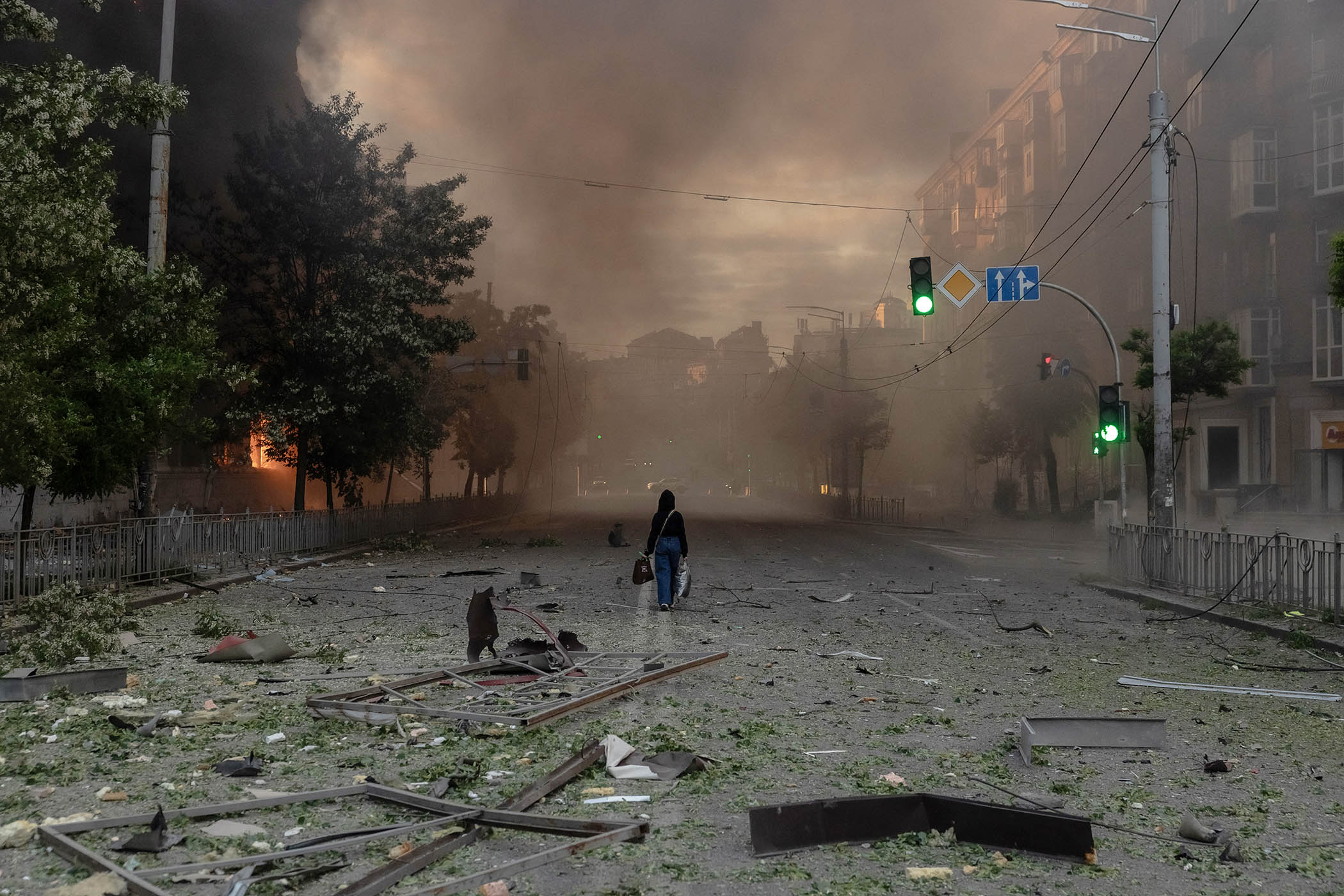
A woman walks along a smoke-filled road beside heavily damaged buildings following Russian strikes in Kyiv
Ukraine still relies on foreign models to an extent, but its massive increase in domestic production was on display at a Khartiia brigade position north of Kharkiv when The Observer visited last month. A small team of Lava recruits operates round the clock from a fortified underground space, catching moments of rest when possible on the bunks lining the earth walls.
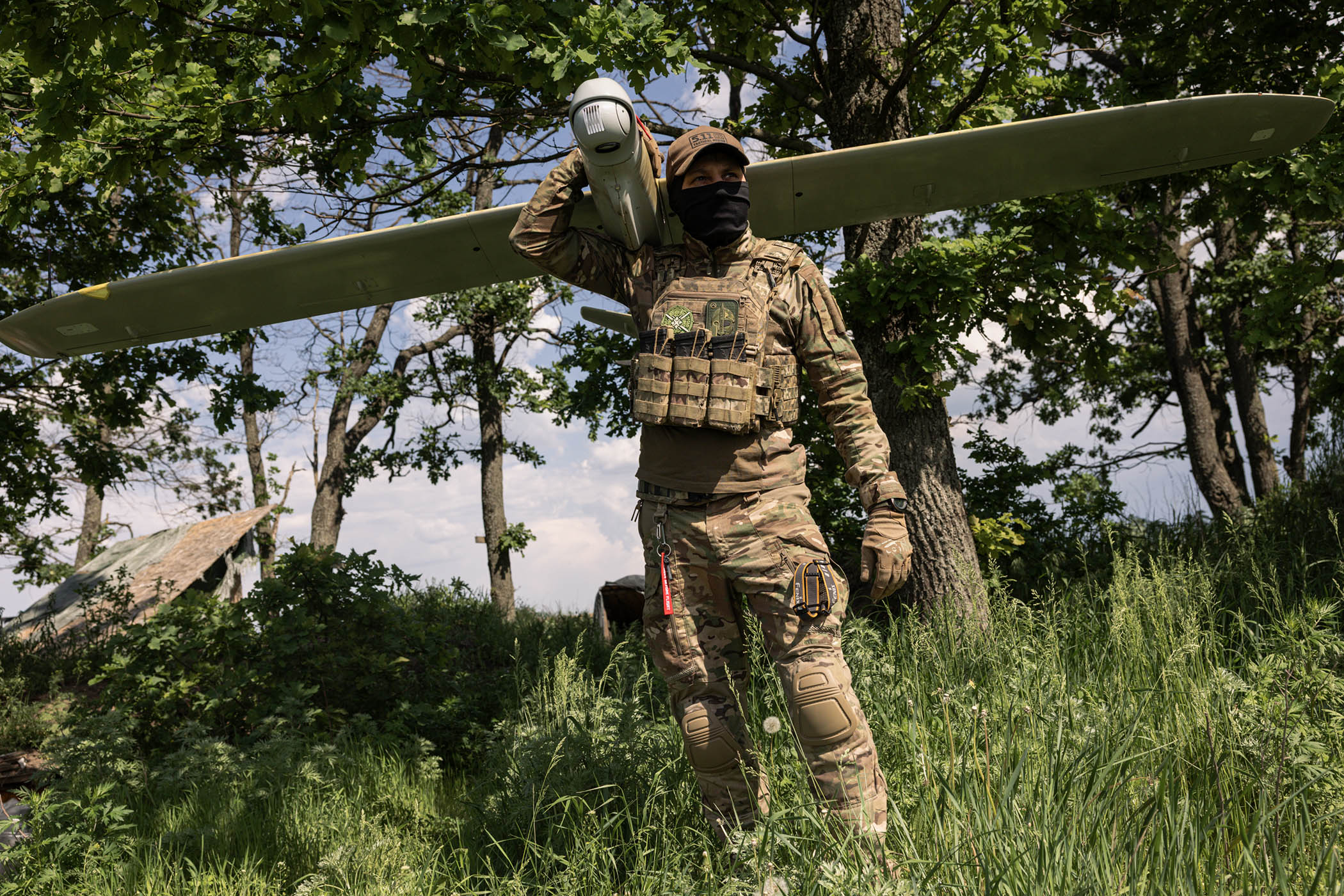
Both types of UAV launched from this position – reconnaissance and strike drones – are Ukrainian, made in the industrial city of Dnipro to the south. The Leleka – or Stork – is marketed as “the reliable eyes of the Ukrainian army”, and can fly for 110km. Outside the bunker, two soldiers showed how it could be assembled in minutes, slotting the long white wings together and inserting a bulbous camera into the plane’s nose. Thermal imaging means it can conduct surveillance operations at night. Weather, though, is often a problem. It needs height to operate over enemy territory, and when we visited it was raining in Russian territory to the north. Flights were off. The team pointed to evidence of an early morning mission on one of a cluster of screens in the dugout.
“We were searching for Russian drone operators, but didn’t find them,” one soldier nicknamed Norman explained. The thick foliage of early summer provides a lot of cover. When a target is found though, the strike drone is launched: a Bulava, long and thin with a distinctive X-wing shape. It can carry enough explosives to take out a tank.
The Lava dugout could be targeted with missiles or a gliding bomb, but it’s still relatively safe. “You can’t even compare this to infantry,” Norman said. Even so, his team has to “learn constantly”, training and retraining to keep up with new gear and new tech. A month of studying, then another of practice, is the basic requirement to operate the Leleka reconnaissance drone, and more trainees are always needed. Ukraine’s well-documented manpower shortage has not been alleviated by conscription, but the hope is that the growing role of robots in frontline operations will begin to reduce casualty numbers and make a dent in the shortage that puts Ukraine at such a disadvantage.
The new defence minister, Mykhailo Fedorov, is 35 and comes from the world of digital advertising. With no military background, he’s an evangelist for the idea of drone technology transforming the battlefield. On his watch the defence ministry has said it plans to move all frontline logistics to robotic systems, contributing to a sense, internationally, that Ukraine is at a turning point.
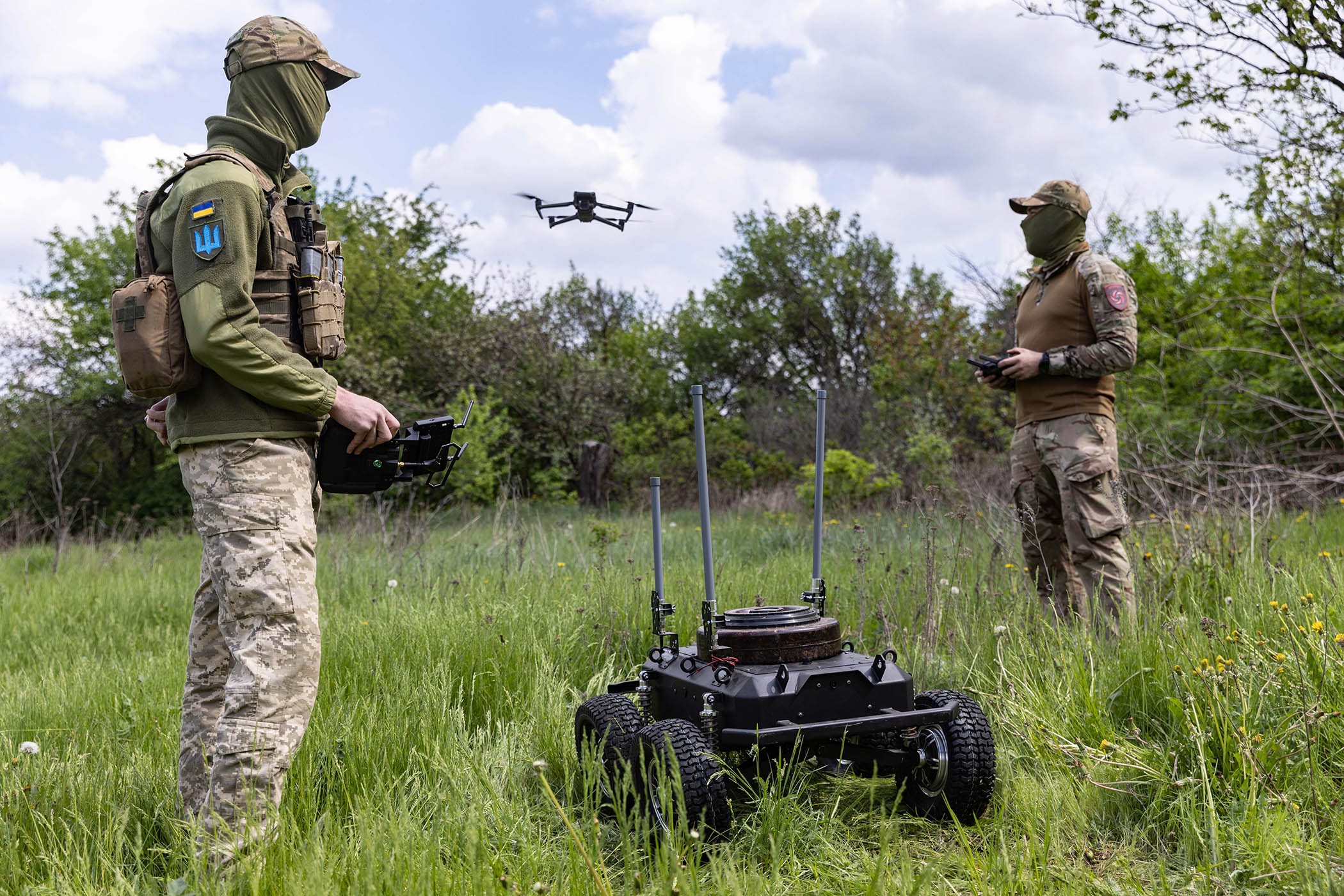
Servicemembers of the Unmanned Ground Systems unit of Ukraine’s 14th Separate Mechanized Brigade ‘Chervona Kalyna’ prepare ground robotic vehicles
The view from the ground is a little less breathless. “They have great tech too,” the Lava regiment press officer said, gesturing in the direction of the Russian border. “They can reach Kharkiv, we can reach Belgorod.”
The team loses up to 70% of the drones it launches to Russian interceptors and missiles. The other side shouldn’t be underestimated, it insisted. “We’re developing in parallel with Russia,” Norman said. “We react to their developments, and they react to ours. We’re certainly not standing still.”
All-robotic assaults are still rare: the saturation of the kill zone with FPV drones makes it impossible to conduct these kinds of operations in all but ideal weather conditions – like February’s snowstorm. Kopach, the maths whizz commander, when asked if such robotic assaults could be a game-changer for Ukraine, gave a cautious reply.
“Yeah, but it’s very difficult. For now, FPV [drones] are the biggest problem. You need a lot of work, and a lot of luck, for these kinds of missions – and to scale it up you need to create some kind of protection from these FPVs.”
The Kupiansk mission, he added, was “super expensive”.
Protections against incoming Russian drones will include mounted guns and net launchers, electronic jamming capabilities, and physical armour or cages. But much of this is still to come. For now the UGVs in Khartiia’s workshop look relatively basic, and more benign than the “killer robot” headlines might suggest.
The team hasn’t had a robot-only assault mission since February. In the meantime, its work consists largely of evacuating the wounded and resupplying combat troops on a points system that rewards units for successful missions. The points can be spent on new drones and other kit. Three people evacuated equals 300 points, Kopach explained – around 1.5m Hryvnia, or £25,000. It’s far more than they’d get for killing Russian troops. Saving the lives of Ukrainian soldiers remains the top priority.
Photographs by Roman Pilipey/AFP/Getty Images, Diego Fedele/Getty Images, Yevhen Titov/Global Images Ukraine via Getty Images