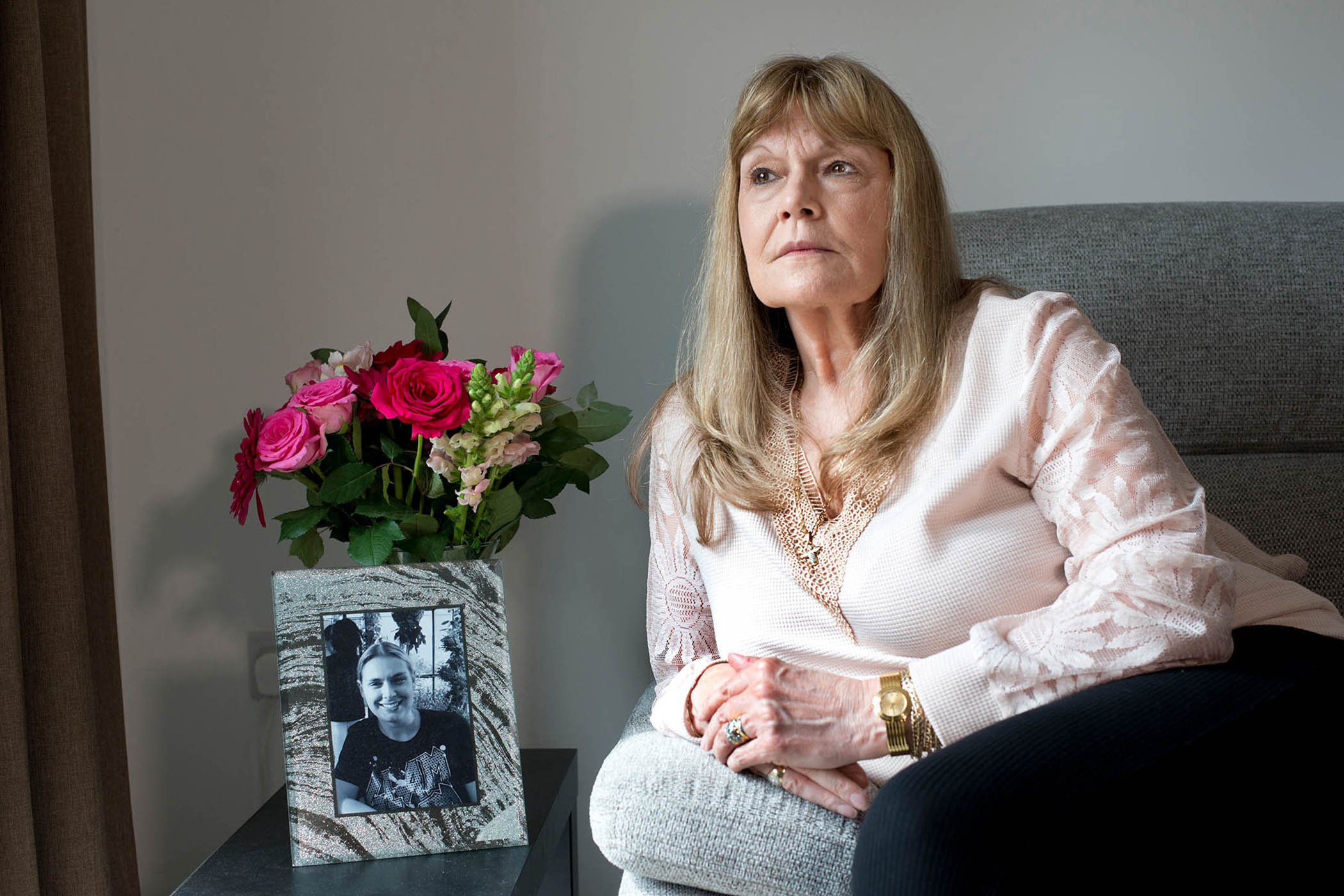


There are some things a parent should never find out about their child. How much their heart weighs when it’s no longer beating is one of them.
But Michelle Baird knows. Not just the weight of Tarryn’s heart but her liver, her lungs. “A mother should never be reading documentation for a [coroner’s] bundle,” she says. “It shouldn’t be that way.”
For nearly a decade, Baird has dedicated her life to investigating her daughter’s suicide. She has pored over reports and diary entries, lobbied politicians and joined the unenviable club of bereaved parents fighting battles on behalf of children they can no longer hold.
Baird knew that Tarryn, who was 34 when she killed herself in November 2017, had been struggling with her mental health. There had been overdoses and suicide attempts. But after she died the family found out that she had also made repeated and serious allegations of abuse against her husband of eight years.
Suddenly, there was a new question, for her family, as well as the police: had Tarryn been driven to suicide?
For two months this year that question was put to the test at Winchester crown court. In the dock was Tarryn’s husband, Christopher Trybus, charged with coercive or controlling behaviour, two counts of rape, and manslaughter.
Our justice system is adversarial, and the jury was presented with diametrically opposed versions of events. According to the prosecution, Trybus was “a controller and wife beater” who unleashed a “tsunami of abuse” against his wife and was therefore legally responsible for her death. The defence claimed Tarryn was a “troubled woman” who had become “addicted to the care and attention” she received from making “demonstrably false allegations”.
The trial was framed by some in court and outside as a battle of agendas: between those seeking to overcome historically low prosecution rates for rape and domestic abuse, and set a legal precedent; and those warning that innocent parties were being swept away by a well-intentioned tide.
The jury deliberated for 40 hours and eight minutes. Last Wednesday they handed down their majority verdict: not guilty, on all counts.
“After three police investigations over the course of 10 years, I’m relieved the jury has carefully considered the evidence and reached the correct verdict today,” said Trybus, standing on the steps outside court, flanked by his current wife. “This has had a profound impact on my life and on those closest to me. It’s been an incredibly difficult experience.”
Everyone involved left court changed by what they had been through. Not least Baird. “I’m devastated,” she said on the phone following the verdict, her voice pained and flat.
I first spoke to Baird in November 2020. It was the middle of the pandemic so we talked on Zoom – me from the bedroom that had become my workplace and Baird from the home office that had become her very own incident room, the magnolia walls covered in timelines and documents about Tarryn’s case.
I was working on a podcast series called Hidden Homicides for Tortoise, now the owner of The Observer, about the number of domestic abuse deaths that go uninvestigated by police, and what was then a new, relatively untested legal frontier: the attempts by campaigners, police and the CPS to hold people criminally responsible for suicides linked to domestic abuse.
Data showed that more people were killing themselves following domestic abuse than had previously been understood, and there was a sense among some that Britain was poised on a legal precipice – that these types of cases would soon be successfully prosecuted as manslaughter.
Three years after her daughter’s death, Baird was deep in the fog of grief. “I’ve got a point to prove,” she told me. “I will say my daughter’s name with pride and with a smile on my face. I will fight until I get justice for her.”
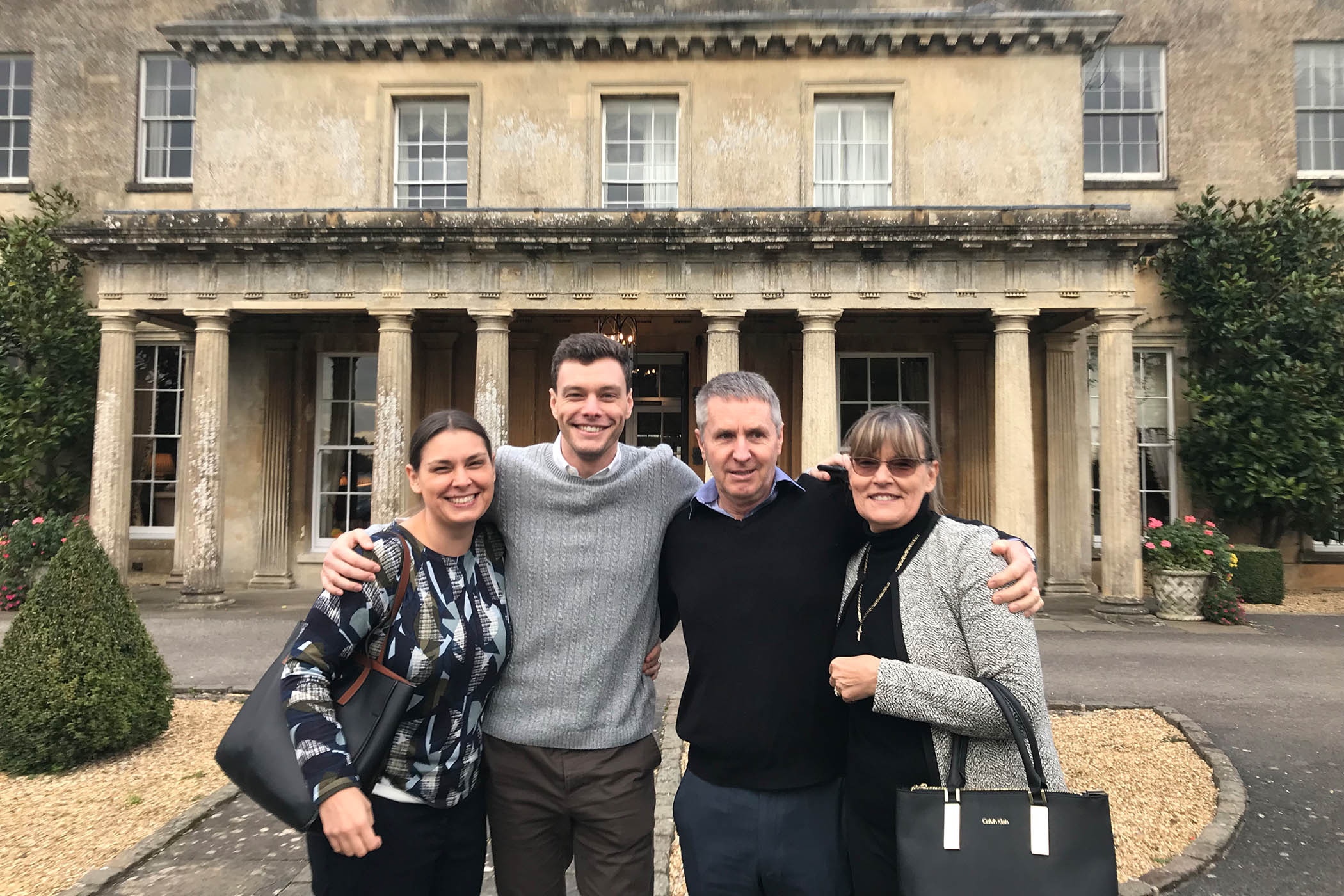
Tarryn on her last family outing, for her birthday in 2017, pictured with her brother, father and mother
Baird had Tarryn when she was 21 years old, in her native South Africa, and says it felt like they grew up together. Her daughter was funny and intelligent. “Not the greatest academically,” Baird says, smiling. “But on the sports field she was absolutely amazing.”
Life in Johannesburg was punctuated by violence. In 2006, when she was 23, Tarryn witnessed car-jackers shoot a woman in the stomach. A few years earlier she’d watched from the kitchen as three men approached her dad, Alan, who was outside on the driveway, and made him lie on the ground, holding a gun to his head while they stole his car and the trainers from his feet.
The incidents were traumatic for Tarryn and later, in her 30s, she’d be diagnosed with suspected PTSD. At the time Baird says the family just got on with things. “It was underlying, but she never spoke about it. We never spoke about it as a family either,” she says.
The following year Tarryn moved to the UK with Christopher Trybus, who she’d met at school. They married in 2009, and in 2010 Baird, husband Alan, and their son Greg followed them to Britain.
From the outside, the couple lived a comfortable life. They were well-off, owned a large detached house in Swindon, drove Porsches and went on frequent luxury holidays. But in 2015, two attempted burglaries at their home appeared to trigger Tarryn’s PTSD and she began to see a counsellor. The following year, she started telling her doctor, and her family, that she was frequently fainting or injuring herself in accidents. Her mental health continued to decline.
In September 2016, the trial later heard, she told her GP that her husband had put his hands around her neck during sex and she’d lost consciousness. She was put in touch with a domestic abuse specialist but she cancelled the meeting. In a text, she wrote that she was not “ready to go down this road yet”, the specialist told the court.
In the weeks and months after Tarryn killed herself in 2017, Baird’s fury was focused on the agencies that she felt had failed her daughter in her time of crisis. But then, while her son-in-law lived in her spare room, she found out about the allegations Tarryn had made against him. “I gave him the benefit of the doubt,” she says. “ I asked him two or three times, did you ever hit Tarryn? And he said to me, no, never.”
Her opinion changed over time, she says, particularly when she read the draft of a domestic homicide review into her daughter’s death – a statutory report that lays out the details of Tarryn’s extensive interactions with the police, mental health and domestic abuse professionals, and her GP.
In 2018, in light of the allegations, Wiltshire police opened an investigation into the circumstances of Tarryn’s death. It was closed the following year after concluding there was insufficient evidence to bring charges. So Baird started her own investigation.
She quit her job and locked herself in her home office, surrounded by pictures of her daughter. “ I worked 24/7 on Tarryn’s case. I gave up my life and I thought, this is it. I need to get to the truth,” she says. She found and read her daughter’s diaries. She combed through reports. “There were times I worked right through the night for months and months.”
In the beginning, she kept her husband and Greg informed of what she was doing. “Eventually, I could see they couldn’t handle it. So I kept everything to myself and I just plodded on.”
In September 2020, Baird started the painstaking process of looking through her daughter’s phone, which Wiltshire police had returned to her after 456 days in their custody.
On it she found – sandwiched between recordings of her daughter reading to herself – an audio file without a name. She pressed play and heard a recording that lasted four minutes and 57 seconds of what the prosecution later alleged to be her daughter being raped. (Trybus said it was consensual sex and the jury acquitted him of the related rape charge.)
“I sobbed my heart out,” Baird says. “That is something a mother should never, ever, ever find.”
Discovering the audio was traumatising for Baird. But it was a turning point. Alan sent Tarryn’s phone to a forensic investigator, and they sent a transcript of the recording to Wiltshire police. Presented with this new evidence, the force reopened an investigation. In 2021 it was taken over by Dorset police following an internal review of how Wiltshire had handled the case.
“[Dorset police] were absolutely phenomenal,” Baird says. “When they came and collected Tarryn’s diaries I gave them in a Waitrose carrier bag. When they came back, they had made a memorial box with Tarryn’s name engraved, and they had all her diaries in there. They treated us with respect. They treated my daughter with respect.”
She met with the Crown Prosecution Service in November 2024. They told her about their intention to bring a charge of manslaughter – explained to her what that meant, legally – and told her that it might take a while to get to court. Baird pauses. “ I thought, OK, I’m happy with that, you know?”
When the trial eventually started in late February, journalists packed the press box. Camera crews waited outside to record Trybus and his new wife turning up at court each day, hand in hand.
The jury was presented with evidence from more than two dozen witnesses as well as hundreds of text messages, diary entries, photographs of injuries, pathology reports and recordings of emergency phone calls. The audio file Baird found was played four times.
Trybus, bespectacled and in a suit, sat quietly in the glass box of the dock and studied the evidence bundle he’d been given.
On the witness stand, he denied ever harming his wife. He said he believed that her injuries had been caused by accidents or fainting, as she’d told her family before her death, and that he hadn’t noticed the extent of the bruising to her body. The defence barrister, Katy Thorne KC, suggested some of the injuries could have been self-inflicted.
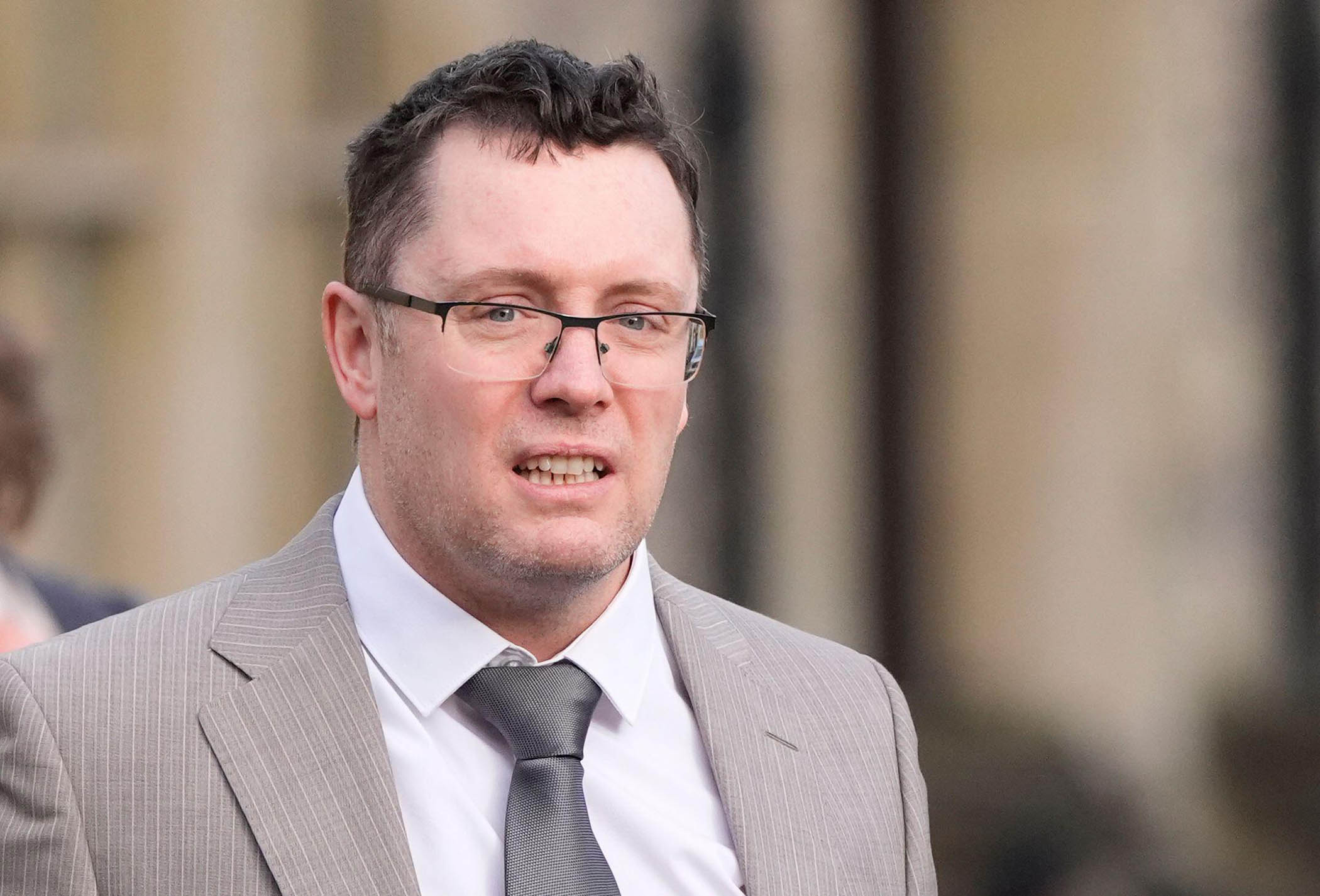
‘This has had a profound impact on my life and on those closest to me’: Christopher Trybus after the verdict
Trybus said he had not been in the country on several of the occasions that Tarryn claimed he abused her. He said that a photograph of bruising to her neck – which a pathologist for the prosecution said looked worse than cases of fatal strangulation that she had seen – had not been caused by him on purpose, but could, he said with some embarrassment, have been the result of consensual sex using a BDSM collar.
After mentioning he still owned the collar he was asked by Tom Little KC, the prosecution barrister, to present it to court, and he was brought back to the witness stand so it could be shown to the jury. Little made his closing speech to the court with it on display.
It was a brutal episode for all involved. Could Trybus remember when he started to put his hands around his wife’s neck in bed? Did she want him to do it? Did he like it?
“It was really, really, really tough,” Baird says. “And I knew it would be. My daughter’s whole life story is out there. Their whole sex life is out there. But I can still sit here and hold my head up high.”
She gave evidence over two days in mid-March, with the press box of the courtroom unusually full. “I couldn't believe I was standing there giving evidence after all these years of hard work,” she says.
Baird never witnessed Trybus abusing her daughter, although she told the jury about a conversation, weeks before she’d died, in which Tarryn had said he’d told her he’d “snap [her] neck in a heartbeat, cut up [her] body, dissolve it in acid and nobody would find [her]”.
The defence probed her recollections and suggested she was misremembering events – that the “acid” comment had been a joke. “I am not going to sit here and let you put words in my mouth,” Baird snapped back.
“I wasn't having any of it,” she says. She decided to watch the rest of the trial from home, where she could express her frustration without causing a disturbance.
The prosecution’s case was that the relationship between Tarryn Baird and Christopher Trybus was markedly different in public than in private, and that the only way she had felt able to leave her husband was by killing herself.
The defence case focussed on what they called “disconnects” – the elements of Tarryn’s allegations, or the chronology of events she put forward to professionals, they said were untrue – and her reliability as a witness. Perhaps she felt let down by the services who were supposed to be helping her with her mental health, suggested Thorne, and allegations of abuse became a way to wrest back attention.
Baird understands that it’s the job of the defence to do the best by their client. But she found the whole process “cruel” and “incredibly insensitive”, she says. “They have assassinated [Tarryn’s] character.”
Back in 2024, when the CPS first told Baird they were prosecuting Trybus for manslaughter, there had been no convictions in Britain by a jury for that crime following a suicide. In 2006 a case against Harcharan Dhaliwal, whose wife killed herself following years of alleged abuse, was thrown out by the court of appeal. In 2012 Nicholas Allen was convicted of the manslaughter of his partner Justene Reece – but the case was never heard by a jury as he pleaded guilty.
Behind the scenes, there was a sense that this landmark area of law was building momentum. But by 2024 no cases had made it to court. The first trial by jury was believed to be the case of Kiena Dawes, whose suicide note directly blamed her partner Ryan Wellings for her death. While Wellings was found guilty of assault and coercive control in 2025, he was cleared of manslaughter.
In a quirk of timing, Britain’s first jury-tested conviction for homicide following a domestic abuse-related suicide happened in the middle of the Trybus trial. In early March a Scottish court found Lee Milne, 40, guilty of culpable homicide – equivalent to manslaughter – and domestic abuse after his wife Kimberly Milne killed herself at the age of 28 following 18 months of violence. As the jury in Winchester heard the closing speeches in the Trybus trial, Milne was sentenced to eight years in prison.
It was this shift in the legal connection between domestic abuse and suicide, and the more pointed attempts by the CPS and police to prosecute domestic abuse, that Thorne, for the defence, appeared to reference during her closing speech.
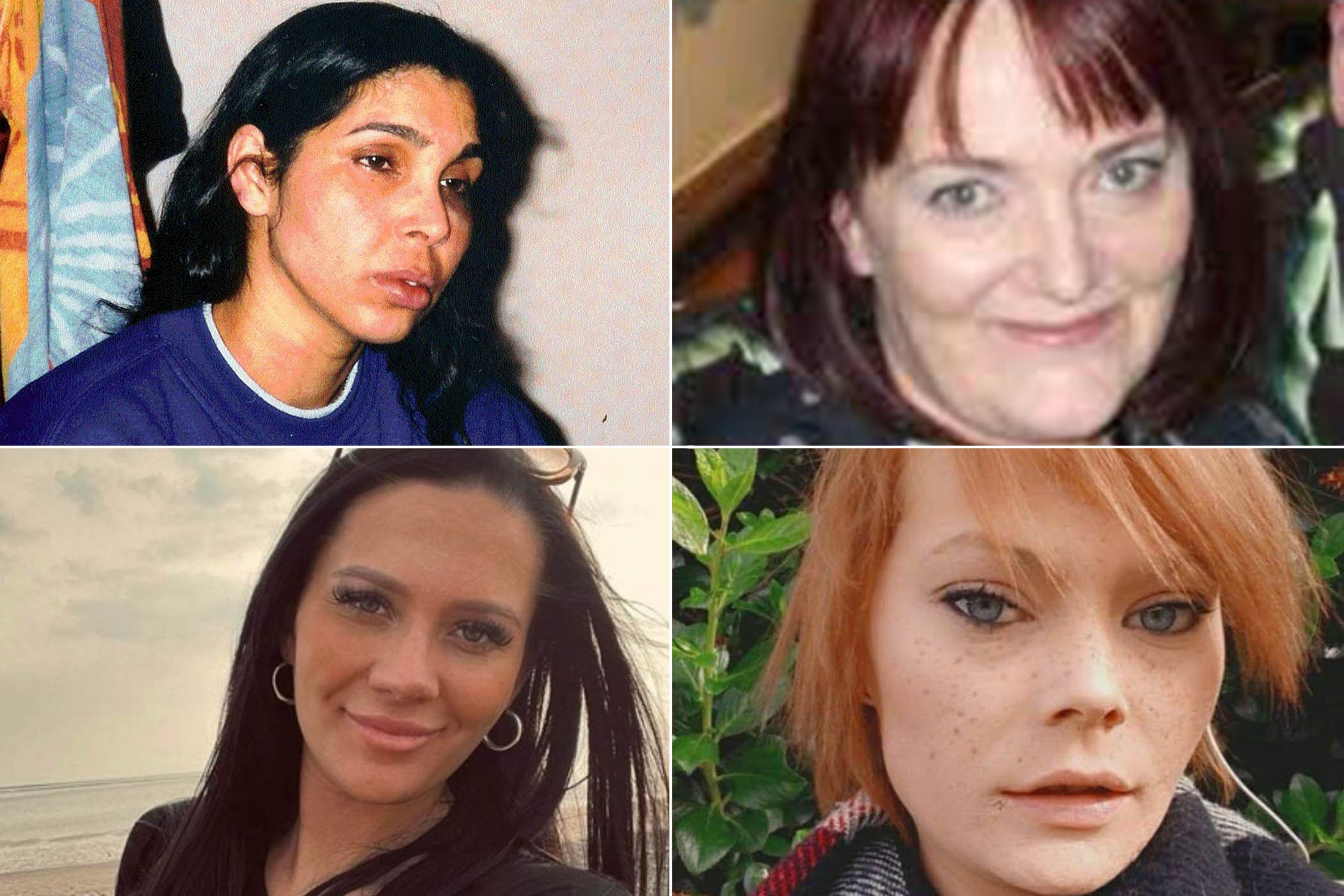
Clockwise, from top left, Gurjit Dhaliwal, Justene Reece, Kimberly Milne and Kiena Dawes
It was admirable, she said, that “at last” police and prosecutors were changing the way they dealt with abuse, but went on to make reference to the French Revolution, in which tens of thousands of innocent people were killed to protect the principles of the republic. She questioned whether the case was part of “a revolutionary agenda” that assumed women were “saintly figures” who always told the truth – and that the criminal justice system had “lost sight … of the individual case”.
Her client, she seemed to imply, had become collateral damage in a wider project for the “common good”.
“I wouldn’t call it revolutionary – I would call it probably a logical progression in terms of the way that we as a society are understanding domestic abuse,” says Nicole Jacobs, the domestic abuse commissioner for England and Wales.
“So I don’t know that it’s a particular agenda. It’s much more an indication of our growing understanding.” This, she says, has emerged from both academic work and police gathering better evidence. The latest data from a Home Office-funded project into suicides related to domestic abuse, for example, shows that between April 2020 and March 2024 there were more suspected suicides of this kind than intimate partner killings. This data only includes the deaths and the abuse that police know about. The true scale of the issue is probably much higher.
Nearly 10 years after Tarryn’s death, does Jacobs think that police are now properly investigating suicides when there’s an alleged history of domestic abuse?
“No. I have every respect for people within policing, but I have to acknowledge the fact that it is extraordinary how much ground is lost when the police don’t have curiosity,” she says. “There’s so many examples of a lack of investigation.”
She believes that the police will be watching these recent cases. “The message [they send] is if I do take the evidence and if I do investigate, it is possible the CPS will consider prosecution,” she says.
Others fear the opposite might be true. That successive not guilty verdicts will heap more suffering on grieving relatives who have already been through so much, and perhaps discourage those who have campaigned hard for a different way for the justice system to understand, and investigate, suicide following domestic abuse.
And then there are those exonerated after gruelling trials. Trybus has faced three criminal investigations and had his personal life shared with the world for crimes a jury found him not guilty of committing. Prior to the trial a website set up in his name declared his innocence. Now its landing page reads “coming soon”. By email, Beata Trybus, his wife, confirmed their plan to use it as a diary, to publish more about the experience and impact of the trial, as well as to “give hope to others facing false allegations”.
In a statement following the verdict, the CPS said it respected the decision of the jury and reiterated its commitment to careful consideration of the evidence in these types of cases: “We recognise that domestic abuse has a devastating impact on victims and in some instances this can lead to victims taking their own lives. We will work with police from the earliest stages. Our view is that there is a strong public interest in prosecuting cases where the evidence shows that a death followed domestic abuse.”
The Observer understands that a “significant number” of other suspected domestic abuse suicides are under review by the agency and that some people have already been charged.
Wiltshire police referred itself to the IOPC, the police watchdog, regarding the handling of the original case into the circumstances of Tarryn’s death to see if there were missed opportunities to investigate. A spokesperson for the IOPC confirmed that the investigation, which looks at potential gross misconduct by two officers, is ongoing. Wiltshire did not respond to a request for comment.
Michelle Baird watched the verdict from home. When we spoke afterwards, she was crushed. After a decade doggedly fighting for this moment, it feels like it will take her a long time to recalibrate.
But there are more battles to come. There’s the IOPC investigation into Wiltshire police. And finally there will be an Article 2 inquest, which will look into whether the state, including the police and mental health services, failed in their duty to keep Tarryn safe, and will again look at the circumstances around her death. The family is yet to receive a date but Baird sees it as an opportunity to clear her daughter’s name.
The weight of the past decade has aged her, she says, and impacted her health. Her office no longer resembles the incident room of 2020. The walls are bare – the timelines and documents hidden away. “I must have 80,000 pages here all bound together,” she says. “I’ll shred it when everything is done and dusted.”
In the wake of the verdict it feels less clear what “done” means.
In the UK and Ireland, Samaritans can be contacted on freephone 116 123, or email jo@samaritans.org or jo@samaritans.ie. In the US, you can call or text the National Suicide Prevention Lifeline on 988, chat on 988lifeline.org, or text HOME to 741741 to connect with a crisis counselor. In Australia, the crisis support service Lifeline is 13 11 14. Other international helplines can be found at befrienders.org
Portrait by Sophia Evans for The Observer
Other photographs by PA/Alamy, Courtesy Family
Newsletters
Choose the newsletters you want to receive
View more
For information about how The Observer protects your data, read our Privacy Policy