
Subscribe to the Observer and join our Culture Club to enjoy 30% off an annual RHS membership. Find out more and claim this offer here.
Some are targeted by kangaroos on midnight foraging raids. Others blossom and thrive in the deserts and hot, arid climate of southern and western Australia.
But native Australian plants – including kangaroo paw (Anigozanthos), bottlebrush (Callistemon) and emu bushes (Eremophila) – will be swapping the outback for central London next month, when a Chelsea flower show display is replanted in Kensington Gardens.
Plants from the event, which ended on Saturday with day tickets costing more than £100, have never before been transplanted into one of the capital’s eight royal parks.
The experiment will form part of a joint research project between the garden’s designer, Max Parker-Smith, and the Royal Parks charity to explore how well native Australian plants cope with London’s evolving microclimate.
“We’re seeing long spells without proper rain and extreme bursts of summer heat that these Australian plants are tolerant of,” said Matthew Pottage, head of horticulture and landscape strategy at the Royal Parks. “Conditions are now similar to Australia in the sheltered microclimate of central London.”
Kensington Gardens, like much of the capital, has notoriously poor soil. But this is not expected to be a problem for the flora. “A lot of Australian plants don’t want high nutrients – it’s not normal for them,” said Pottage.
The planting list includes banksias – a tall Australian wildflower with large, colourful spikes made up of hundreds of individual flowers – which have evolved to release organic acid, Parker-Smith said. It enables these prolific producers of nectar to break down sand molecules, allowing the drought-tolerant plant to extract the phosphorus it needs to grow.
“These are plants that have survived millions of years in sand, extreme heat and extreme drought, so I think we should be looking at them [in the UK],” said Parker-Smith, who created his Chelsea show garden, Journey Beyond the Tracks: From Adelaide to Perth, to showcase the rich biodiversity of the western Australian outback and southern national parks. “We’ve got to take some responsibility and plant as diversely as we possibly can, because every year [the climate] seems to be changing.”
In a letter to Charles Darwin, the botanist Joseph Hooker predicted that the southwestern part of what is now the state of Western Australia would one day become one of the most ecologically valuable places in the world. “You go there and you kind of understand that,” said Parker-Smith
Newsletters
Choose the newsletters you want to receive
View more
For information about how The Observer protects your data, read our Privacy Policy
Pottage hopes the new flowers and trees, which in June will replace a “jumble [of] tired parkland shrubs and laurels and ivy” on the northern edge of the park between Buck Hill Lodge and Queen Anne’s Alcove, will act as a cure for “plant blindness”.
“It’s an opportunity to surprise and delight people,” he said. “I’m keen to get people noticing plants and paying attention – and generally the most powerful thing is beauty or intrigue. You have to get people to stop and think either ‘wow’ or ‘gosh, what’s that?’ And I think some of these plants will do that.”
He gives the example of Xanthorrhoea glauca, a grass tree that can grow taller than 5 metres. “My partner, who is not into horticulture at all, saw this grass tree, which had a great big flower on it, and went: ‘That’s insane, why don’t we have one in our garden?’”
There will also be 3-metre tall mimosas and a striking grevillea with rosemary-like foliage. “The flowers look otherworldly – very, very unusual and pretty,” said Pottage.
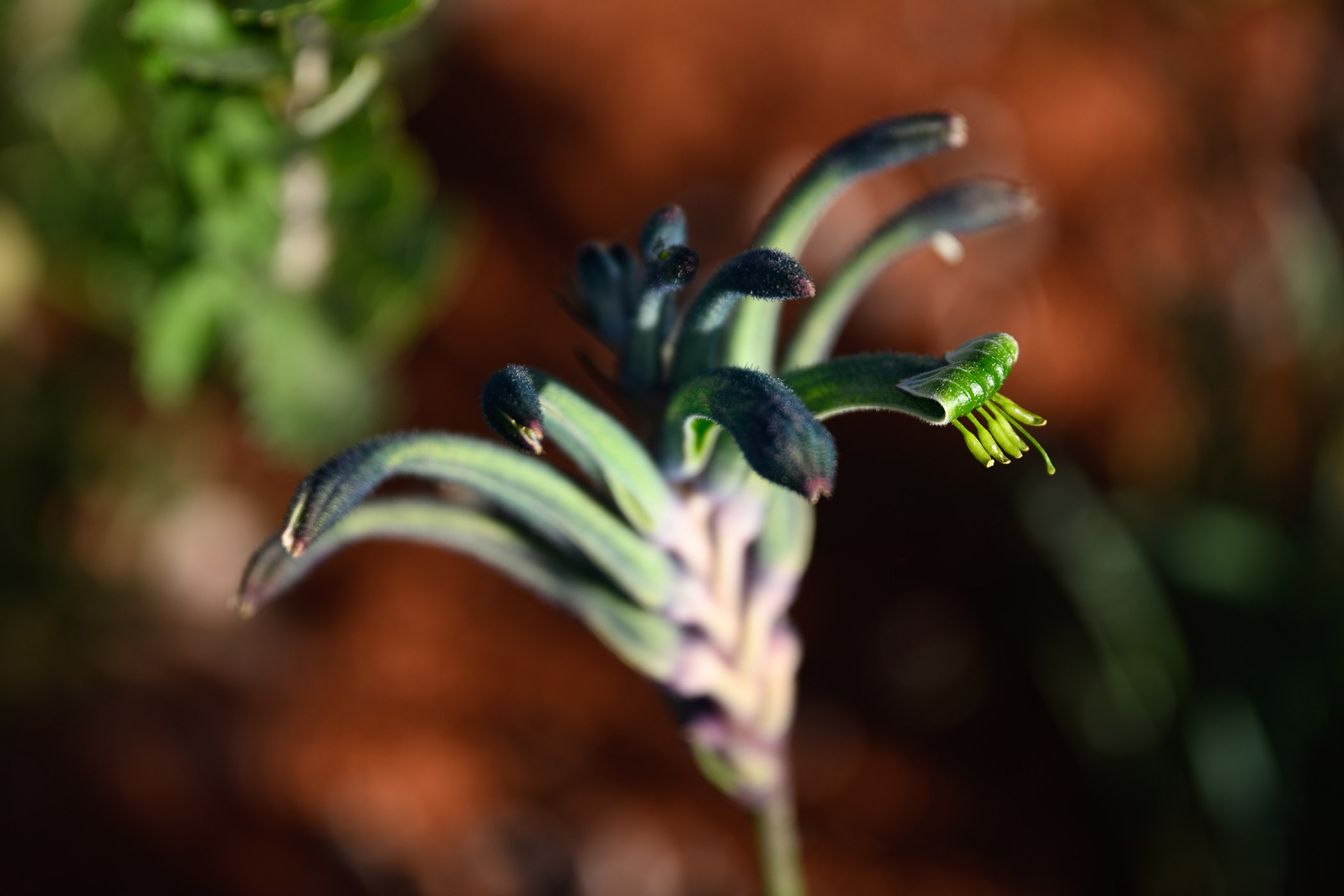
Close up shot of kangaroo paw
Curing plant blindness is the first step towards getting people to care about the environment around us, Pottage argues, adding: “They need to notice something [about the plant], then you start to engage them, and then once they start to understand it, they might start to care about it.”
He said it is possible a “small percentage” of the plants would not survive their first winter in London, but to give them the best chance possible he has chosen beds on a warm south-facing slope, so the rainwater drains away. “There is an element of learning and experimentation with it, because some of it has just never been tried out, to our knowledge.”
Horticulturists in charge of historic parks and gardens cannot ignore the climate emergency and keep planting the same plants they always did, he said. “The climate’s changing all around us. Plants that used to be happy are no longer happy.”
As well as increasing the biodiversity of the gardens, Pottage hopes the project will have a positive impact on wildlife. Bees, for example, “just adore” exotic plants such as bottlebrushes and paperbark, which they use to produce melaleuca honey, he said. “They don’t care where the plants are from – if they can take the pollen and the nectar, they will.”
He is particularly looking forward to seeing kangaroo paws blooming in Kensington Gardens. “There’s one that’s a vibrant aquamarine – a really electric colour – while others are yellow and orange. They’re fluffy and look like a mini kangaroo’s paw. They’re just ridiculously cute.”
Kangaroos love to feast on this plant and in Australia will raid people’s gardens to get at it. But Pottage said the kangaroo paws in Kensington Gardens are unlikely to be eaten by any roving marsupials. “I wish,” he added. “I’d love to see a koala in the park.”
Thanks for reading. You can tell us what you think by writing to letters@observer.co.uk
Photographs by Jonathan Hordle/Inhouse Images