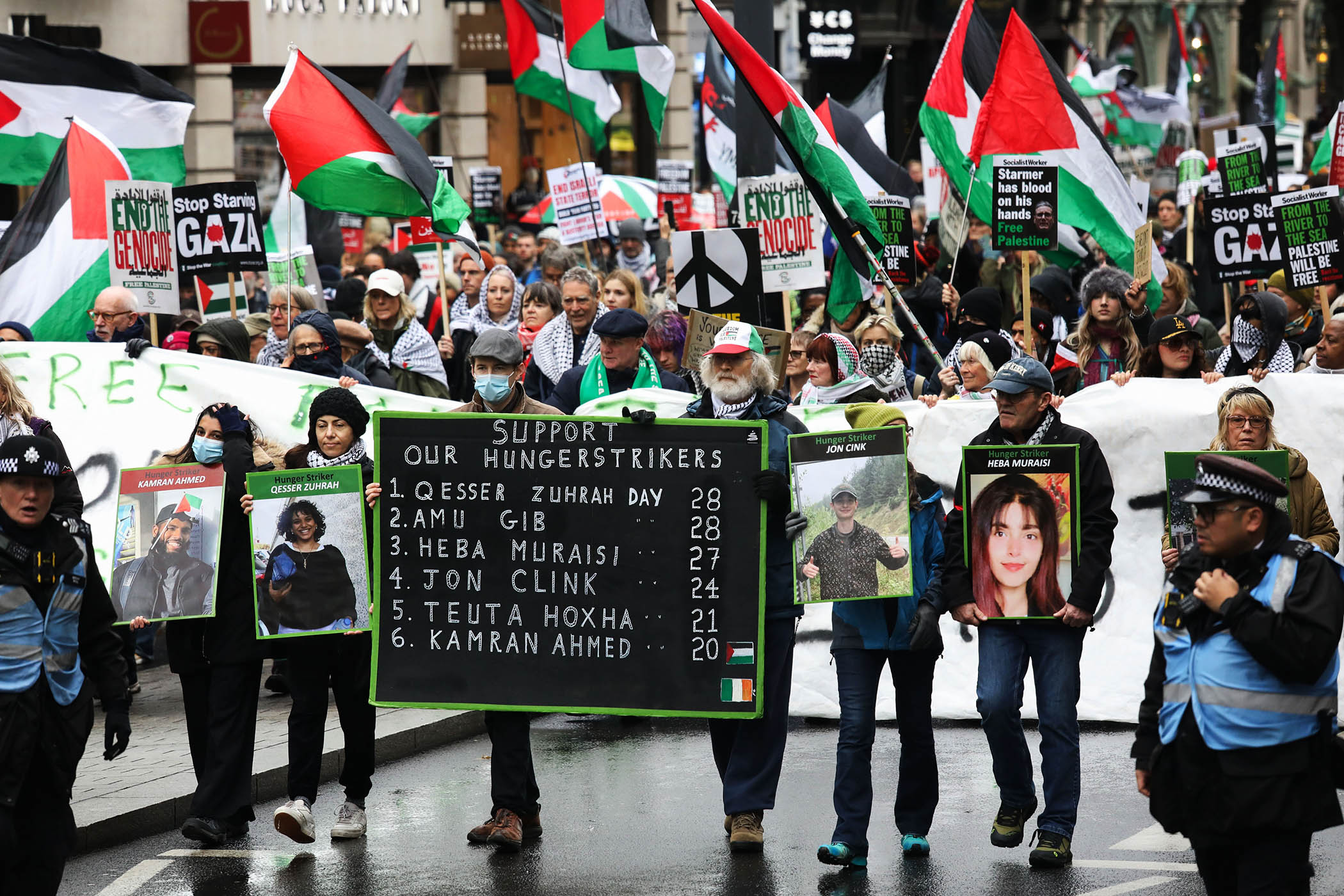



A doctor supporting the families of seven prisoners who are on hunger strike while awaiting trial for alleged criminal damage during Palestine Action protests has warned: “This is a trajectory that ends with death.”
Six of the activists have been on hunger strike for between 26 and 35 days after being denied bail for their alleged involvement in Palestine Action raids on an arms factory owned by Elbit Systems, Israel’s largest weapons company, and RAF Brize Norton. A seventh began a hunger strike last week.
“As a healthcare worker, I’m extremely concerned,” said Dr James Smith, an NHS emergency doctor who has been in regular contact with the families of the prisoners.
Among their demands is the de-proscription of Palestine Action, which was banned under terrorism legislation in July.
Last week a three-day judicial review of the Home Office’s unprecedented decision to ban the direct action group, alongside two Russian militias, ended in the high court. A judgment is expected this week.
A victory for Huda Ammori, the Palestine Action co-founder who brought the case, could mean the collapse of the prosecutions of thousands of people arrested under terror legislation for holding signs saying: “I oppose genocide. I support Palestine Action”.
Smith, who has not yet visited the prisoners, said: “For someone who was previously well, with no other underlying medical issues, [at] around six to eight weeks, there’s a very, very high risk of death.”
Many of the prisoners have been on remand for a year and are demanding bail as well as the right to a fair trial and an end to Elbit Systems’ UK operations. Five of the seven have recently returned to prison from hospital, where they said they were all handcuffed to officers throughout their stays.
“They’ve been on water and some kind of homemade mixes of electrolyte solutions, so salt and sugar,” said Smith. “The hunger strikers have complained that books and letters have been censored, that they don’t have freedom of expression.” He says they consider themselves political prisoners.
“I’m most concerned about the substandard treatment in the prison system… If someone’s on a hunger strike, the obvious thing is that they need to be weighed every single day. From the information I’m receiving from the families, it doesn’t appear to me that there has been, for most of them, a single day in which they have had a full set of their observations taken: heart rate, blood pressure, blood sugar levels, proper weights,” Smith said.
Newsletters
Choose the newsletters you want to receive
View more
For information about how The Observer protects your data, read our Privacy Policy
“It can’t be overstated that they’ve not been convicted of anything.”
A Prison Service spokesperson said: “Any prisoner assessed as needing hospital treatment is immediately taken to hospital.”
Photograph by Kristian Buus/In Pictures via Getty Images