

Eight days ago Dawa Sherpa sat down for a breather high above Camp 3 on Mount Everest on the last day of the climbing season. Soon afterwards a British climber passed him, heading down, and asked if he was OK. Dawa said that he was fine.
It was the last thing anyone heard from him for nearly a week.
Rescued on Thursday after six days alone on the world’s highest mountain, Dawa was close to death. The confusion and flawed planning that left him there were, one of the world’s top climbers told The Observer, “a complete clusterfuck”.
Kenton Cool, who this year became the first non-Nepali to have summited Everest 20 times, said there was “no way” Dawa should have been left behind, and queried why the party had set out to summit so late in the season. His story raised “serious questions” for the climbing industry, Cool said.
Dawa, also known as Hillary Dawa after the climber Edmund Hillary, spent those six days sliding and crawling towards base camp on Everest after summiting the peak with clients and then becoming separated on the descent. Left without food or water, he survived on biscuits he found in a pocket of his climbing suit and ice from the mountain.
He was part of an expedition that had made it to the top of Everest on 29 May at about 5pm with a team whose members included Chris Thrall, an “extreme endurance athlete” and former Royal Marine commando.
According to a video Thrall posted on social media, on 30 May Dawa had stopped for a rest on the descent from Camp 4. Thrall said: “I turned and I said, ‘Hillary, are you OK, brother?’ He said, ‘Yes, yes, fine Chris, please go, go!’ This is nothing new, you know.”
As he continued his descent, Thrall encountered a fellow client on the expedition, a Polish climber who was suffering from frostbite and lacking in oxygen, and helped the man down to Camp 3.
Thrall said when they were in Camp 3 he kept his head torch on so they would have been visible to Dawa had he made it to the camp. But according to Thrall’s video, whenever he looked up at the mountain, he was unable to see Dawa’s head torch, and assumed the worst.
Cool says the decision to go for a summit at the end of the season was risky.
Newsletters
Choose the newsletters you want to receive
View more
For information about how The Observer protects your data, read our Privacy Policy
“Why would they go up so late? To me, it makes no logical sense,” he said. “ From an Everest guide’s perspective, it’s all very, very loose in my opinion… it’s really pushing the boundaries of what I would consider safe on that mountain.”
The late summit would have meant it was unlikely there were other parties behind them that could have found Dawa on their way down. It would have also meant some of the infrastructure set up to help climbers lower down the mountain would have been in the process of being dismantled.
The Khumbu Icefall is a treacherous glacier that all climbers must cross to reach Everest when climbing from the Nepali side. At the beginning of each climbing season a team of skilled sherpas known as “icefall doctors” establish a route across the glacier using fixed lines and ladders, which all climbers use during their ascents.
According to the Tourism Times, the Sagarmatha Pollution Control Committee (SPCC) – the group that manages Everest base camp and climbing infrastructure – had notified guiding companies that it intended to remove some of the ladders from the glacier section of the mountain on 29 May.
Cool says it was “bonkers” to expect clients and Sherpas to descend through the icefall and its yawning crevasses after it was no longer fully set up for mountaineering.
It also means Dawa would have found himself without fixed lines and ladders when he reached the glacier, after days on the mountain.
Thrall said Dawa had a radio and satellite with him, but wondered whether the Sherpa had run out of battery due to the length of the expedition. According to Thrall, the climb had taken 11 days, instead of the planned five.
The incident has prompted questions about the way the search and rescue operation was handled.
Dawa Sherpa was part of a tour run by Himalayan Traverse, but the group had acquired its climbing permits via the adventure company 8K Expeditions, which also provided the insurance policy for a rescue operation. All climbers must have permits to climb Everest to manage the number of people on the mountain.
Despite Dawa being left on the mountain on 30 May, a search and rescue operation wasn’t launched until Thursday 2 June.
8K Expeditions, which managed the search operation, told Outside Magazine that Himalayan Traverse did not contact them at any point requesting a search and rescue operation, and that 8K Expeditions had instigated the search after reading about the disappearance on the news.
Cool says: “I suspect that this particular outfit was a cheap outfit.”
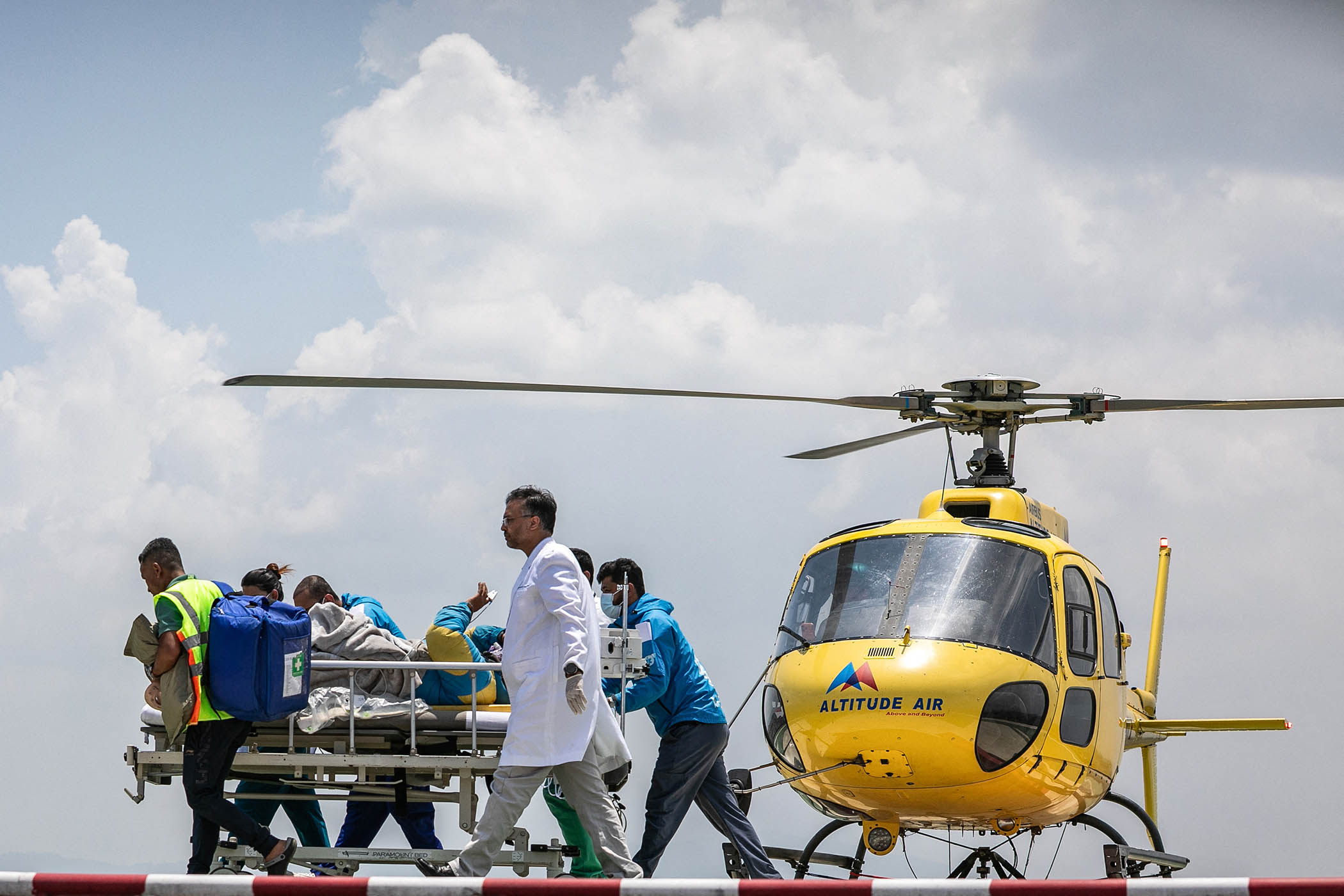
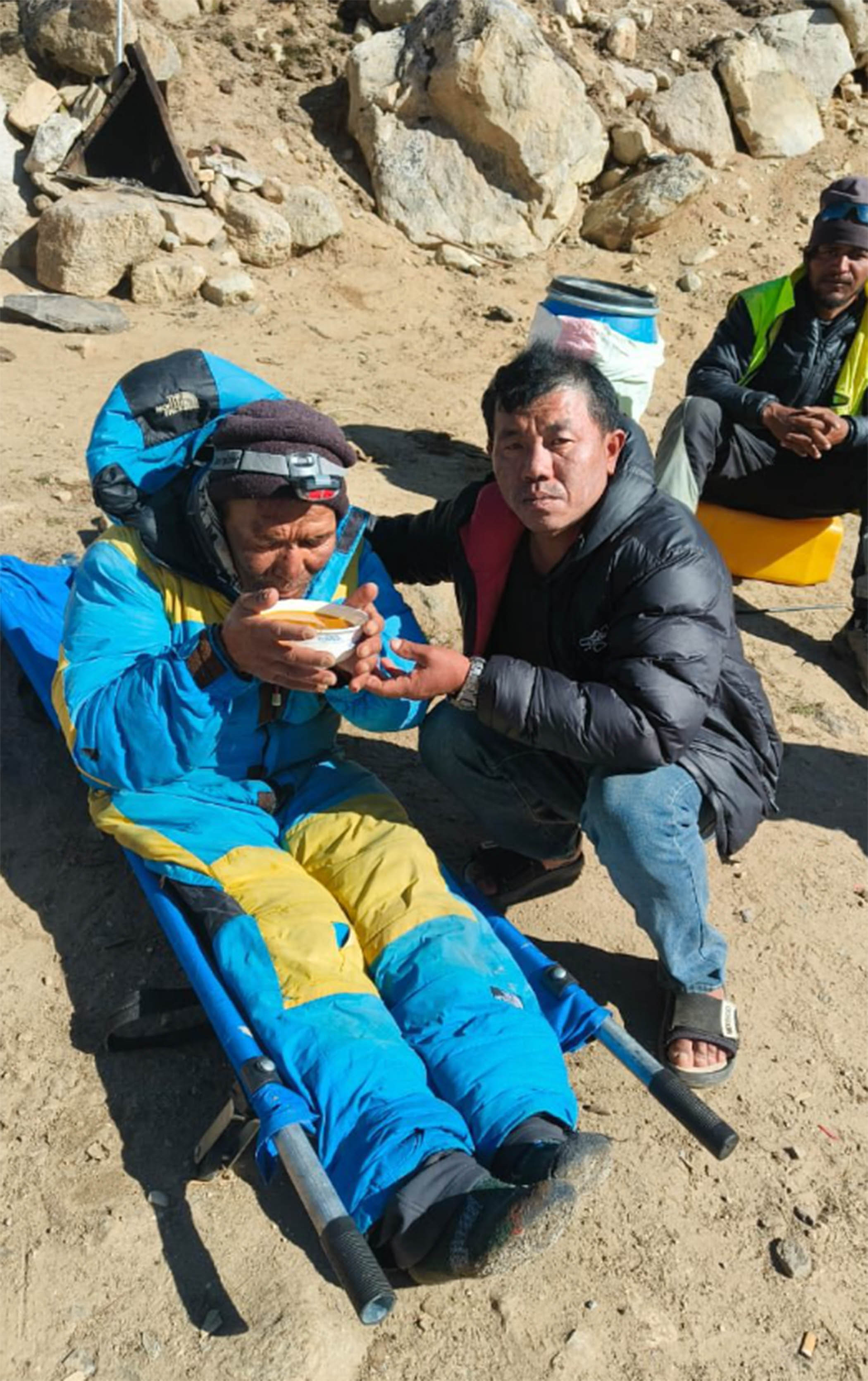
Dawa was eventually found by the SPCC’s clean-up team on 4 June, crawling down through the glacier. He was airlifted to hospital in Kathmandu where he is being treated for frostbite.
Since the first recorded expeditions to the summit of Everest in the 1920s, more than 340 people have died on the mountain. It’s far more common for a mishap on the world’s highest mountain to end in fatality than in survival. As Cool says: “This is one of the epic survivals of Everest.”
Photographs by Prabin Ranabhat/AFP/Getty Images, Courtesy of SPCC