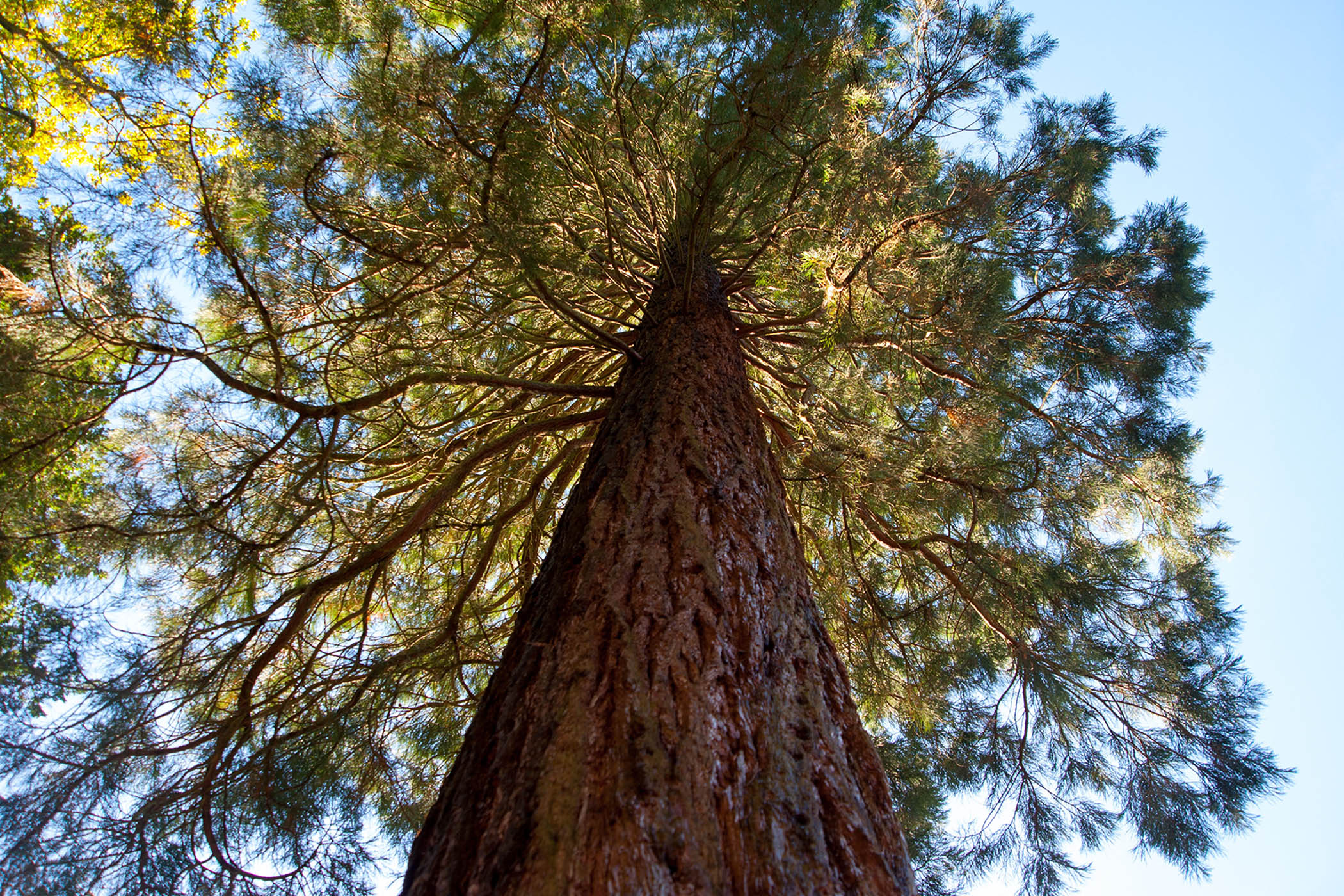

What makes a British forest? Is it Alfred, Lord Tennyson’s oak, bright in spring, and summer-rich? Or is it Walt Whitman’s California redwood, with stalwart trunk and foot-thick bark?
Ministers are leaning towards Whitman. Redwoods are at the forefront of government plans to plant millions of trees that are more resilient to the climate crisis and that absorb large amounts of carbon.
Coast redwoods are expected to feature in a new Trees Action Plan outlining how the government will meet its target to invest £1bn in tree planting by 2029. Trials by Forest Research, an arm of the Forestry Commission, show that the giant conifers, along with 16 other non-native species, have the potential to grow well in the UK and be a commercial success for the timber industry.
Britain already has about 500,000 coast redwoods and their giant sequoia cousins, many of them planted individually by Victorians, who were fascinated by these majestic brothers, as Whitman described them. Most are scattered around the country, lining suburban streets, in parks or on the grounds of stately homes.
The oldest were planted about 150 years ago and are still some way from maturity – they can live 3,000 years. Their 10 metre-wide trunks and Methuselahian lifespans make them ideal for carbon sequestration, with the capacity to store about 2,200 tonnes of carbon per hectare.
Yet part of the attraction for foresters is that coast redwoods are fast growing and do well when planted under the canopy of existing woodland, creating a more diverse species mix. “Diversification is really important in a future climate,” said Dr Gail Atkinson, head of climate science at Forest Research.
Much of the UK’s planted woodland is commercial timber, and plantations focus on just nine species of fast-growing pines.
“Coast redwood is a species really valued for its timber in California, where it’s now endangered, and it can show wildfire resistance, which is really advantageous in the light of changing fire risks,” Atkinson said. Firefighters dealt with 996 wildfires in England by 4 September this year, a new record.
Longer periods of drought also made it harder for foresters to plant saplings this year, which is another reason why the Department for the Environment, Food and Rural Affairs (Defra) is focusing on the need to adapt woodlands.
The Climate Change Committee had recommended planting 30,000 hectares of trees a year by 2025, but previous governments barely achieved half that target. Last year just over 20,000 hectares of trees were planted, but the increase is unlikely to be sustained.
Newsletters
Choose the newsletters you want to receive
View more
For information about how The Observer protects your data, read our Privacy Policy
Emma Reynolds, the environment secretary, said: “We’re turning the tide on nature’s decline, by planting more trees than any point in the last 20 years, introducing new species trials and delivering better forest management to hit our goals for increased canopy cover and support biodiversity.
“But with hotter, drier days, our woodlands must be protected. Previous approaches lacked credibility, but the new environmental strategy I’m announcing in the coming days will restore and protect nature across the country for generations to come.”
The trees plan is part of the government’s Environmental Improvement Plan (EIP), due to be unveiled on Monday, which will outline how ministers aim to meet the UK’s “30 by 30” target to conserve at least 30% of land for biodiversity by 2030.
Defra is working towards a target for trees to cover 16.5% of land in England by 2050 – about an extra 210,000 hectares.
The EIP was introduced as a post-Brexit measure, but green campaigners were critical of the previous government’s lack of ambition.
Craig Bennett, chief executive of the Wildlife Trusts, said that the plan should prioritise biodiversity and nature recovery targets and work out how to deliver commitments the UK has made at forums such as Cop.
“Our test for the EIP should be whether it provides the clarity as to what needs to happen, by when, to ensure we rebuild our natural infrastructure in time to meet those domestic and international targets,” Bennett said.
“What we don’t need is a shopping list of existing policy commitments, developed and implemented in silos, without any assessment of how it all adds up and whether there are still any gaps or not. We’ll be watching closely.”
Coast redwoods and other non-native species including Atlas cedar and Norway maple may help the timber sector, but the Tree Action Plan is also expected to encourage land managers to use European species, including oak grown in southern Europe.
“We’re not focusing solely on conifers by any stretch of the imagination,” said Mark Broadmeadow, the Forestry Commission’s head of climate change. Three species trials taking place are for broadleaf species in areas prone to drought and wetter areas.
“Native species will continue to play a really, really important role,” he said.
“We’re looking at provenances from further south for our native species. Oak, like coast redwood, has got a huge range, so that can help us along the adaptation pathway.”
The redwoods may rise, but Tennyson’s oak will still stand, trunk and bough.
• This article has been amended post-publication to clarify the area of tree coverage required to achieve Defra's 16.5% target
Photograph by Chris Ware/Getty