

Photograph by Katherine Anne Rose for The Observer
When Eilidh MacInnes joined a crowd on a Glasgow street last Sunday to watch smoke billowing above the city centre, she had deja vu.
“The big, lit-up clouds and that smell – it did feel like [2018],” she says. With a laugh, she adds: “Or just another day in Glasgow.”
MacInnes, a hospitality worker, has witnessed two of the city’s most dramatic fires. The first was the second of two blazes at the A-listed, Charles Rennie Mackintosh-designed Glasgow School of Art (GSA), in June 2018. It also destroyed the adjacent O2 ABC music venue.
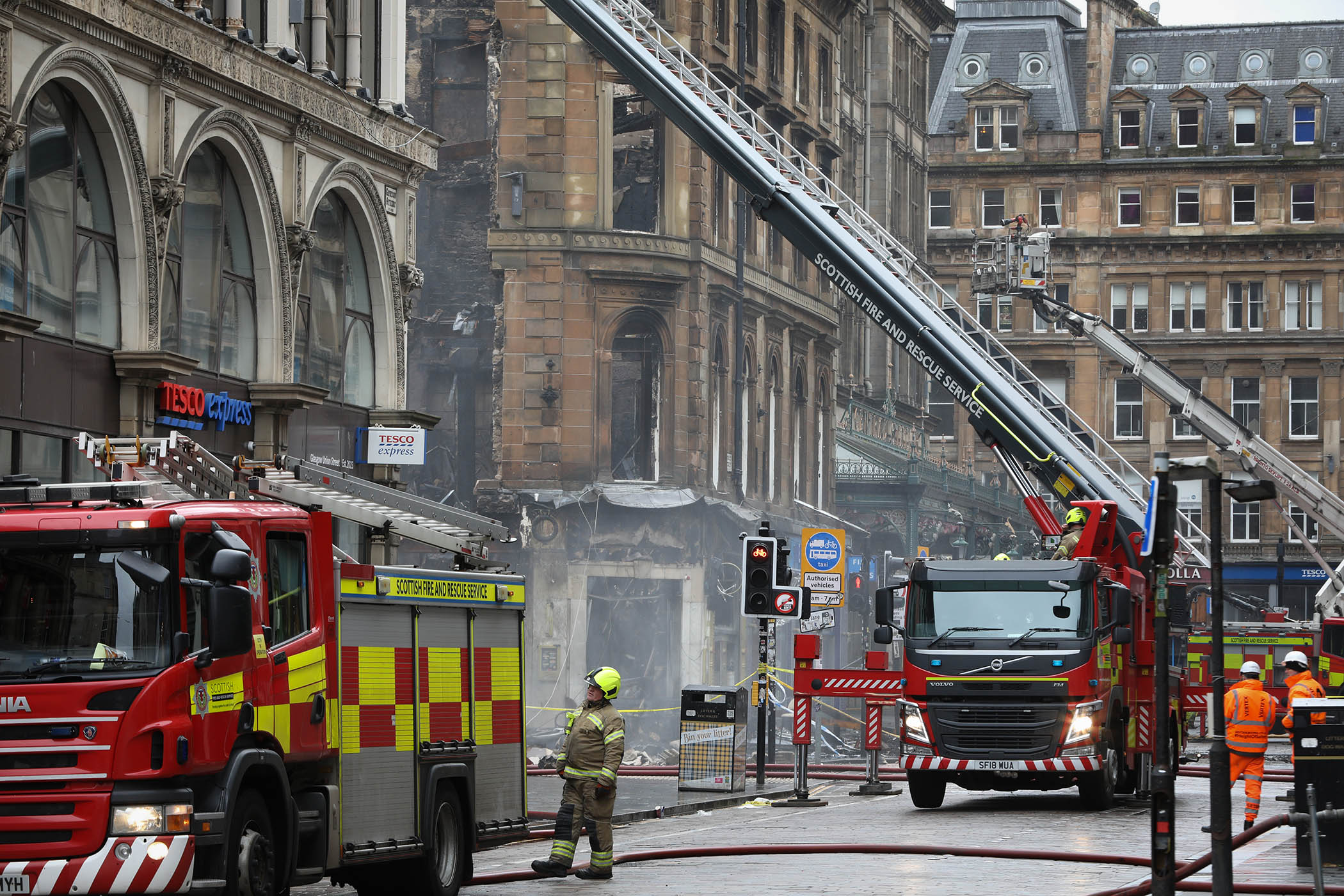
Then, last week, MacInnes watched as a fire took hold on B-listed Union Corner, starting in a vape shop and causing possibly weeks of travel disruption after narrowly avoiding the railway station next door. An estimated 50 businesses lost their premises, the majority small and independent.
It’s heartbreaking to see further loss of the city’s built heritage
It’s heartbreaking to see further loss of the city’s built heritage
Niall Murphy, Glasgow City Heritage Trust
Since flames first destroyed the art school in May 2014, there have been at least 15 fires in historic Glasgow buildings, according to a map compiled by local outlet the Glasgow Bell. Some, like that which destroyed city centre Victoria’s nightclub in 2018; or the fire that gutted a tenement on Albert Drive in 2019; or that which tore through B-listed Carlton Place in 2024, made national headlines. Others passed with less attention, but all have contributed to a sense that the city’s heritage is being eroded.
“It’s heartbreaking to see further loss of the city’s built heritage,” says Niall Murphy, director of Glasgow City Heritage Trust. “These buildings are a key part of the city’s story and identity. When they are destroyed, it leaves a lasting mark on our streetscape.”
Glasgow might be fire-prone for a few reasons, Murphy says: depopulation in the centre has left vacant buildings, a number of them, such as Union Corner, built using traditional methods that predate fire safety codes.
The fates of the buildings destroyed by fire has been mixed. Some sites, such as Victoria’s nightclub and the O2 ABC, remain derelict. Others, such as the GSA, have been shrouded in scaffolding for several years. Some sites have been privately developed.
For many in Glasgow, the fires play into a feeling that the city, once named UK City of Architecture and European City of Culture in the 1990s, risks falling into disrepair.
Newsletters
Choose the newsletters you want to receive
View more
For information about how The Observer protects your data, read our Privacy Policy
“One of Glasgow’s challenges is that the built environment is falling apart,” says James White, professor of planning and urban design at the University of Glasgow. The level of civic grief that followed the Union Street fire was such that the council might need to consider some citizen engagement around what happens to the site, White suggests, referencing the city’s famous slogan, People Make Glasgow. The phrase was displayed on the Met Tower to mark the city’s turn as Commonwealth Games host in 2014. Today, the tower is empty, its signage faded and peeling.
For MacInnes, while there’s still a lot to be proud of in Glasgow, the city’s changing streetscape is hard to ignore. “This is a diverse, interesting city and people will always find ways to do cool stuff here,” she says.