
On 30 January 1978, Granada TV’s World in Action programme transmitted an explosive interview with the then leader of the opposition, Margaret Thatcher. “People are really rather afraid that this country might be… swamped by people with a different culture,” she claimed, a fear that would lead Britons to be “rather hostile to those coming in”. It was a naked (and successful) attempt to wrest back voters from the neo-Nazi National Front (NF), which was threatening an electoral breakthrough, having gained 119,000 votes in London local elections the previous year.
The day after Thatcher’s interview, the BBC broadcast as its Play for Today, one of the most important political dramas of the 1970s: David Edgar’s Destiny, the story of the rise of neo-Nazis in contemporary Britain. The theatrical gods were obviously in a mischievous mood.
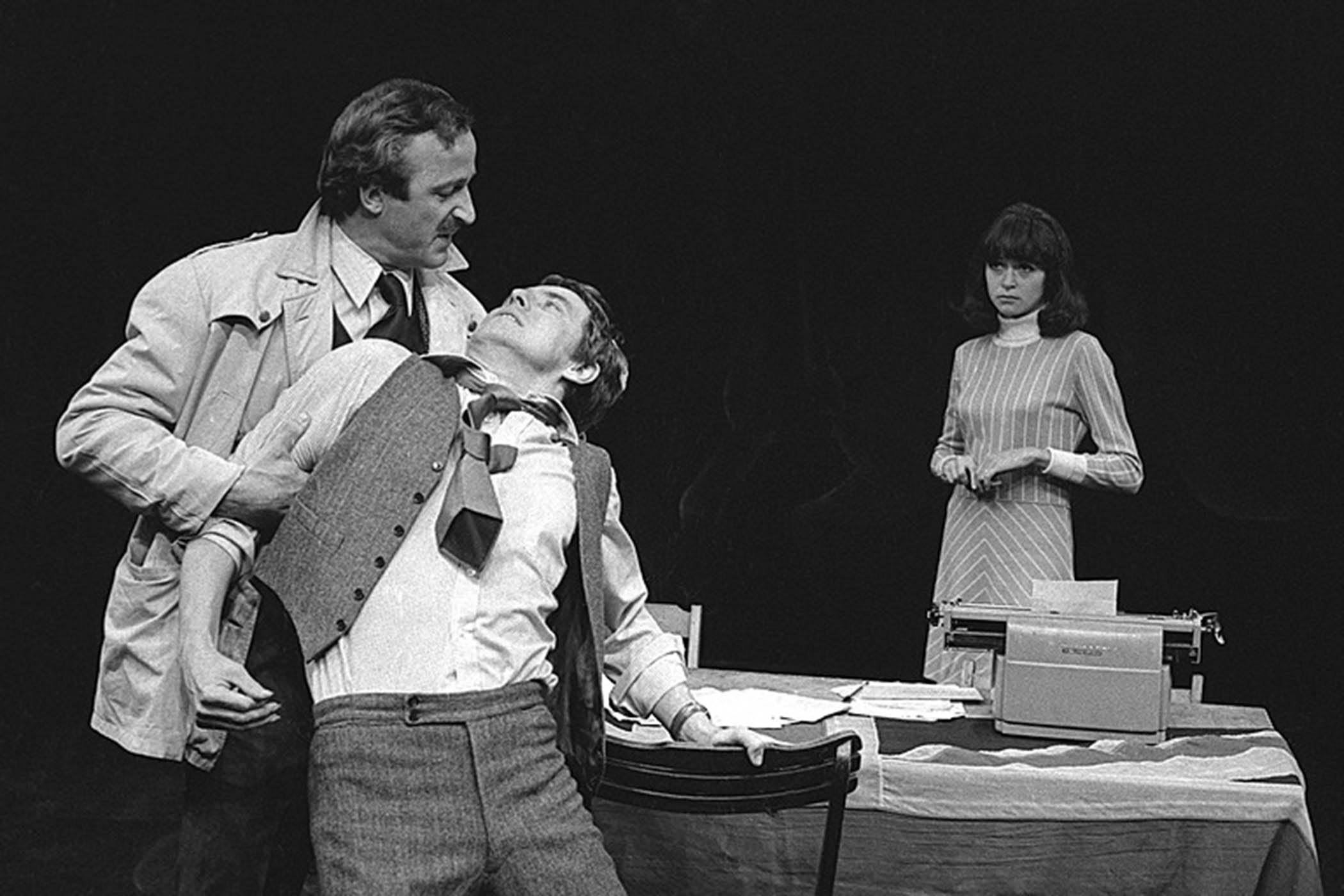
Destiny had originally been staged performed two years earlier at the Royal Shakespeare Company in Stratford-upon-Avon, its success providing a launchpad for Edgar to become recognised as a significant political playwright. Now, the Cockpit theatre in London is reviving the play on its 50th anniversary, together with a discussion on its relevance today.
Destiny begins in India on independence day, when three British soldiers, Colonel Chandler, Major Rolfe and Sergeant Turner, and their Indian attendant, Gurjeet Singh Khera, are preparing for British withdrawal.
The lives of the four become entangled again three decades later in Taddley, a West Midlands town where a byelection is to take place. Chandler, the local Tory MP, has recently died. The far more reactionary Rolfe attempts to succeed him but is thwarted by Peter Crosby, a liberal Tory who, as Rolfe acidly puts it: “Knew all the right words.”
Turner owns a small antique shop that is shuttered by property speculators, and his bitterness draws him into the neo-Nazi Nation Forward party.
Khera is a shop steward at a local foundry, leading industrial action against discriminatory pay for the mainly Asian workforce. Into this mix is thrown also the aspiring Labour candidate Bob Clifton, torn between supporting the Asian workers and not wishing to alienate racist voters; torn also between his Bennite election agent, fiercely anti-racist, and his wife, Sandy, more sympathetic to working-class concerns about immigrants.
Their disagreements foreshadow a debate that would burst out in the real world several decades later.
Destiny is a complex and nuanced work, marrying the political engagement of a Ken Loach with the subtlety and craft of a Mike Leigh.
It debuted at a time of political and cultural transformation. From punk to Thatcherism, from neoliberalism to New Labour, the maul of the new was about to crush the verities of the old. Destiny captured that mood of a nation in transition.
Newsletters
Choose the newsletters you want to receive
View more
For information about how The Observer protects your data, read our Privacy Policy
There is a thread of yearning for lost worlds and lost hopes. Crosby, the Heathite Tory candidate, mourns the “watercolour world” of his childhood, now displaced by “monstrous chauvinism” and a “desire for something dark and nasty”.
Rolfe, breaking down after his soldier son’s death in Northern Ireland, has “more time” for the sniper who shot him than for “the generals, the ministers, the police chiefs” who won’t see that “we are at war. Same war. In Belfast. Bradford. Bristol, Birmingham, the one we lost in Bombay 30 years ago, the one we’re going to lose in Britain now.” And then there is Turner’s incomprehension at the way his livelihood has been snatched away.
Part of Destiny’s strength lies in its ability to empathise with that sense of bewilderment and powerlessness, betrayal and loss, while challenging also the way that hatred for immigrants and Jews can become a means of articulating it.
Destiny portrays the dashed hopes largely of the lower middle class, nostalgic for a lost empire. Fifty years on, it is the working class whose world has been turned upside down and who feel that sense of betrayal and loss, not for a vanished empire but for a broken social contract and system that denies them their voice.
Many have abandoned the old parties just as those parties have abandoned them.
Edgar, as he readily acknowledges, was wrong in suggesting that Britain was on the cusp of a Nazi upsurge in the 1970s. But that very misstep helps also to illuminate contemporary trends.
For while the NF’s John Tyndall or the British National party’s Nick Griffin were never close to power, many of their old ideas now are. As Edgar observed to me last week: “Much of the ideology peddled by the far right in the 1970s – then seen as way beyond the political pale – is now seeping into the mainstream.”
The demand for “remigration” and mass deportation was in the 1970s found largely on the fascist fringe. Today, it is at the centre of politics. When the Financial Times reported last week that Reform UK policy would require the deportation of at least 2 million people, the party’s Zia Yusuf responded on X: “You’d better believe it.”
The “great replacement theory”, the belief that liberal elites are deliberately importing immigrants to replace white people, once the province of out-and-out racists, is now part of respectable talk. Enoch Powell is routinely cited as a sage by mainstream politicians.
“In the mid-1970s, the liberal establishment consensus was that the National Front was just an unpleasant and raucous anti-immigration pressure group, and that defining them as fascists was grandiose leftwing paranoia,” Edgar observed. “Destiny was part of the campaign to show that the NF’s leaders were and remained fascists.”
Fifty years on, the issue is not that people can’t see Nazis for what they are but that many of the ideas in which they traded have been made respectable by liberal society.
Joe Cocks Studio Collection/Shakespeare Birthplace Trust