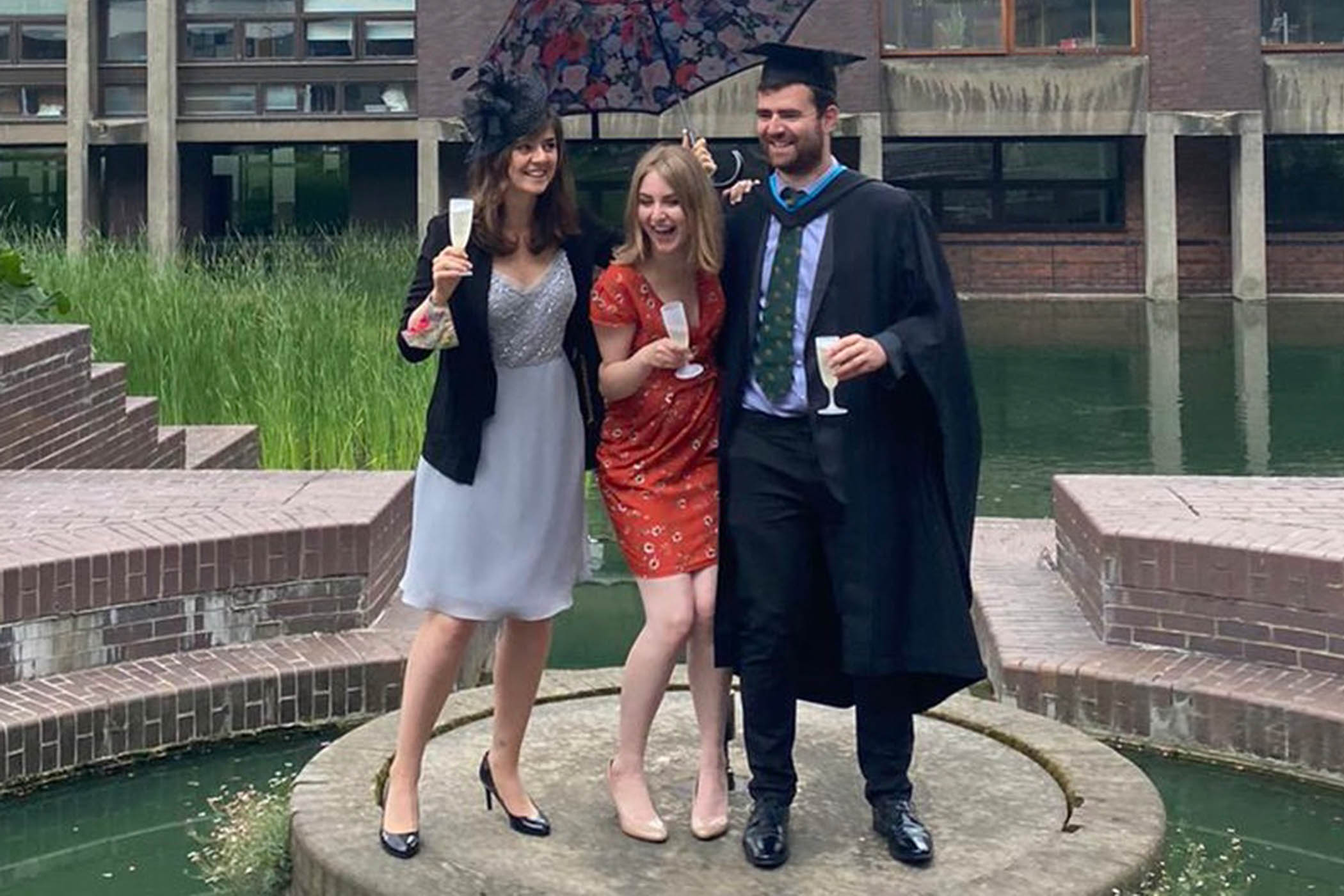


September 2009. Gordon Brown and the Labour party were entering their final months in power. The economy was still reeling from the previous year’s financial crisis. The UK’s largest haul of Anglo-Saxon treasure was discovered buried in a field in Staffordshire – and Hannah Duncan, 34, from a village in South Wales, began studying law at the University of Exeter, paying £3,000 a year in tuition fees.
“I remember thinking: ‘This is such an awful lot of money,’” Hannah, who is now a freelance business journalist, says. She also took out a maintenance loan from the government to cover living expenses while she studied – but that still wasn’t enough.
“I worked for 26 hours a week the whole time I was a student. I worked in Carphone Warehouse and in pubs. I couldn’t afford anything… At the time it felt crazy,” Hannah says.
Even so, the £25,000 of student loan debt Hannah left university with when she graduated in 2012 pales in comparison to the combined £187,500 her siblings, Toby, 28, and Holly, 23, have accumulated thanks to the coalition government tripling tuition fees in the same year.
“I have a lot of survivor’s guilt about it,” she says. “I don’t want [my siblings] to think that this is normal. My husband is Spanish, and he didn’t pay anything to be a student.”
Hannah owes £7,333 to the Student Loans Company for her undergraduate degree 13 years after graduating. When her earnings peaked in 2018, when she was making £70,000 a year working in financial services, she was paying just more than £400 a month towards her loan.
When Toby, who now works as a doctor in Glasgow, finished studying medicine at St George’s, University of London, in 2021 after five years, he had borrowed £89,549. By April 2022, interest on the loan meant he owed £108,672. Despite paying around £350 a month out of his NHS paycheck, he now owes £122,526.
“Perhaps naively I thought my debt would fall as I paid it back instead of rising with added interest,” Toby says. “It never occurred to me that I would end up owing so much more as time goes on.”
One reason Toby’s debt is so much higher than that of other graduates is that, on top of doing a longer course in London, he was eligible for the full maintenance loan due to his parents’ being in a lower income bracket. Like many of the 5.6 million graduates on plan 2 loans, he is likely never to pay off his debt before the 30-year cutoff.
“Even if someone has a student loan half the size of mine, there’s a fair chance they will never pay it all back… I don’t see how saddling 18-year-olds from poorer families with greater amounts of debt is progressive.”
Newsletters
Choose the newsletters you want to receive
View more
For information about how The Observer protects your data, read our Privacy Policy
That said, Toby doesn’t regret going to university and getting a degree that means he does a job he loves: “I’m grateful that I was able to go to university, and without a student loan it wouldn’t have been possible”.
Right now, he says, the biggest strain on his income is trying to buy a flat as a first-time buyer. Although he and his partner are both doctors, they are making little progress towards saving for a deposit.
‘I don’t know if the students today fully realise how badly they’ve been failed and how much this sucks’
‘I don’t know if the students today fully realise how badly they’ve been failed and how much this sucks’
Hannah Duncan
The youngest Duncan sibling, Holly, decided to return to university last year to retrain as a nurse after struggling to find work in the media sector with an undergraduate degree in American studies and film studies from the University of Sussex.
Although Holly initially found work as a video producer when she graduated in July 2025, after three months the company dissolved: “Suddenly I was left with bills, debt and no job prospects.” Currently, her debt stands at nearly £65,000, which is likely to rise to more than £100,000 by the time she graduates.
“As an 18-year-old, I didn’t have the life experience to really know what I wanted. I’m very lucky that healthcare degrees can receive student funding as second degrees. I’m sure there will be lots of students who find themselves in similar situations without having the finances or options to redirect their lives,” Holly explains.
Knowing what she does now, Holly says she “definitely” didn’t understand the long-term cost of a university degree when she decided to begin her studies five years ago.
“My family isn’t rich. My choice wasn’t between self-paid or loan – it was a loan or nothing. So why bother dwelling on it? The general – wrong – belief was that you needed a degree to have a ‘good job’, so the only choice I understood was between a ‘bad job’ or debt.”
Holly believes the current student loan system in the UK has been mis-sold as a system of “opportunity and fairness” while ignoring the instability and obstacles in the job market.
“Students without connections, economic support, sponsorship or access are not on equal footing with their cohorts. Without the same privilege, the poorest students are stuck repaying the most. How can anyone afford to save for a house, for a family, holidays or basic necessities when thousands are being pulled out of your pay cheque each year?”
Hannah remembers what it was like to be one of the last students to pay the £3,000 tuition fees in 2012 as students across the country held demonstrations to protest the incoming price rises.
“I don’t know if the students today fully realise how badly they’ve been failed, how much this sucks and how much it’s not fair… It’s such a vicious cycle, because it’s not just about money, it’s about your life fulfilment. How can you not want to learn more? How can you not want to do something to benefit the world?”