
Ever since he was presented with a toy Aston Martin aged six years old, Andrew Mountbatten-Windsor has felt a special affinity with the great British car market.
He had a custom-built DB7 Volante in the 1990s to transport his young family and later as a divorcee could be spotted driving across London in a racing-green Aston, sometimes with a female companion in the passenger seat.
In July 2010 one of Aston Martin’s key shareholders was struggling in the aftermath of the financial crash and buyers were circling. Andrew, in his position as UK trade envoy tasked with championing British business, had taken a keen interest. It was at this point he received an email from a veteran investment banker called Terence Allen, based in the United Arab Emirates.
“Would you object if I were to pursue Aston Martin?” Allen wrote. “The aim is to keep the brand going. You need not be involved. But the inside information would be invaluable.”
In the email, Allen asked Andrew to introduce him to a Libyan contact to arrange a loan of up to three billion of an unspecified currency. “It can be arranged quietly and discreetly,” Allen wrote. “What do you think?”
Mountbatten-Windsor assured Allen in an email that he had “been kept in the picture by the relevant people… about Aston”. An ownership approach would not be practical because of “conflicts between internal parties”, he advised.
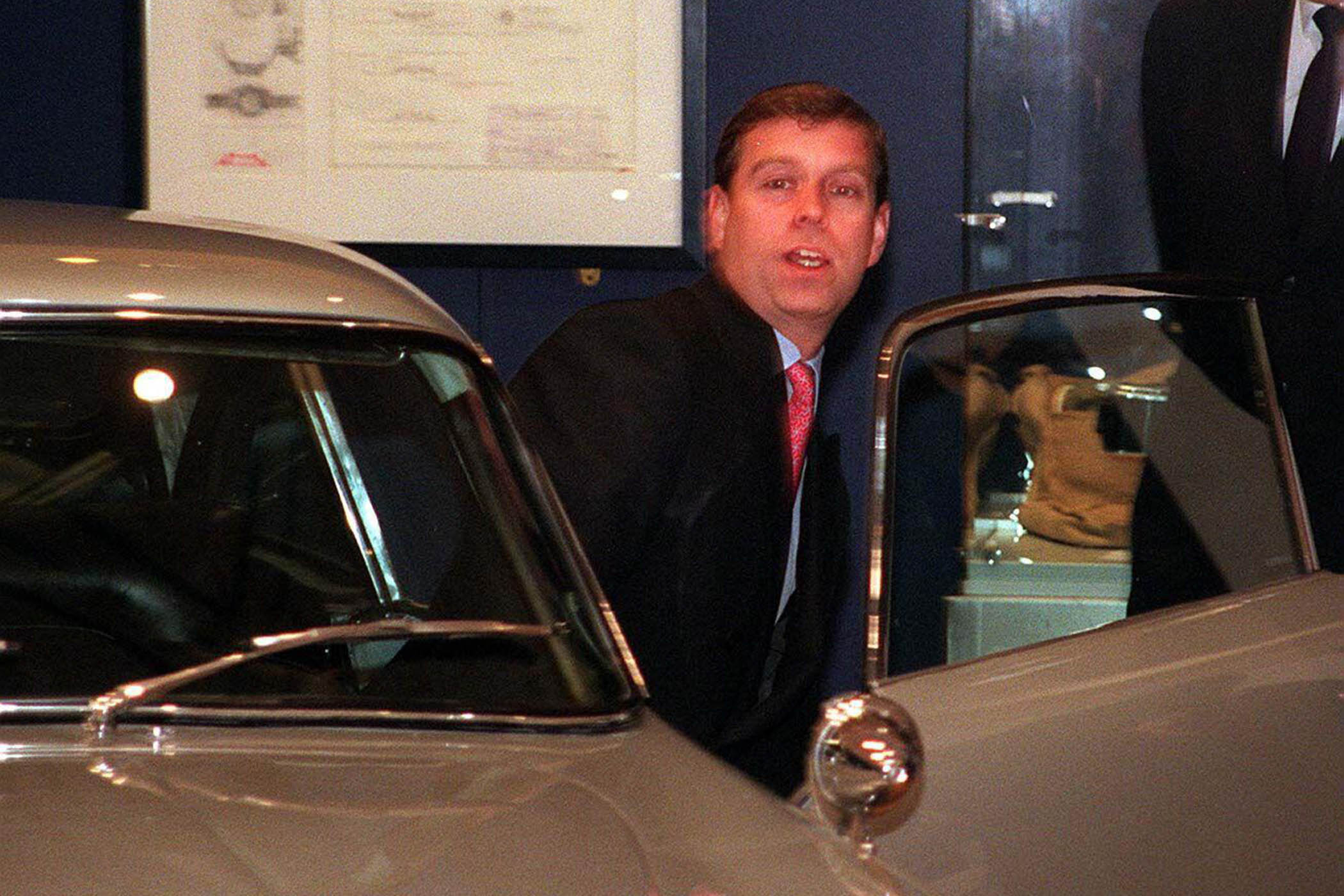
The car-mad former prince climbs into a gold Aston Martin DB6 at a James Bond exhibition in Leeds, 1997
Mountbatten-Windsor seemed to have better news about the Libyan loan. “I’m trying to orchestrate this from behind the scenes,” he wrote. “I can’t be seen to be up front on this.”
The dossier of more than 3m documents relating to the late sex offender Jeffrey Epstein, released by the US Department of Justice on 30 January, contains new evidence of how Mountbatten-Windsor appears to have exploited his role as trade envoy to share private information with key associates.
Some of these associates, including Allen and Epstein, provided or offered to provide financial support for Mountbatten-Windsor or his ex-wife Sarah Ferguson. Those involved deny there was any cash for access or information. The Observer can, however, report that:
•A firm was set up in 2011 with Epstein’s approval to land business deals by exploiting Mountbatten-Windsor’s “aura and access” at the time he was a trade envoy. The firm was created by one of Mountbatten-Windsor’s aides.
Newsletters
Choose the newsletters you want to receive
View more
For information about how The Observer protects your data, read our Privacy Policy
•In 2010, while trade envoy, Mountbatten-Windsor sought information from company executives on the financial fortunes of Aston Martin and steel firm Sheffield Forgemasters which, it was claimed by an aide, would be passed on to Epstein.
•Mountbatten-Windsor shared details of a private briefing from UK Trade and Investment, the UK body managing the government's recapitalisation of the banking sector, on the performance of Royal Bank of Scotland with Terence Allen, the investment banker in the Middle East.
The revelations have triggered calls for a wider inquiry into Mountbatten-Windsor’s decade-long role as UK special representative for International Trade and Investment. Thames Valley Police is already examining claims that he sent Epstein reports on trade visits to Singapore, Hong Kong and Vietnam and confidential details of investment opportunities.
“He was on a permanent hustle,” said a government source. “He couldn’t differentiate between his own personal interests and those of everybody else.”
Graham Stringer, the Labour MP, said ministers should now disclose the details of trips and Mountbatten-Windsor’s activities while a trade envoy. He said: “He has done more damage to the royal family than anyone since Edward VIII. He’s abused his position as a member of the royal family.”
Trade envoy
Mountbatten-Windsor was appointed by the Labour government in 2001 as the UK’s Special Envoy for International Trade and Investment. The role was unpaid, but gave Mountbatten-Windsor a job after he left the Royal Navy to promote UK business and convene groups of senior business executives.
Mountbatten-Windsor was viewed by some diplomats on his overseas trips as inconsiderate, boorish and demanding. He typically travelled with a six-strong entourage which included equerries and a private valet.
One source said: “He had this huge entourage and wouldn’t just take a hotel suite, but the whole floor.”
While Mountbatten-Windsor was nicknamed by some diplomats as “His Buffoon Highness”, there were more serious concerns about his official role. He was incurring expenses of around £600,000 a year, with claims by some diplomats that he was pursuing what was described as a “parallel agenda”.
Epstein’s middleman
In February 2010, Ferguson introduced him to the businessman David Stern, who she said had a “great Rolodex [contacts list]” and was “highly” rated by Epstein.
At the time, Epstein was still under house arrest in the United States for procuring sex from a minor. Mountbatten-Windsor has always denied any wrongdoing in his friendship with Epstein.
Stern had expertise in Asian markets and became a trusted aide until 2019. The new adviser was keen to exploit Mountbatten-Windsor’s access to politicians and billionaires for new business ventures, which would be overseen by Epstein.
In an email to Epstein in July 2010, Stern proposed a plan: “We set up small investment highly private office in London with small outpost in Beijing, for high net worth individuals. We discreetly make PA [Prince Andrew] part of it and use his ‘aura and access’”.
Early the next year, Stern told Epstein he was forming the new venture which would be called Witan, with offices in the UK and Hong Kong. Its name was inspired by Witenagemot, also known as Witan, an Anglo Saxon council that advised English kings in the early middle ages. Epstein approved the name of the business.
Private briefings
In the aftermath of the financial crash of 2008, Mountbatten-Windsor was being regularly briefed about the challenges faced by some of the country’s best-known businesses. The Epstein emails reveal how he was relaying some of this sensitive information to his associates.
In 2010, Andrew told Allen that he had discovered from UKFI, the UK body managing the government's recapitalisation of the banking sector, that Stephen Hester, the then-chief executive of Royal Bank of Scotland, “isn’t all that well thought of”. He said there were concerns and a “number of balls” were being dropped.
Mountbatten-Windsor was also hunting for information on Aston Martin and Sheffield Forgemasters.
Stern wrote to Epstein: “Had meeting with PA [Prince Andrew]. – no action re [Sheffield Forgemasters] and Aston Martin without your go-ahead. He is waiting for further info from the companies which I will send you.”
In November 2010, Mountbatten-Windsor passed trade reports on his trips to China and south-east Asia to Epstein. The next month, he passed what he described as a “confidential brief” on investment opportunities in Helmand in Afghanistan.
Emails published last week by the Telegraph also show how Mountbatten-Windsor in 2010 apparently passed a private HM Treasury briefing on the Icelandic financial crisis to Jonathan Rowland, son of the British property magnate David Rowland.
The younger Rowland had accompanied Mountbatten-Windsor on a trade envoy trip to China in 2010, using the visit to promote the family’s private bank Banque Havilland. There is no suggestion of wrongdoing by the Rowland family and the family has denied providing money in exchange for access or contacts.
The new emails do not reveal a payday for Mountbatten-Windsor over his questionable activities while trade envoy, but there are financial links with some of the business associates he appears to have helped or furnished with information. Sarah Ferguson sought advice over her debts from Epstein and accepted £15,000 from him. She later described the decision as a “gigantic error”.
It was reported by Bloomberg in 2021 that Mountbatten-Windsor had taken a £1.5m personal loan from the Luxembourg-based Banque Havilland. The loan was reported to have been paid off by companies connected to David Rowland.
‘I’m trying to orchestrate this from behind the scenes. I can’t be seen to be upfront on this’’Prince Andrew in 2010
‘I’m trying to orchestrate this from behind the scenes. I can’t be seen to be upfront on this’’Prince Andrew in 2010
Allen, the banker, told Mountbatten-Windsor that he could help “financially” over Ferguson’s debts or may be able to help find her a suitable business role. A source close to Allen said none of the discussed deals with Mountbatten-Windsor had been concluded. No financial support was provided to Ferguson, the source said.
Andrew Lownie, author of the Mountbatten-Windsor biography Entitled, said it was an open secret that Mountbatten-Windsor was pursuing freelance business interests while travelling the world for a decade as UK trade envoy at the taxpayers’ expense.
“He was shoehorning in meetings that weren’t part of the mission,” said Lownie. “People knew about it and were turning a blind eye.”
Mountbatten-Windsor, Stern and the Rowlands have been contacted for comment. Allen declined to comment. Aston Martin said the Epstein files suggested third parties had discussed funding of the car manufacturer, but there was no direct contact between Mountbatten-Windsor and Aston Martin executives. Sheffield Forgemasters has been contacted for comment.
Photographs by John Thys/AFP via Getty Images, PA/Alamy, Department of Justice