
Photograph by Paul Cooper for The Observer
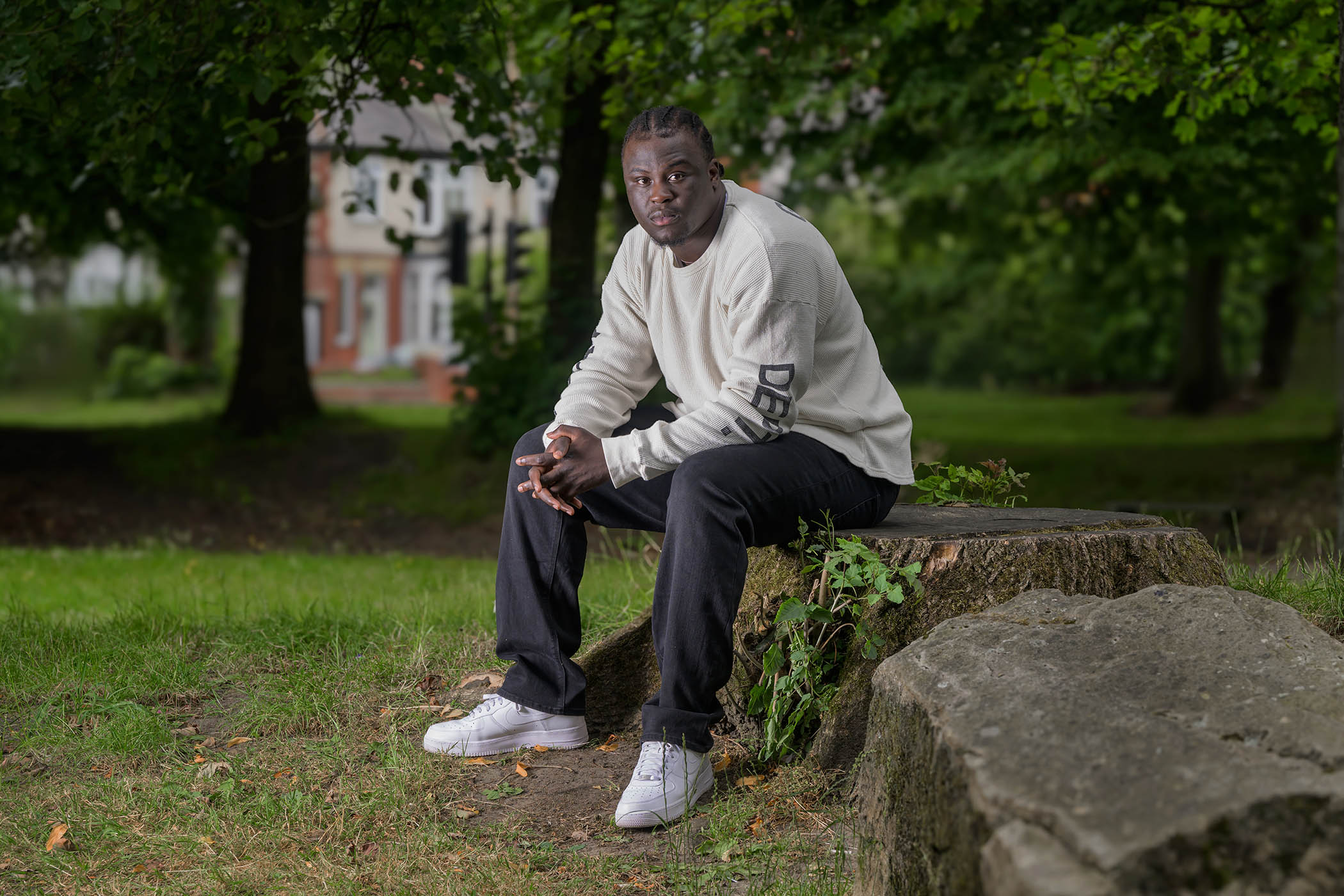
Ademola Adedeji should be a solicitor by now. Just a few years ago, he was head boy with a place on a law degree course. But in 2022 he was declared a gang member in a court of law and jailed for a crime he didn’t commit – serving three years in prison over a string of text messages.
In January last year his conviction was quashed. Yet Adedeji, 26, has now learned he will not be financially compensated for the time he spent in jail.
Of the 538 people who applied for compensation after a miscarriage of justice in the last decade, only 42 have succeeded in getting it. “Which is crazy,” says Adedeji. “Because how much more do I have to prove to you? What more can I possibly do to let you know that I am innocent?
“But I shouldn’t even have to do all those things. I spent so many years of my life trying to fight those things and now that I finally won, it’s like a kick in the face. I’m not really innocent, am I then?”
Adedeji’s ordeal started in November 2020. Two rival groups of youths clashed in Moston, north Manchester, armed with machetes and baseball bats. Adedeji’s friend, 16-year-old rapper John Soyoye, was cornered in a lane and stabbed to death.
Adedeji hadn’t been part of the brawl; he was on his way home from school. He’d seen blue lights speeding up the road, but was still some distance away when his phone started ringing with the news that his best friend had just been killed.
“I remember seeing so many people, so many young boys just broken,” he says. “No one was really there to say, ‘OK boys, it’s okay to feel how you’re feeling. It’s OK to feel the emotions of anger, sadness, grief. This is grief’.”
In the hours that followed, Adedeji was added to a Telegram chat. In it was talk of revenge – kidnap and stabbings to be meted out to the Rochdale crew that had allegedly killed their friend. Adedeji sent 11 messages in the chat and left it within half an hour. In one message, he offered the postcode where one member of the rival group lived. “It never even crossed my mind that something would happen. I got therapy and then moved on with my life. I forgot completely about the text messages.”
Unknown to him, the messages in the group triggered a chain reaction. Some members of the Telegram chat had driven to Rochdale and carried out vicious reprisals. When police caught them, the group chat was discovered. Nothing had happened at the postcode that Adedeji provided. Regardless, two months after his friend’s murder, the police arrived at Adedeji’s door. He was charged with conspiracy to commit grievous bodily harm.
Newsletters
Choose the newsletters you want to receive
View more
For information about how The Observer protects your data, read our Privacy Policy
“No one said in the group chat, ‘we’re going to go kill these people, who is with us?’. No one said anything like that. No one said we’re going to go hurt these people. That’s a conspiracy. No one agreed to go and do anything,” he says.
‘I saw a lot of things from a young age. I’ve seen people hang themselves, cut themselves, and some violent attacks. I don’t think I’ll ever be the same person I was before I went into prison’
‘I saw a lot of things from a young age. I’ve seen people hang themselves, cut themselves, and some violent attacks. I don’t think I’ll ever be the same person I was before I went into prison’
Ademola Adedeji
Following the attacks, 10 young men were convicted – four of conspiracy to murder and six, including Adedeji, of conspiracy to commit grievous bodily harm with intent. At their eight-week trial in 2022 the prosecution argued that they were all part of a gang called “M40”, and were seeking revenge on the rival gang that had murdered their friend Soyoye. Six men and one 16-year-old were convicted for Soyeye’s murder in a separate trial the previous year.
Adedeji and the other young men who stood trial with him in 2022 became known as the Manchester 10, in a case criticised for its reliance on racial stereotypes. Some of the 10 had indeed carried out acts of serious violence. But others, such as Adedeji, merely participated in the group chat.
The case against them was not one of joint enterprise, in which multiple people can be charged and convicted of the same crime, even if they did not directly carry out the offence. Instead it was one of conspiracy – which means they were accused of entering into an agreement with each other to carry out violence.
Conspiracy is “the prosecutor’s darling,” says Keir Monteith KC, Adedeji’s appeal lawyer.
“Even if seconds or minutes after [...] it’s abundantly clear you’re not up for it, or you’re not going to carry anything out, technically, and from a legal perspective, you’ll still be guilty of a conspiracy.”
At his trial, Adedeji – a model student who was head boy and had secured a place at university to study law – was portrayed as a gang member and drug dealer. He was identified by police as a drill rapper in a video lasting nine seconds, which was used as evidence of Adedeji’s alleged gang affiliation.
Only, it wasn’t him in the video – it was another young black man entirely.
Misidentified and convicted on the charge of conspiracy, Adedeji was sentenced to eight years and would spend more than 1,000 days imprisoned, first in a young offender centre, then in three different prisons. “I saw a lot of things from a young age. I’ve seen people hang themselves, cut themselves, and some violent attacks,” he says. “I don’t think I’ll ever be the same person I was before I went into prison.”
His conviction was quashed last year, however, when the young man who actually was the rapper in the video agreed to take the stand at appeal, disproving the allegation that Adedeji was involved in the gang.
This still astonishes Monteith: “It only happens in the films – that type of event doesn’t really happen in court. And for it to happen in the court of appeal is off the scale.” The court accepted that Adedeji was not the rapper in the video. He was the only one of the 10 to have his conviction quashed.
‘The 2014 test for compensation is brutal, leaving many miscarriage of justice victims destitute. It should be quashed as soon as possible’
‘The 2014 test for compensation is brutal, leaving many miscarriage of justice victims destitute. It should be quashed as soon as possible’
Matt Foot, co-director of Appeal
In the eyes of the law, Adedeji is blameless and should never have been jailed. But he will not receive compensation for the years 1,000 he wrongly spent in jail.
In 2014, the law around compensation for miscarriages of justice was tightened. It now relies on something known as the Section 133 test, and is decided not by the courts, but by the government.
Normally, a British citizen can depend upon the presumption of innocence until proven guilty. To receive compensation for a miscarriage of justice, the law flips on its head. Compensation is only granted if new facts shown by the appeal can prove a person did not commit the offence beyond reasonable doubt. The secretary of state – not a judge or jury – decides this.
In Adedeji’s case, the drill rapper helped him overturn his conviction because it proved he had been misidentified as a purported gang member. But the state would argue this still does not prove that he had not entered into a conspiracy, despite his conviction being quashed. A government spokesperson said it would not comment on individual cases.
Matt Foot, co-director of the legal charity Appeal, says: “The 2014 test for compensation is brutal, leaving many miscarriage of justice victims destitute. It should be quashed as soon as possible.”
But Lord Faulks KC, who was minister of state for justice in 2014, thinks the test is correct. “I don’t think it’s really about proving innocence, it’s about eligibility for compensation. People understandably want to get compensation if they possibly can, and it’s the state’s job to try and strike a balance between those who actually deserve it and those who don’t.”
Those who don’t may include serial or high-profile offenders whose convictions have been quashed on legal technicalities – people to whom the government does not wish to be seen to pay out.
Adedeji is now trying hard to get a job which the intervening years have denied him. He remains determined to pursue a career in law despite his bitter experiences. “If there’s 15 or 20 me’s as solicitors, that would make a difference. For the rest of my life I’m going to have something to say. You ain’t heard the last of me.”
What are your thoughts on this? Send us a letter to letters@observer.co.uk