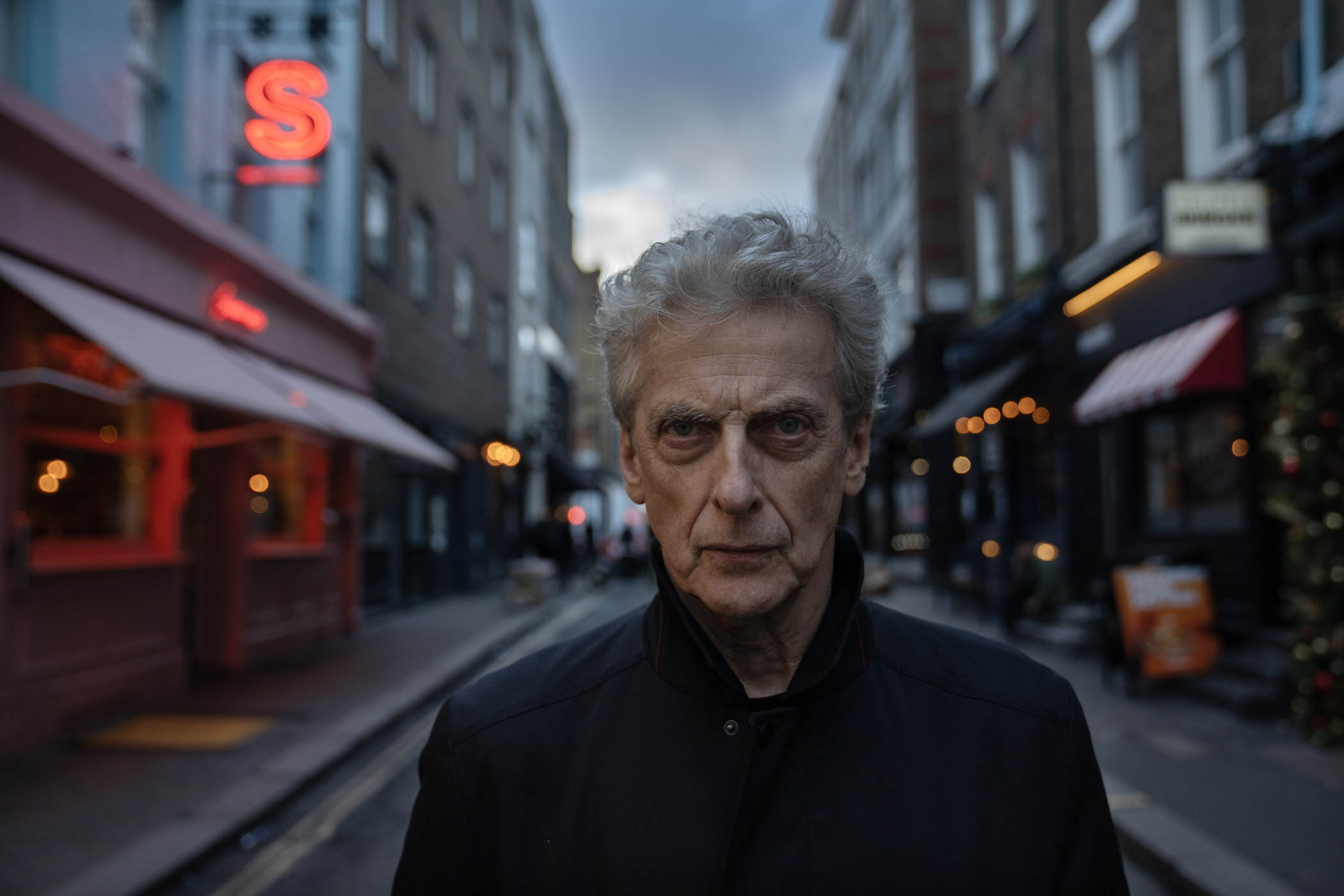
Portrait by Tom Pilston for The Observer
Sometimes the right sort of backdrop, one familiar from the past, is hard to find again. The landscape has altered and you struggle to find your bearings. Sometimes you don’t even know what you’re looking for. When Peter Capaldi set off through London’s Soho last spring to shoot a cover image for his album Sweet Illusions he searched for somewhere suitably gritty.
“I couldn’t find the sort of scuzzy place I wanted. In the end the photographer, Ray Burmiston, who I’d worked with a lot on Doctor Who, took me sitting in a bus shelter outside the old Saint Martin’s School of Art building.
“It worked, because during one of the longueurs in my career, when things weren’t going too well, I went along to a fantastic term of life drawing classes there.”
The album, released last year, consolidated Capaldi’s return to music – a return sparked by meeting guitarist Robert Howard (Dr Robert from the 1980s band the Blow Monkeys) – and heralded a live tour that will now take him across Britain. Howard encouraged the actor to make music again, and produced his latest album and 2021’s St Christopher.
Music was at the heart of the formative years Capaldi spent in London, keen to hit the big time with his first band, the Dreamboys. Back then, in the early 1980s, the young singer and frontman roamed the shady streets bordered by Tottenham Court Road, Oxford Street and Leicester Square, thirsty for a break. “I wouldn’t mind some of my ashes being spread here one day,” he says, as we retrace his youthful steps, “and perhaps some in Crouch End, where I lived a long time, and in Glasgow. And maybe Venice.”
The Scottish actor is best known for playing those twin totems of British pop culture: the 12th Doctor and the fiery Malcolm Tucker in The Thick of It. His stint in the Tardis won him an audience of millions, while the political sitcom won him a Bafta. Although he was born and raised in Glasgow, he had two distinct runs at Soho life as a young adult, establishing an affinity with the area that starts and ends with his love of music.
“The initial wave was trying to be a pop star. I’d come down armed with cassette demos and trail around the music labels,” he says. Sometimes his fellow band members would join him, like drummer Craig Ferguson, who later became a talkshow host in the US. “We would go to a telephone box in Soho Square and phone up all the record companies. This is where all the business was then, and later I would be here on stage, or in a recording booth inside a little studio doing a voiceover.”
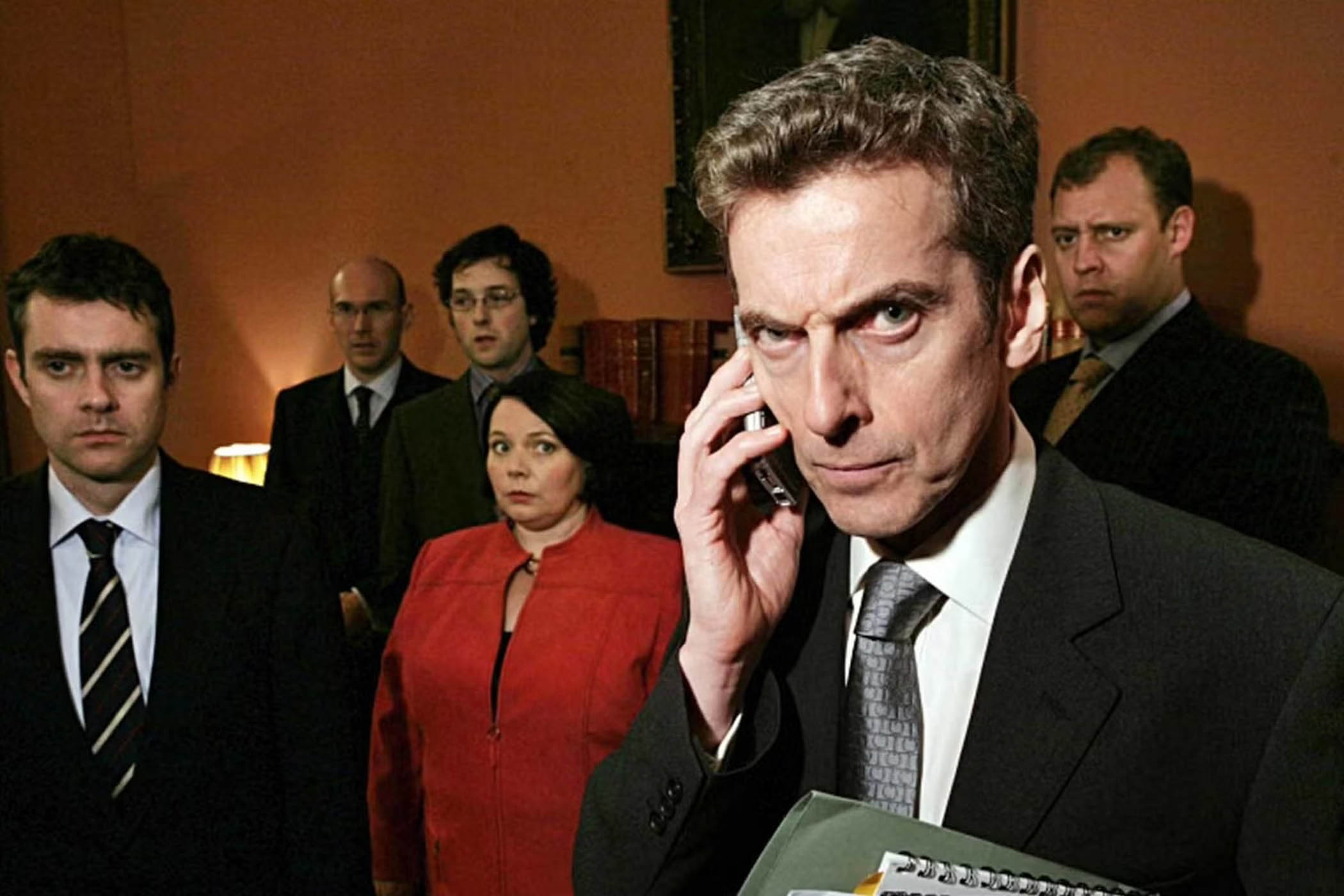
Peter Capaldi as Malcolm Tucker in The Thick Of It
As the winter light dims, Capaldi, 67, turns up the collar on his dark overcoat and strides ahead through streets that have – despite cigarettes and chewing gum – otherwise rather cleaned up their act. “I have spent most of my professional life here, one way or another, but it was much grubbier back then. I watched the wonderful Neil Jordan film Mona Lisa the other day, and there are scenes in Soho in it, where Bob Hoskins goes looking for a lost girl. They shot it on location and there were fluorescent pieces of card stuck up everywhere with things like “Danielle, French model, top floor” written on them in marker pen. I feel less at home here now, because it’s all been tidied up and commercially branded.”
The films Jordan made in the late 1980s, along with John Mackenzie’s London thriller The Long Good Friday, remain favourites. “They were beautifully shot and romantic somehow. There was a sadness and melancholy to them.”
Newsletters
Choose the newsletters you want to receive
View more
For information about how The Observer protects your data, read our Privacy Policy
Our plan is to wind our way to the 100 Club, a fabled music venue on Oxford Street. It is where the Dreamboys long ago supported Scottish band Altered Images. It is also, rather aptly, the venue of the final date of Capaldi’s new tour. Even better, he tells me gleefully, a second night has just been added because the first sold out. Most of the landmarks on our stroll, however, will date from his second assault on the English capital – his years as a wannabe actor.
First port of call is the Angus Steakhouse near Leicester Square, where his visiting parents, Gerald and Nancy, bought him dinner when he was cast in his first play. “I was down here to make my name as a fresh-faced actor, having already failed as a fresh-faced pop star. My parents, who were not very well travelled, sweetly made the big trip from Glasgow with my sister to come and see me. I wasn’t even on in the West End.
“It was a production of Dracula, starring Daniel Day-Lewis, at the old Half Moon Theatre in the East End. I was playing Jonathan Harker. When I came off stage, Daniel, who was brilliant, said to me, ‘I know where your parents are sitting because they are the only people in the audience who aren’t looking at me.’ He was right, because they were quite taken with their son,” Capaldi says, with an affectionate smile. “Anyway, my father, rather movingly, wanted to take me for a slap-up meal later. He had looked up the steakhouse. It wasn’t a world they were used to at all.”
‘I was never part of “dark Soho”, but it was there as a background, a flavour’
‘I was never part of “dark Soho”, but it was there as a background, a flavour’
Unlovely Leicester Square also means a lot to Capaldi. He met and fell in love with his wife, the producer Elaine Collins, while they both worked on a show that ran at the nearby Donmar Warehouse. On their way home on Saturday nights they would pick up early editions of this newspaper in the square. Close by, on Frith Street, Bar Italia is still going strong. “That was the place! Thank god it survives. I was looking for an identity then, but even though I had Italian heritage on my dad’s side, I didn’t really know what coffee to order.”
Soho was where a cohort of young acting hopefuls were sent to auditions, he recalls. “You would go up a rickety staircase to some little room and find to your horror that all kinds of other more successful, tall, pale actors were there too.”
After keeping up with his purposeful pace on my bespoke tour, I’m glad when we suddenly stop at the Greek Street doorway of the Coach & Horses. This pub, surely a pin-drop on any map of the demimonde, is where the first of a steady flow of Capaldi fans approach. The star gamely acknowledges them and poses for selfies before we step into the crowded bar. “I was never part of ‘dark Soho’, but it was there as a background, a flavour,” he tells me, with a desire to convey his meaning that has, happily, nothing of the ferocity of Malcolm Tucker making a point. “I was quite frightened of going into such a famous pub, especially because, as a geek, I knew that Tom Baker, then the Doctor, used to come here. He was part of the whole Jeffrey Bernard/Francis Bacon set. Important for those aspiring to be louche.”
Capaldi once parodied the Soho scene in his spoof documentary The Cricklewood Greats in which he invented a club called the Hokey Cokey, “because when you were in you were in, and when you were out…” Back then, he says, he wished he could just “metamorphose” into the actor John Hurt, who seemed to him a perfect confection, with “a Keith Richards rock star thing, at the same time as a kind of Paul Scofield quality. He had all the bases covered.”
The young Capaldi clearly had an urge to push at closed doors and it seems to have fuelled his creative drive. “I only went to art school in Glasgow because I didn’t get into drama school. I was rejected, so my art teacher asked if they could have a look at me, because I’d missed the admission dates. They let me in and it was the best thing that could have happened. It was a way more delightful, constructive place to be. In fact, we looked down our noses at the drama school kids, who were rather staid.”
Later, in London, he “was kicked out of the music fraternity”, and so tried acting. But this also proved “a whole other world where I didn’t really know anybody”. He tried to “reinvent” himself in an England that was very different to home. “I mostly remember feeling my days were numbered because there were a lot of people clearly more talented and already more famous than I was. There was a stark class difference. I felt I stood no chance.”
The old wounds are evident as his eyes flash with remembered disappointments. The sense that the cards were stacked against him has left its trace, despite success and the passage of time.
“Unfortunately, it was assumed that other actors who spoke standard English could do any other accent, whereas if, like me, you were Scottish, that was all you could do.”

Peter Capaldi as the 12th incarnation of Doctor Who
It was, he agrees, a matter of doggedly betting against the odds. “But when you are young you throw yourself into things just to see what happens. And it worked, because by falling into playing music, I ended up supporting Altered Images, which was fronted by Clare Grogan, who had starred in Gregory’s Girl. Bill Forsyth, who directed it, used to come along to the gigs, so that’s how I got to know him and that’s how I got a part in his film Local Hero – such a break!”
Although acting jobs were sporadic, Capaldi featured in two cinematic classics of the era, not only Local Hero but also Stephen Frears’s Dangerous Liaisons.
After a pause for a photo with a couple of women out on a birthday treat, a small group of English schoolgirls in tartan kilts draws near. One says she recently began watching David Tennant as the Doctor and has now got up to Capaldi’s episodes. He smiles. I could already have testified to his warmth when handling his public, because my younger son, a fan, once received a kind, amusing note from him in the post, complete with a little sketch of a Dalek.
As the street lights begin to twinkle, there is brief concern that we have not yet visited the Gielgud Theatre on Shaftesbury Avenue, where the actor starred in The Ladykillers just over a decade ago. One of his fondest memories is of a parcel from Italy sent to him there. “Inside it was a huge, beautiful cheese from the mayor of Picinisco, the village my grandfather came from. It was to celebrate a son of Picinisco making it to the West End stage.”
The small town in the Comino Valley is the ancestral homeland for several Scottish-Italian families, not just Capaldis like Peter and his famous second cousin once removed – Lewis, the singer.
In Wardour Street, Capaldi directs my eyes up to the Hammer House sign, an emblem of the great days of British screen vampires, cavorting under flickering chandeliers. “I love horror,” he explains. “I was a huge devotee of the Hammer films of the 1960s and 1970s. When I was doing Local Hero my screen test was at Bray Studios, near Windsor, where they were made. I immediately recognised the forest around there as Transylvania.”
‘When you are young you throw yourself into things just to see what happens. And it worked’
‘When you are young you throw yourself into things just to see what happens. And it worked’
Soho Square still looms large for the actor. It is steeped in the history he loves. Once a London home for the 18th-century Scottish painter Allan Ramsay and today for Paul McCartney’s business, in the 1980s it was HQ for Sony Music, where he remembers “some very unfruitful and depressing meetings”. On a corner stands the House of St Barnabas, former home of a non-profit members’ club Capaldi helped to found, on the instigation of Richard Strange, frontman of the 1970s punk band Doctors of Madness.
“We put money in because it was about helping homeless people. We wanted to give people a chance by working there. It was a welcoming and positive place that wasn’t drenched with Soho elites from the advertising and music worlds. I was really sad when it closed last year.”
We leave the square to the sound of Hare Krishna bells and pass, on our way to the 100 Club, an alley above which Capaldi auditioned for The Thick of It. “The places we’ve been to have changed my life and the 100 Club is still a great venue. My music now is just for fun though. I take it seriously in the sense of giving time to it, but don’t expect anything,” he says, with a confident shrug.
For someone with no expectations, he’s doing pretty well: last summer he joined Franz Ferdinand on stage at Glastonbury. “There is no ambition attached to it for me now though. I have musician friends who have given their life to it, to all the ups and downs, so I don’t think I’m suddenly the same. I’m not going to be some Johnny-come-lately.”
He’s no such thing; he’s just come full circle. When Capaldi stands before the 100 Club crowd again in early March, he will be reclaiming a lost prize, first glimpsed on these Soho streets.
Peter Capaldi Live is on tour nationwide from 24 February - 9 March; myticket.co.uk
Image courtesy BBC