Listen to the Slow Newscast for more of Jay’s story
The boys had been drinking for some time. It was a Saturday night in early 2024 and they had travelled from their homes in the middle of Scotland to a holiday cottage in the Lake District. By the early hours their talk had drifted, as their talk often did, from religion to philosophy and back with increasingly slack coherence.
Such nights were nothing new. The boys liked to drink and they liked to talk. They were all recent converts to Orthodox Christianity, which had given structure and meaning to what they’d grown to see as aimless lives. Jay Fraser had long struggled with his identity. The 23-year-old had grown up in a middle-class family in Dunblane, the genteel commuter town in the Scottish central belt. Fraser had always been academic, part of a small friendship group with a penchant for YouTube and online gaming. After a term studying chemical engineering at university in Glasgow he had dropped out, citing boredom and a desire for something more hands on.
What came next was luck: a Facebook advert for an apprenticeship at Tennent’s, the vast brewery in Glasgow’s East End. Competition was fierce, with more than 2,000 applicants for just two places. It was difficult to imagine a better job for an 18-year-old. Free beer, good hours, a generous wage. But as the years passed, the job’s comforts began to feel like a trap. In late 2023, he abruptly quit.
By then, Fraser’s views had hardened. He was embarking on Russian lessons and had taken to describing the war in Ukraine as an existential clash between the manly east and irrevocably corrupted west. But no one present was quite prepared for what Fraser would reveal on the first night of their Lake District getaway.
For Paul, it has never felt quite real. “We were all sitting around having drinks and he said: ‘Look, guys, I’m leaving. I’m going to fight [for] Russia.’ I was like: yeah, whatever, man. I thought he was pulling our legs.”
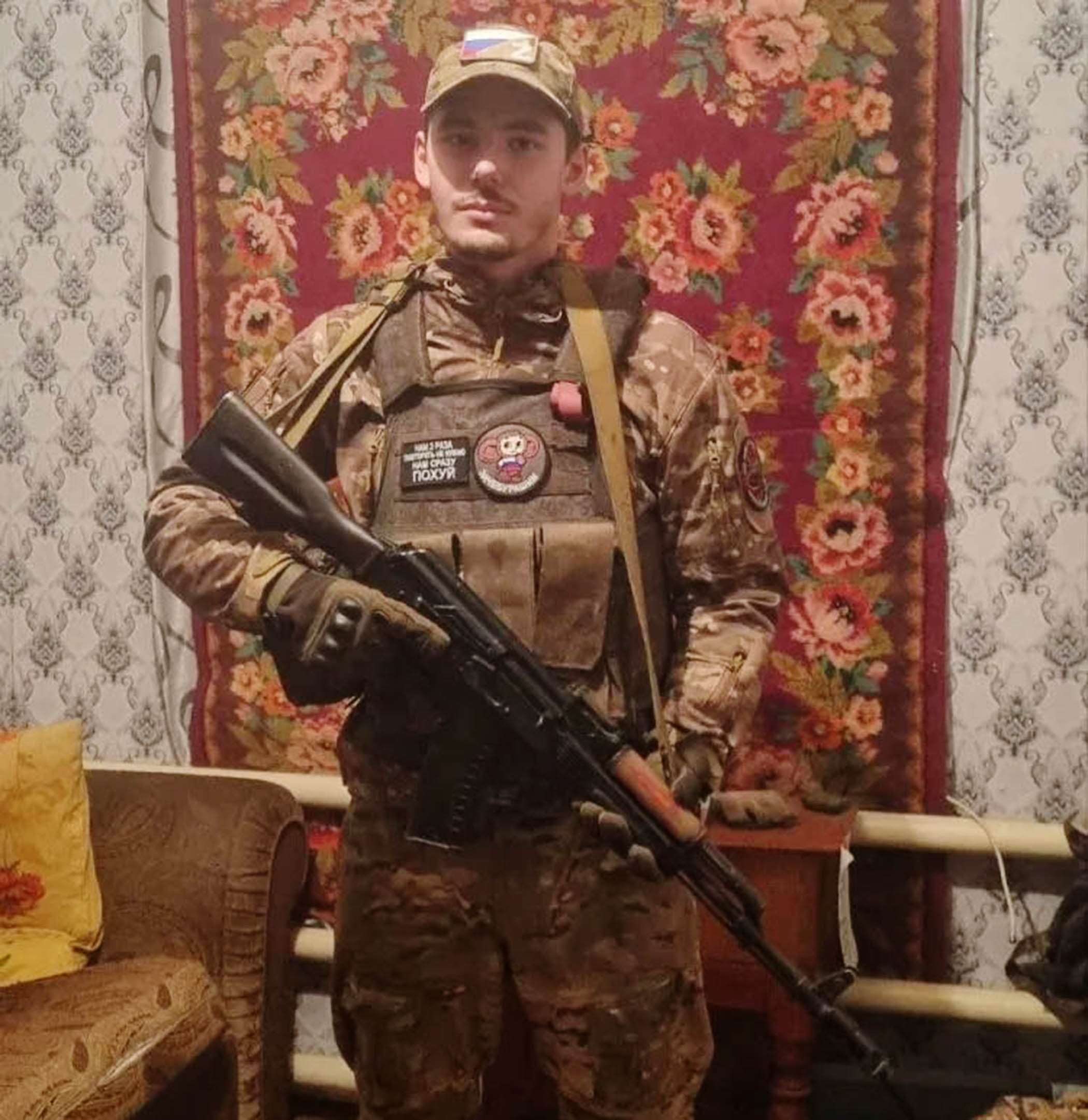
Jay Fraser, who visited Moscow for the first time in 2023 and eventually left home in Scotland to join an international unit fighting for Russia in Ukraine
Weeks later, Fraser was gone. On the first night of his deployment in an artillery unit, he found himself in a Ukrainian forest, mired in shin-deep mud. Overhead a kamikaze drone stalked him through the trees. Death has become familiar over the intervening 16 months. There have been regrets and bitter nights. He has been labelled a traitor by the British press and celebrated as a hero by Russian state media.
No one, least of all Fraser, knows what the future might hold. What is certain is that he was not the first British citizen to have taken up arms for Russia after its full-scale invasion of Ukraine began four years ago. Neither has he been the last.
Most who have left this country to fight have chosen the other side. Somewhere between 2,000 and 3,000 Brits have since signed up for Ukraine’s International Legion, the biggest volunteer mobilisation of its type since the Spanish civil war. Several dozen have been killed, including a former sales manager from Bristol and a psychology undergraduate from Birmingham, as well as British army veterans who had toured in Kosovo and Iraq.
No one is sure how many British citizens have travelled to fight for the Russian armed forces since 2022, though the closest estimates, including those from several of the men themselves, put it somewhere in the double figures, to go with the hundreds of “first wave” volunteers that signed up for Russian militias in the Donbas during the beginning of hostilities in 2014.
Newsletters
Choose the newsletters you want to receive
View more
For information about how The Observer protects your data, read our Privacy Policy
It did not take long for Fraser to be unmasked in the British tabloid press. In late 2024, the Sun published a piece on “Putin’s Pint Puller”, its content almost entirely cribbed from a series of videos that had been posted on Russian social media channels. They showed a smiling Fraser in full military gear, nodding along shyly to questions from his unseen interlocutor. Why was he here? Values, Fraser replied, were what he had come to fight for. “Eastern civilisation is the correct one. And, accordingly, I have decided to take a direct part on your side.”
‘I don’t particularly agree with what I’ve done now. Guilt, I suppose, is the word attached to that’
‘I don’t particularly agree with what I’ve done now. Guilt, I suppose, is the word attached to that’
Jay Fraser
At first, Fraser did not seem much bothered about the resulting outrage in his homeland. On X, where he has been a prolific and aggressive poster, he has bragged of over 10 confirmed kills and vowed to put an end to any British soldiers he encountered on the Ukrainian side. “You keep sending your British army lads over here… we’ll keep sending them back in boxes,” he exclaimed in a video addressed to the Sun.
It was a surprise when Fraser agreed to speak to me at the beginning of this year. He is currently stationed near Donetsk, though he has also been in Bakhmut and completed several rotations in Kursk, at least until “the North Koreans came and took our jobs”.
As time passed, Fraser began to speak to me with disarming frankness. He described the occasionally slapstick details of his journey to the frontline, as well as the step-by-step disintegration of his homespun philosophy. Fraser said he holds few illusions: the life he once knew is shattered beyond repair. This, he readily concedes, is no one’s fault but his own.
Fraser’s upbringing offers partial clues to his trajectory. His friend John agreed to meet in the lobby of a budget hotel on the fringes of Stirling city centre. John is not his real name. Like almost all of those who knew Fraser from back home and were willing to speak, there was still considerable worry about the potential consequences. If John wanted to talk, it was only to do what he saw as justice to the complexity of his old friend’s character.
The year 2020 was an important one for the boys’ friendship. “ We were both sceptical of the lockdowns. That was something we bonded over,” John explained. “A lot of our friendship was playing video games and drinking. That was a big part of it.” They also shared a growing alarm at the zealously liberal society they thought they saw forming around them.
It was a shock when Jay revealed his regular church attendance. Growing up, both had considered themselves committed atheists, John said. “I was intrigued and went along to see what it was like. It seemed like such a strange thing to do… And that [then] became a big part of our friendship. Going to church every week and being part of the community.” In June 2022, the boys were baptised in a tiny Greek Orthodox church in Dunblane.
They were not alone in their religious fervour. Orthodox Christianity is increasingly popular among young men across the west. During the last half-decade, a rapidly growing number of young converts have been drawn to the masculine certainties of the faith, in opposition to what they see as the increasingly feminised societies around them.
In the winter of 2023, Fraser visited Moscow as a tourist for the first time. After years spent dreaming of Russian purity and otherness, the city’s normality came as a shock. There were even bars serving Brewdog beer. Back in Scotland, Fraser told his closest friends what he had to do. By early summer, he was back in Russia, travelling from the beaches of Sochi to rural Siberia.
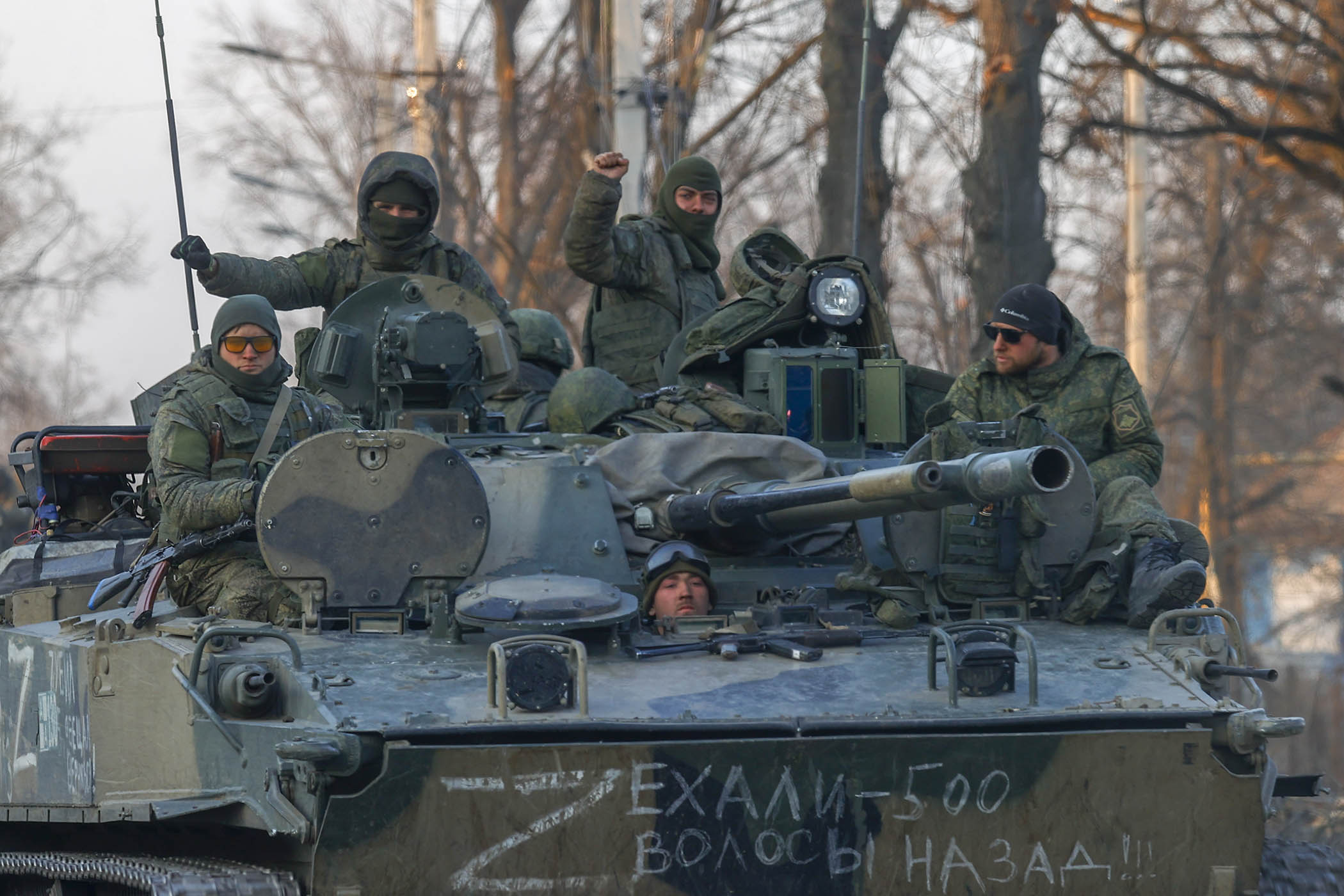
Russian troops patrol Volnovakha, a pro-separatist area of Donetsk that has been under Russian control since March 2022
After several rejections by military recruiters, Fraser found himself chatting on Telegram to a young American Orthodox convert who was also in the process of signing up. He asked if Fraser had heard of the Pyatnashka Brigade, the international volunteer unit that had started life in Donetsk in 2015. Fraser was eventually connected with a recruiter, who presented him with several options, including drone and tank divisions. Fraser preferred to be sent to a storm infantry unit, to the heart of the bitterest fighting where life expectancy could be measured in days, rather than weeks.
His handler did not understand. No one had ever asked to be sent to storm. Fraser settled on artillery as a grudging compromise. He was given several days to observe life at base before being presented with a contract. If Fraser was certain, he could sign. He had rarely felt as sure of anything in his life.
Fraser’s disillusionment did not begin overnight. When his early battlefield death did not materialise, he was forced to reckon with his choices. The truth was that he had harboured a death wish: Orthodoxy and culture war talking points had only served to retroactively justify it. It did not take long for the ideological scales to fall away. Russians, it transpired, were just as flawed as anyone else.
When Fraser began a Substack detailing the realities of life at the front, he was quietly advised to delete it by his superiors. “I went down the path of telling the truth and it didn’t turn out so well. People do not like to hear that things are not all sunshine and rainbows.” His social media bravado is, he argued, little more than a character, built to please his modest online following. “I have a reputation to uphold and an audience to appease.”
Fraser had joined a Private Military Contractor (PMC) group, rather than the regular Russian army. Flexible and comparatively relaxed – often with better options in frontline placement – they have one major drawback in comparison with the regular army: they do not typically offer a road to Russian citizenship. This is not too much of a problem for a Chinese or Colombian fighter assured a legal return to their homeland. The same is by no means certain for a Brit.
British volunteers fighting for either Ukraine and Russia are both bound by the 1870 Foreign Enlistment Act, which makes it illegal for British citizens to enlist in a foreign army at war with a country at peace with the UK. No one, however, has ever been prosecuted under it. For Fraser and his comrades, the real issue is more modern. Section 40 of the British Nationality Act 1981 gives the home secretary the right to revoke citizenship if it is deemed “conducive to the public good”. It was, most infamously, applied in 2019 to Shamima Begum, the British-born teenager who left the UK to join Isis in the mid-2010s. In January, Mark Bullen, a former Hertfordshire police officer, had his citizenship stripped, having spent the last 11 years living in Russia.
Fraser’s constant proximity to death has, he said, at least put life into perspective. There is little self-pity. All responsibility, he acknowledges, lies with him alone. There are two months left on his current contract. He does not plan to renew.
Post-military life remains uncertain. If he were to return home, the reality is prison or pariah status, if he is even allowed past border control. In Russia, his prospects are not much better. The support of his fellow foreign fighters will be important. “Being in a conflict for so long can affect people. I don't particularly agree with what I've done now. Guilt, I suppose, is the word attached to that.
“You're never going to spend your last moments, bleeding out in the snow because a drone finally caught you at the wrong time, thinking about politics or ideology… in the end it's about those you love and the time spent with them.” The truth, Fraser added, is that choosing death was a lot easier than learning how to live.
Listen to the Slow Newscast for more of Jay’s story
Photographs by Russian Defense Ministry/Handout/Anadolu via Getty Images, Sefa Karacan/Anadolu Agency via Getty Images