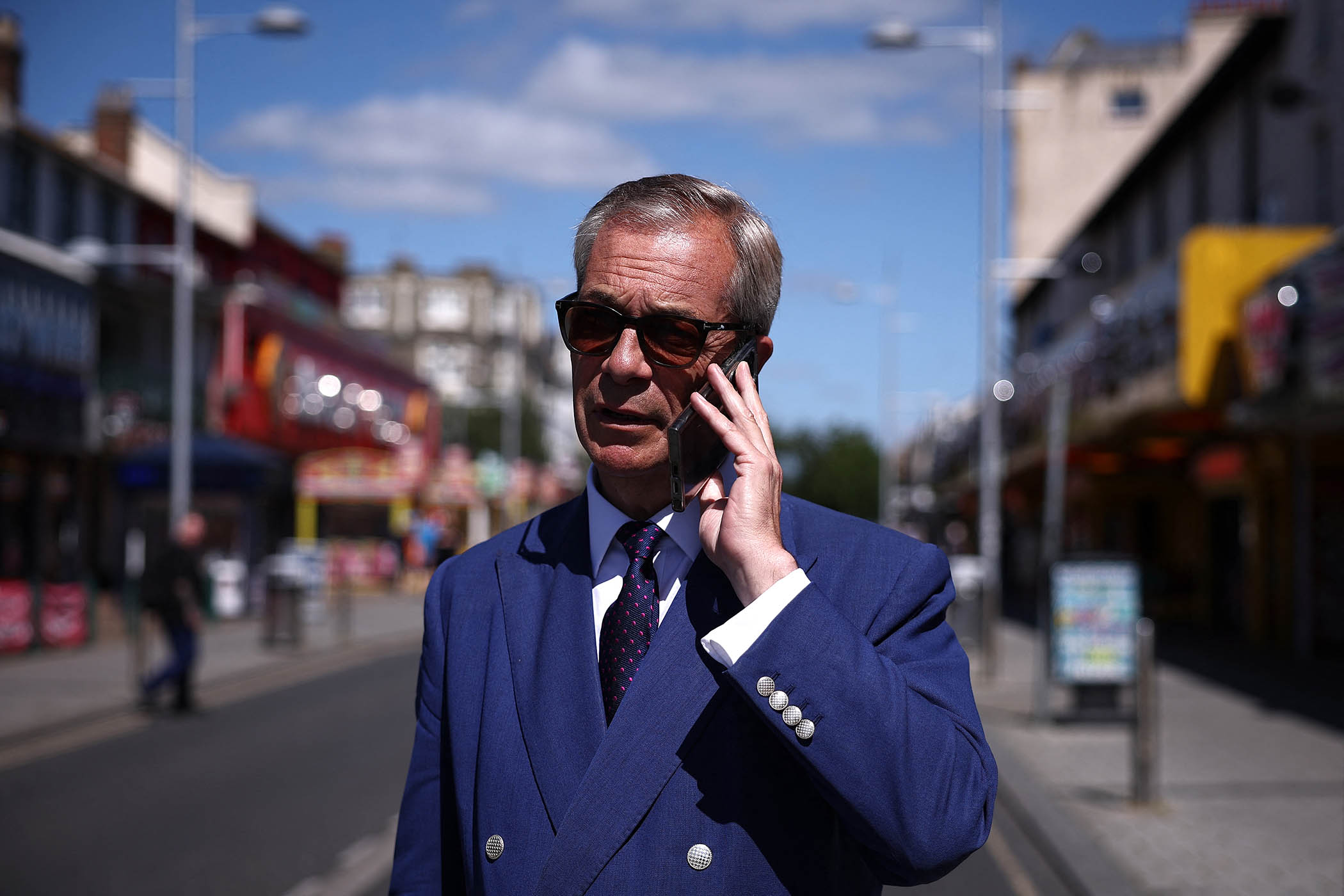


Stack BTC was almost unheard of until a few weeks ago, when the small company announced that Nigel Farage had bought shares in it worth about £215,000. If Stack performs as well as its owners hope, that investment will hand him a profit of millions of pounds in as little as two years.
The company is what is known as a bitcoin treasury, set up to buy and hold bitcoin. It is part of a cryptocurrency industry whose profits, experience shows, tend to rise as regulation gets lighter. Farage is the UK’s most prominent advocate of lighter crypto regulation.
Today, Farage owns about 5.5% of Stack. He can boost the company and talk up its share price, as he did in a video last week. He can tell the crypto industry, “I am your champion”, and describe the UK’s legislation of crypto as “ludicrous” – as he did, to applause, at a cryptocurrency conference in London in October – and as long as he says those words outside the House of Commons, he will not be in breach of parliamentary standards. He can potentially make himself a small fortune, trading on his position in public life, without breaking any laws.
There is no guaranteed payday for Farage. A startup like Stack needs luck as well as judgment to succeed. It could easily fail – but even if that happens, Farage’s critics believe he has already overturned decades of established thinking about conflicts of interest. He has been accused of importing into the UK one of the ideas that have made Donald Trump and his associates rich while he has been president – that as long as you do something in plain sight you can convince the world there is nothing wrong with it. He may be the first British politician to profit financially from the power and status of the office of prime minister before he has even occupied it.
Farage’s first investment of £215,000 in Stack on 9 March did not go unnoticed. It came hot on the heels of news that the crypto billionaire Christopher Harborne had given Reform UK £3m in late 2025, on top of the £9m he had donated three months earlier. The extent of Reform’s reliance on fortunes made in crypto was writ large (and larger still, subsequently, when another cryptocurrency billionaire, Ben Delo, announced his own £4m donation).
Against that backdrop, Farage’s investment in Stack is a personal one; it is unequivocally his own money, the company told The Observer, and at his own risk. It came with two privileges that were not available to everyone.
First, Farage bought his shares at a discount of about 20% on the market price (a corporate investor bought a much smaller number of shares alongside Farage and got the same rate).
Stack’s CEO, David Galan, seemed surprised that the discount has raised eyebrows. Farage, he said, is a “strategic investor”, the kind of backer who often gets preferential terms. “The reason we want Nigel involved as a shareholder is because it raises the profile of the company, and for small companies that are just launching you want to have a high profile. And that’s exactly the reason that Nigel came in.”
‘Stack has not paid one pound to Nigel. That was never the intention – and it never will be’
‘Stack has not paid one pound to Nigel. That was never the intention – and it never will be’
David Galan, Stack CEO
The second incentive given to Farage was a way to cash out. Stack issued a “warrant” that allows him to sell his holding if the value of the company exceeds £100m on five consecutive days. It is the warrant, more than the discount, that watchers of the crypto industry find extraordinary. In part because it quickly became obvious that Farage’s ability to drive up Stack’s share price – and push the company’s valuation closer to the level at which he can take his money out – is exceptional.
The day before Farage declared his involvement in Stack its value (the total of all its shares in circulation) was just under £4m. The share price doubled on the day he invested, and today the company is valued at about £8m. On paper, the shares Farage bought for £215,000 in March were worth about £400,000 when the market closed on Friday. He bought a smaller tranche of shares later, taking his overall holding to just over £450,000.
“There’s a hell of a lot to do” for Stack to reach a valuation of £100m, Galan told The Observer. It might never happen and, even if it does, “being very realistic, it is going to take a couple of years at least to get to that point. That would be impressive.” Other players in the crypto industry agree: impressive but by no means impossible.
A promotional video released last week seemed to mark a real break with the conventions that have governed MPs’ conflicts of interest in the past. It stars Farage and Kwasi Kwarteng, the chancellor of the exchequer who oversaw the economic disaster that undid prime minister Liz Truss, and who is now executive chairman of Stack. “The company’s really starting to get moving,” said Farage. Kwarteng agreed: “This is only the beginning of a great journey.”
Galan could not be clearer: “To be absolutely categorical, Stack has not paid one pound to Nigel and will not pay money for anything that he’s done, like the video for example. That was never the intention – the arrangement – and it will not be.”
Was it part of a more loosely defined role like “brand ambassador”? The co-founder of Stack is Paul Withers who also owns a gold-trading company, Direct Bullion, and has paid Farage £415,000 since December 2024 to be its ambassador. But Galan said that no such arrangement is in place.
If he was not paid for it, The Observer has asked Farage to explain why he agreed to make the promotional video. He has not replied.
Stack is not the first bitcoin treasury company to think about getting into bed with Farage, but it is the first to actually do it. The Observer asked a senior executive at one of Stack’s more established rivals how he might react if someone proposed a link-up: “Well, they have. We’ve discussed it several times. Farage is obviously very pro-bitcoin so there’s always the question of ‘can you get this guy on board… can you get him to say nice things about our company?’”. For them, fear of politicising the company outweighed the potential benefits.
Farage’s public involvement with Stack may encourage other companies to reconsider the value of political relationships. Will he be the first of many MP recruits? The barriers standing in the way are low. They rely heavily on the idea of transparency deterring profiteering by MPs, but Farage’s critics believe it is transparency that he has just weaponised.
As Elizabeth David-Barrett describes from her vantage point as director of the University of Sussex’s centre for the study of corruption, the guardrails around conflicts of interest are specific.
“There are still rules,” she said. “It’s not just that you can declare an interest and then anything goes. You’re not supposed to take payment in return for lobbying. But the definition of lobbying is fairly narrow. It is about advocating a particular matter in the House. MPs must not provide or agree to provide paid parliamentary advice. So that is basically saying you can’t take money to try and influence the parliamentary process – but within parliament, not outside.”
For Farage, the floor of the House of Commons is almost an irrelevance compared with the platform he enjoys in the digital sphere. The rules that are intended to govern conflicts of interest do not obviously apply to the world he inhabits.
Photograph by Henry Nicholls/AFP via Getty Images
Newsletters
Choose the newsletters you want to receive
View more
For information about how The Observer protects your data, read our Privacy Policy