Related articles:
Jose’s alarm blared at exactly 5am, a sound engineered not to wake but to dominate. It severed the fragile calm of sleep like a blade through flesh and bone. In the camps, mornings were not meant to be gentle. They were meant to remind you that time and truth were no longer in your possession.
It had been two months since Jose was taken by ICE – though the screens in the corridor insisted it had been three weeks. The discrepancy bothered him more than the atmosphere; he had learned quickly that memory was a liability. The truth, even more so.
His cell was painted a dim pastel green, a colour selected by some distant committee to inspire “compliance and reassurance” they would say. The paint peeled in thin, curling strips, revealing older layers beneath – grey, then white, then a darker green. History, buried and repainted. The air was stale, unmoving, as if the room itself had learned not to breathe. From the cell on the right came the stench of rot. No sound followed it. Silence, here, was never neutral. It pressed against Jose’s skull until his thoughts echoed too loudly.
A speaker crackled overhead.
“Good morning, detainees. Today is April 14, 2025. You are safe. You are protected. You are being processed.”
Jose closed his eyes. Yesterday, the voice had said it was 3 March.
Truth shifted daily, sometimes hourly. The announcements were never wrong. If reality disagreed, reality was corrected.
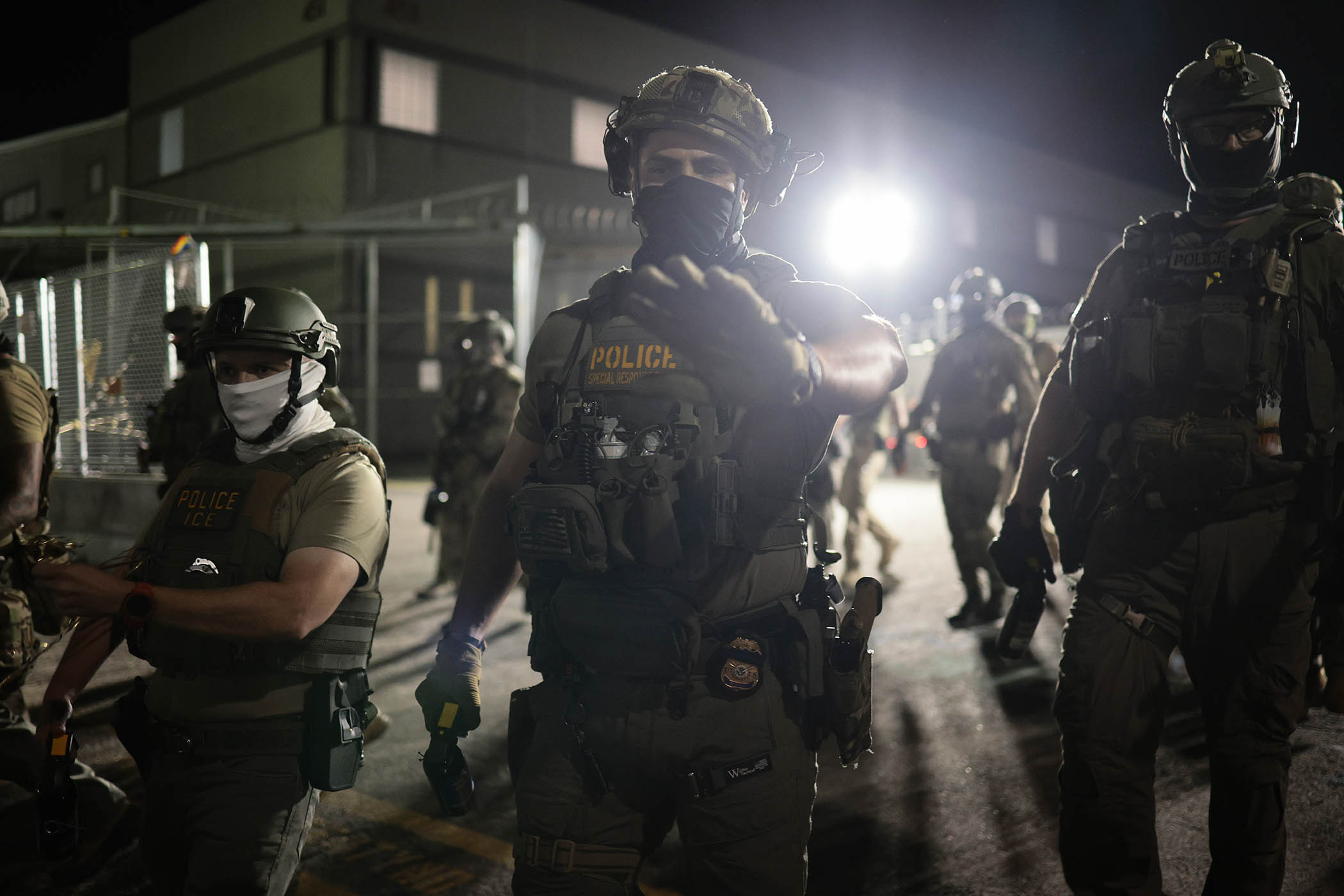
When ICE first appeared decades earlier, it was described as an agency. A function. A tool. Tools, people believed, could be put down. But after the Reclamation Act of 2025, ICE became something else entirely. A force not bound by borders, courts, or definitions. Citizenship was revised. Records were “updated”. People were reassigned origins they had never known.
Related articles:
Jose had been born in Arizona. He had a birth certificate once. He remembered holding it, creased and warm from his mother’s hands. But the terminal said otherwise.
SUBJECT: JOSE MARTÍNEZ
STATUS: UNVERIFIED
ORIGIN: UNKNOWN
“Unknown” was worse than guilty.
Each day, guards marched detainees to the processing hall, a vast white room with no corners – curves only, so sound could not hide. On the walls, screens looped the same message:
TRUTH IS SECURITY.
SECURITY IS FREEDOM.
Jose repeated it when ordered. Everyone did. Refusal was recorded as “cognitive resistance”.
The interrogations were polite. That was the most terrifying part.
“Jose,” the officer said, smiling without warmth, “do you recall entering the country illegally?”
“No,” Jose answered. He had learned not to elaborate.
The officer nodded, fingers dancing across the tablet. “Incorrect memory is common. We can help you.”
She showed him footage – grainy images of a man crossing a desert fence at night. The man’s face was blurred, but the caption was clear.
SUBJECT CONFIRMED.
“That isn’t me,” Jose said, though his voice felt thin, unconvincing even to himself.
The officer leaned closer. “Truth is not personal,” she said gently. “Truth is collective.”
Back in his cell, Jose tried to hold onto small certainties. His mother’s laugh. The smell of sopes and tostadas on Sundays. The way the sun looked against red rock. But the longer he stayed, the less solid those memories became. The screens contradicted him constantly. The guards corrected him casually. Other detainees whispered new versions of their own pasts, each one more uncertain than the last.
One night, the silence broke.
From the cell on the left came a voice. Hoarse. Fragile. Real.
“They took my name,” the voice said.
Jose pressed his ear to the wall. “What?”
“I had one yesterday,” the man whispered. “Today I’m Detainee 44109. They said names create confusion, disorder.”
Jose felt something dangerous stir in his chest. Recognition. Truth shared.
“What was your name?” Jose asked.
The silence stretched.
“I don’t remember,” the man finally said. “I think that means they’re winning.”
The next morning, the cell beside Jose was empty. Cleaned. Reset. The smell remained.
Weeks later – months, perhaps – Jose was summoned for Final Verification. This was where stories ended.
The officer smiled wider this time. “Good news,” she said. “We’ve confirmed your origin.”
The screen lit up.
STATUS: ILLEGAL
DESTINATION: REASSIGNED
Jose stared at the word “illegal”. Not person. Not human. A condition, illicit.
“That’s not true,” he said, louder than he meant to.
The room went still.
The officer’s smile vanished. “Truth,” she said coldly, “is what remains when resistance is removed.”
Two guards seized his arms. As they dragged him away, Jose did the one thing they could not process.
He laughed.
It startled them. Laughter wasn’t in the manuals.
Because in that moment, bruised and terrified, Jose understood something vital. They could rewrite records. They could erase names. They could bend reality until it snapped.
But the need for truth – the hunger for it – that lived deeper than language, deeper than law, was still his.
And as long as someone remembered that truth existed, even if they could no longer prove it, the system had not fully won.
The lights dimmed. The speaker crackled.
“You are safe.
You are protected.
This is the truth.”
Jose closed his eyes and held on to the lie that frightened them most:
That truth did not belong to power.
______________________________
The Orwell Youth Prize uses the writing of George Orwell to inspire young people aged 11-18 to write bravely and creatively about their own ideas and experiences. This year’s winning entries, selected by judges Nandana Sen, James Bloodworth, and Sophia Smith Galer from an original list of more than 1,300 entries, were announced at University College London by George Orwell’s son, Richard Blair. Their writing, published digitally in full with The Observer for the first time, ranges from intimate personal reflection to engagements with issues of censorship, propaganda and resistance.
George Orwell wrote regularly for The Observer and its former editor David Astor was among his closest friends and most important supporters. But this is also a forward-looking partnership, rooted in a shared commitment to nurturing the next generation of talented journalists. Entries for the new prize cycle will open, with a new theme, in autumn 2026, and everyone who enters before February 2027 will receive free personalised feedback on their writing.
Photograph by Michael M Santiago/Getty Images
Newsletters
Choose the newsletters you want to receive
View more
For information about how The Observer protects your data, read our Privacy Policy