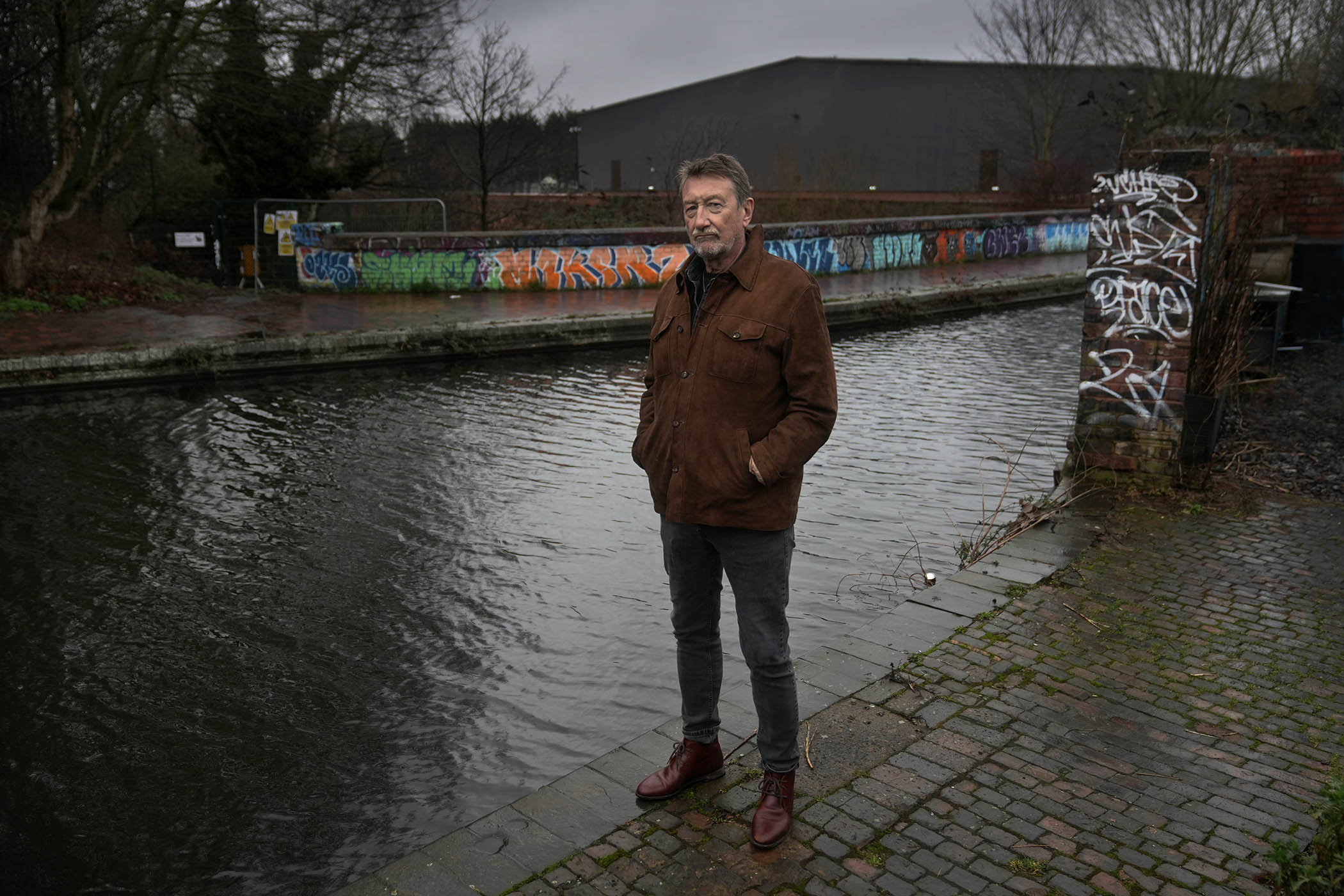


Portrait Tom Pilston for The Observer
When the flat-capped Cillian Murphy rode his big horse bareback through the streets of Birmingham in the unforgettable opening scene of Peaky Blinders, back in 2013, he was staking out more than his character Tommy Shelby’s territory. This was also, we were invited to understand, Steven Knight’s manor.
The show’s creator and writer did some of his growing up on those Birmingham streets just south-east of the city centre where his fictional Shelbys rule, and here he was laying imaginative claim to them.
Knight is recalling some of that childhood to me in another part of that stomping ground – the stands of his beloved Birmingham City FC, where 20 or 30 of his extended family would attend home games when he was a child. The boardroom bar is now named after the Shelbys’ local HQ, the Garrison Tavern (the real pub was half a mile away).
Knight loves the fact that a section of Birmingham fans have a habit of unfurling a banner on away trips: “By the order of the Peaky Blinders.”
I have to confess it’s a bit disturbing for me, looking out on this sea of royal blue seats. I’m a lifelong Aston Villa fan – fiercest neighbour and rival of the Birmingham blues – and most of my memories of coming to this corner of my home city are of Saturday afternoons in the 1980s trying to avoid getting beaten up. Knight had heard that I supported “the enemy” and couldn’t, he suggests, resist starting our walk here.
We are chatting in the dry before heading out into the sleet. Knight casts his eye around the ground and explains how he is not just a fan these days but has been heavily involved in the plans to build a new £1.2bn, 62,000 seat stadium in conjunction with the club’s American owners led by Tom Wagner.
Knight has been working with architect Thomas Heatherwick on the “nothing if not bold” new Powerhouse development – the stadium, on the site of an old brickworks, will be supported by 12 huge steeplejack chimneys.
It’s not the only thing Knight is building. Our walking route will take us from here to his Digbeth Loc film studios a mile or so away, which opened last year, and where the long-awaited Peaky Blinders movie, The Immortal Man, out this last week, was made.
The movie is a climactic celebration of what has become Birmingham’s most famous 21st century export (diehard fans range from Steven Spielberg to Snoop Dogg). It begins during the second world war with Tommy Shelby in exile from the city in a gloomy manor house in the sticks; his estranged son, played by Barry Keoghan, has taken over the Peaky Blinders gang, and has fallen in with a Nazi plot to collapse the British economy using millions in counterfeit pound notes. Only Cillian and his cheekbones can save him from destruction.
Newsletters
Choose the newsletters you want to receive
View more
For information about how The Observer protects your data, read our Privacy Policy
The story, Knight says, is based on the historical evidence of two documented attempts by the Third Reich to flood the British economy with counterfeit notes made by slave labour in the Sachsenhausen concentration camp. The Peaky Blinders’ role is believable poetic license, and allows Knight to indulge all his cinematic gifts for explosive violence and dark family emotion on a grand scale. He smiles. “We had a decent budget,” he says, “so you can play a bit.”
‘Brummies have always been quite self-effacing, always taking the piss out of ourselves. But there comes a point when you’ve got to stand up…’
‘Brummies have always been quite self-effacing, always taking the piss out of ourselves. But there comes a point when you’ve got to stand up…’
Steven Knight
Knight is a tall man, now 66. You don’t have to talk to him for long to get a sense of his big-hearted energy. The youngest of seven children, he is now the father of seven himself. He made his first fortune by coming up with the idea for the format of Who Wants to be a Millionaire? along with two friends back in 1998. He used the consequent “financial liberation” to have a crack at his dreams.
His second attempt at a screenplay, Dirty Pretty Things, won him an Oscar nomination in 2004. He has since written 20 more films including the mesmerising Tom Hardy vehicle Locke, which he also directed; his TV writing, aside from Peaky Blinders, includes SAS Rogue Heroes, House of Guinness and many more. He is a lover of understatement. When I ask him what else he has been working on, he mentions that he has just finished a draft of the next Star Wars film (though he imagines there will inevitably “be a process”). His next gig is the new James Bond movie. Is that all?
“I get up quite early,” he says.
Is he ever stuck for ideas?
“No, I mean, if necessary, I just tell myself I’m not really doing it. I’m just messing about. And also: what’s the worst that can happen?”
With this thought in mind we step out on to the rain-soaked streets of Small Heath. The genius of Peaky Blinders, for me, is the way Knight conjured old myths out of the sometimes dispiriting present day city. Growing up in Birmingham, which had suffered at the hands of the Luftwaffe and 1960s urban planners and Maggie Thatcher, you heard tales from parents and grandparents of what it had been like before all that – when it still had resonance as the furnace and engine of the industrial world; Joseph Chamberlain’s Victorian miracle.
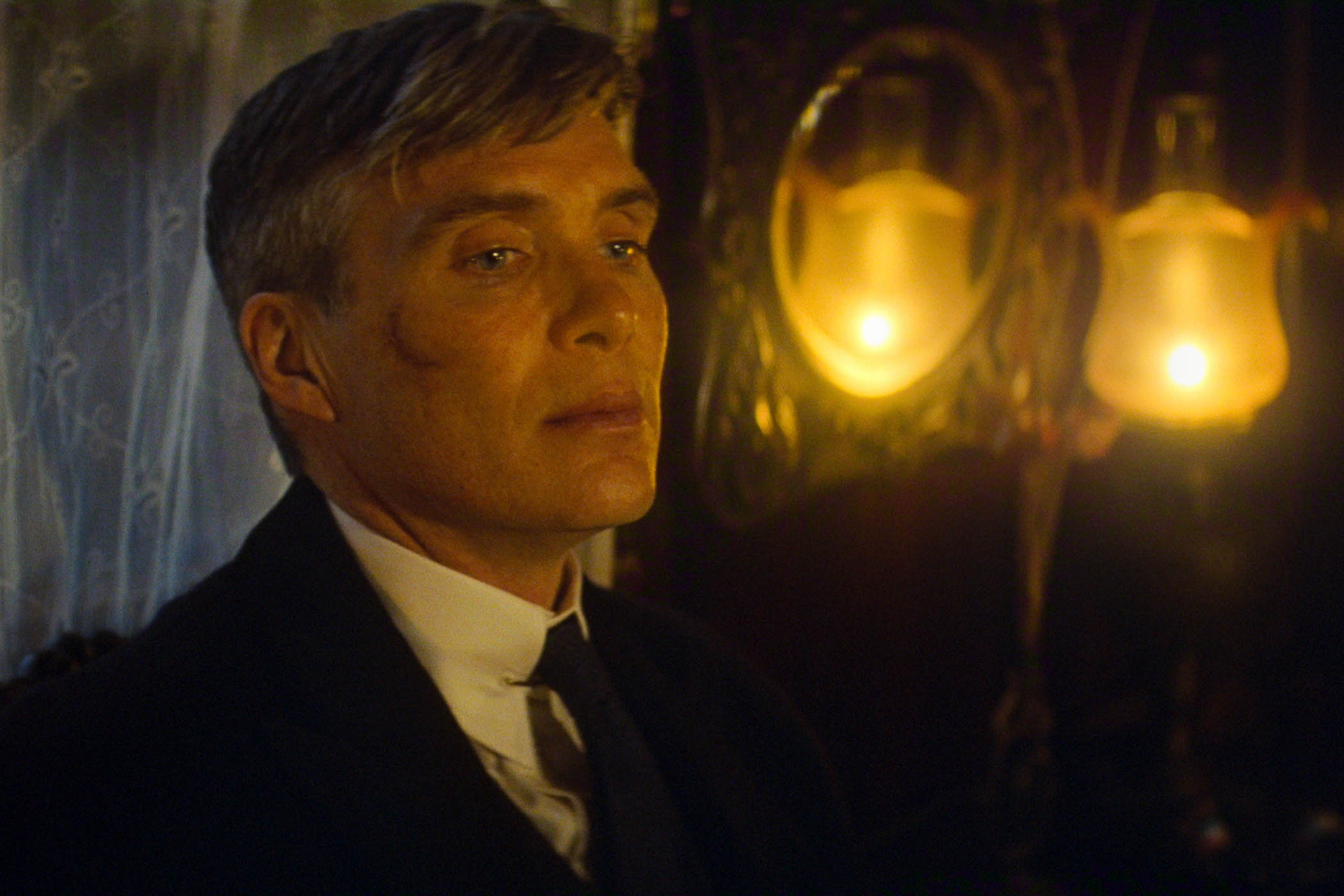
Cillian Murphy as Tommy Shelby in Peaky Blinders: The Immortal Man
Our route to Digbeth Loc passes through bits of the derelict memory of that world. Across the ring road, past waste ground green spaces and pinched housing projects, under railway arches and beside a murky stretch of canal, the streets are dotted with former industrial warehouses and small factories now rebranded as boxing gyms and discount tyre garages and nightclubs and cash & carrys.
Knight senses an older sort of magic here, though, and one that can be reborn. “It’s like a blank canvas,” he says, “which does help, in a way, because we got to find what we’re about again. Brummies have always been quite self-effacing, always taking the piss out of ourselves. But there comes a point when you’ve got to stand up...”
The new HS2 rail line, he believes, which will terminate at Curzon Street, will be a big driver of that growth. “I don’t think people have quite cottoned on,” he says. “Essentially, timewise, we’re going to be in zone five of the London Underground. When I first started building the studio, everybody was very keen not to talk about London. They’ve got that all wrong…”
‘At 18 I wanted to get to London. Working-class students were still a bit of a novelty, so UCL liked the look of me’
‘At 18 I wanted to get to London. Working-class students were still a bit of a novelty, so UCL liked the look of me’
Steven Knight
There are corners of these streets, old terraces, where you get a glimpse of the more storied past, the one that Peaky Blinders exhumes. (The opening scene of the new film dramatises the 1940 bombing of the BSA factory near here, which killed 53 people – an event I heard about from my own Dad who was, aged six, in a damp air raid shelter a mile up the road). Knight associates this area very much with his parents too.
His father had a blacksmith’s forge, originally with the contract to shoe the horses of the Co-op milk stable. “Peaky Blinders is definitely his world,” he says. “By the time I was about seven, he used to take me on his rounds shoeing the horses of the Romany families in the centre of town, the scrap metal dealers like Charlie Strong.” Some of them were distant relatives. “They were really interesting people.”
Knight was obsessed with westerns as a kid and he sensed the same rough glamour in the hard working lives of the men his dad knew. “A western,” he says, “is a film about 19th-century agricultural labourers. And yet there was this entire code of honour and chivalry. That’s what I wanted to do with Peaky Blinders.” Small Heath became his wild west.
His dad died aged 57 when Knight was only 17, but here was his way of returning to that world. “I remember going to a fairground, getting out of the van, and he said: ‘Don’t look at anybody too long here, son. Because if I get into a fight here, I’ll lose.’ I was thinking ‘What? How is my dad ever going to lose a fight? But he wasn’t wrong.’”
At scrap yards – there are a couple on our route that Knight has his developer’s eye on – he’d ask his dad if the stuff was stolen. “No,” his dad would say, “Charlie always finds things just before they’re lost.” His old man had something of that same skill.
“One day,” Knight recalls, “he brought home the plinth that had stood underneath the statue of Lord Nelson in the city centre – ‘erected by the citizens of Birmingham in 18 whatever.’ My mum was like: why? And he’d be like: why not?’” The plinth is still in Knight’s brother’s garden.
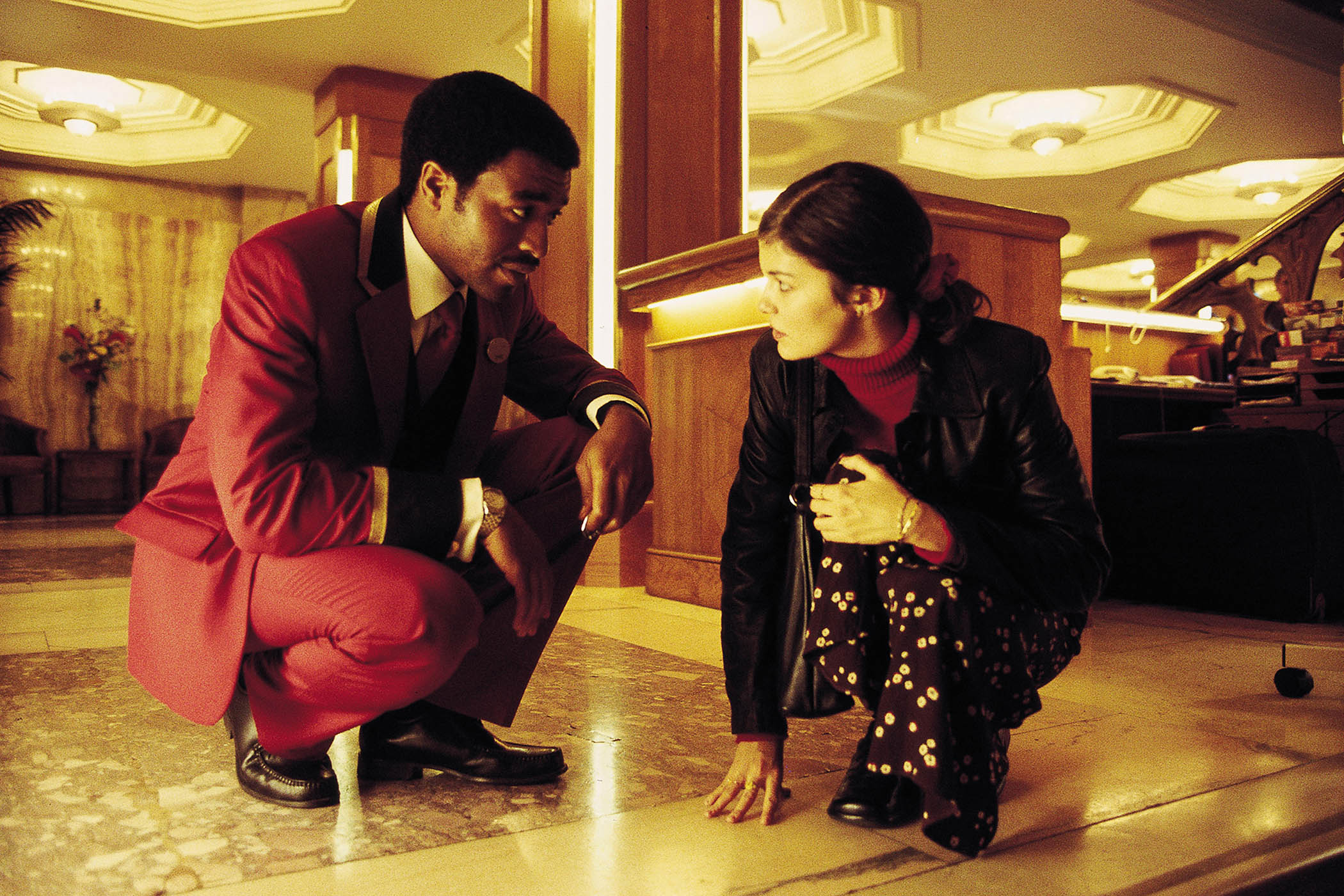
Chiwetel Ejiofor and Audrey Tautou in Dirty Pretty Things, 2002
When he first persuaded Murphy to take the role of Tommy Shelby, Knight took him for a long night out in a pub up the road. Murphy not only picked up the accent, but also the winning Brummie desperation to find a laugh in anything. Knight has a lot of good stories to tell, many about his mum, who worked as a cleaner holding down three jobs.
One of his favourites is about the time the council neglected to grit the pavements, and she solved the problem by supergluing grit to the soles of all of her shoes.
He says he learned to see the world of these streets more clearly first of all by escaping them.
Knight had a primary school teacher who told him he had a talent for poetry when he was nine or 10, and he took that to heart. “At 18 I wanted to get to London,” he says. “Working-class students were still a bit of a novelty, so UCL liked the look of me.”
He hitched down to the capital with his mate on a Guinness lorry. His plan was: get to London, give up the uni and get a job. But in the end, he stayed on.
He reckons it takes about 15 years for someone from his background to catch up with the cultural references that the public school kids he met took for granted. “You think they are smarter to begin with, but then you realise they have just been exposed to more stuff.” Once he caught up, he suggests, he just kept on going. He’d not only done the reading but he also had this deep well of stories.
A lot of them involved violence. “There’s always one person or one family in a place like this that everybody’s scared of,” he says. By now we have taken refuge for a beer in an unlikely Cuban bar, his pre-match favourite, in an otherwise broken-down street. “I used to hear stories of this bloke called Abbie in Pelsall, a place right on the border of the Black Country,” he says. “One time he came out of a pub, and a car pulled up with four Black Country blokes ready to fight. Abbie said: ‘Four on one, that’s not very fair. I’m gonna go and get me dad.’ That was agreed. So he walks across Pelsall Common and walks back wearing a long black coat. They say, where’s your dad? He pulls out a big iron bar. He says, ‘This is my fucking dad.’”
Digbeth Loc studios is just up the road. An impressive 46,000 square foot of sound studios by the canal, it’s built on the site of Knight’s father’s old smithy (of course it is). “We’re trying to do all sorts of creativity here, not just film,” he says. The band UB40 are making an album in one unit; the Royal Shakespeare Company is looking at using a rehearsal space in another. There is an ambitious plan to hire and train young local people in all various screen trades.
Birmingham City have a club song, I recall: Keep Right on to the End of the Road. Does Knight have a sense of having arrived, looking at all this, I wonder? “No,” he says, smiling, “we’re just getting going.”
Peaky Blinders: The Immortal Man is in cinemas now and on Netflix from 20 March
Additional photographs by Robert Viglasky/Netflix, The Hollywood Archive/Alamy