



At least three women have been investigated for illegally ending their pregnancies since MPs voted to decriminalise the procedure last June.
One woman was arrested in the bereavement room of a labour ward after a miscarriage when she was 17 weeks pregnant. Staff had alerted police to her case only because they were worried for her safety, and believed police would offer her “support”.
A clinician involved in her care said the woman was arrested in hospital, her home “ransacked” and devices seized, which prevented clinicians from contacting her about postnatal care. Another woman’s home was searched on Christmas Eve while she was in hospital after a stillbirth.
In a vote last June on an amendment to the crime and policing bill, 379 MPs voted to remove women from the criminal law in relation to their own pregnancy. More than 40 medical, legal and public health bodies and experts had been calling for the reform of abortion law in England and Wales after a rise in investigations and prosecutions of women.
The Abortion Act 1967 allows women to end their pregnancies under medical supervision up to 24 weeks, or beyond in certain circumstances, such as if the life of the mother is at risk or if the foetus has a serious abnormality. However, under the Offences Against the Person Act 1861, women can still be criminally investigated for ending their pregnancy outside the 24-week legal limit.
In the three years to June 2025, six women appeared in court in England charged with ending or attempting to end their pregnancy under the 1861 law, including Nicola Packer, 46.
After a four-year police investigation and a three-week trial last May, Packer was found not guilty of illegally ending her pregnancy. She said she was “not shocked” to hear police had investigated more women since MPs voted to decriminalise abortion last summer.
“It’s yet another example of the systemic misogyny and contempt for women within the police force. Even more disturbing, the police are unwilling to recognise or tackle the problem,” she said.
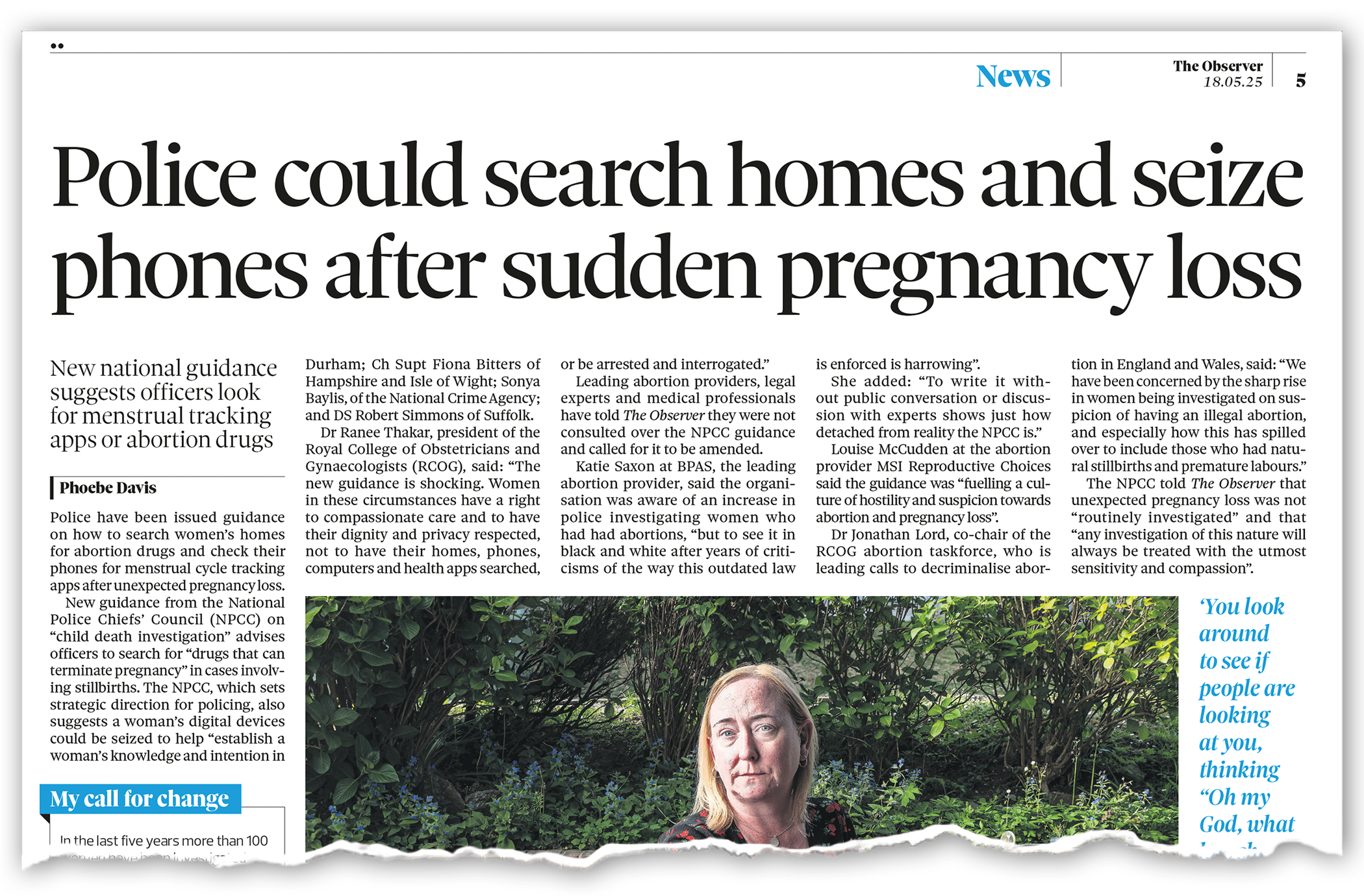
The Observer reported last May that the National Police Chiefs’ Council (NPCC) , which sets strategic direction for policing in the UK, had issued new guidance on searching phones and women’s homes for abortion drugs after an unexpected pregnancy loss. At the time, s enior medical professionals and abortion providers said the guidance was “truly shocking to read” and it was “fuelling a culture of hostility and suspicion to wards abortion and pregnancy loss”.
According to a Freedom of Information response provided to The Observer, the day after the Commons vote police chiefs met to discuss the criticism of the guidance and how officers had handled their investigations of women for illegal abortions.
Newsletters
Choose the newsletters you want to receive
View more
For information about how The Observer protects your data, read our Privacy Policy
A transcript of the meeting of the NPCC working group states that a review of the guidance prompted by the criticism concluded that the NPPC had “provided clear, balanced guidance to ensure an appropriate and sensitive police response to reports of suspected illegal abortions”.
An NPCC member said public criticism of the guidance, including from the Royal College of Obstetricians and Gynaecologists (RCOG), was “sensationalist”, “unhelpful” and “unfair”. They also noted that RCOG had called for the guidance to be withdrawn while the law was being actively considered by parliament.
However, the NPCC maintained the guidance was “sound” and stated it would “take no action that could be interpreted as comment upon the debate around abortion”. In response to the recent investigations of women, RCOG’s president Alison Wright, said: “The women affected in these cases are clear examples of the harmful implications of this outdated law.”
“Every ongoing investigation represents a failure of compassion and a breach of women’s reproductive rights, particularly as these cases often involve women at some of the most vulnerable moments in their lives,” she added.
A NPCC spokesperson said: “Police do not routinely investigate unexpected pregnancy loss. An investigation is only initiated where there is credible information to suggest criminal activity, and this would often be because of concerns raised from medical professionals.”
Tonia Antoniazzi, who introduced the crime bill amendment, said MPs had made it “abundantly clear” last year that “the criminalisation of women under abortion law has no place in modern society”.
“Yet the police have deemed it appropriate to investigate more women since. They, and the wider criminal justice system, cannot be trusted with abortion law,” she said. Antoniazzi added that claims that decriminalisation would result in a dissolving of safeguards for abortion care are “frankly, erroneous”.
Photograph House of Commons/PA