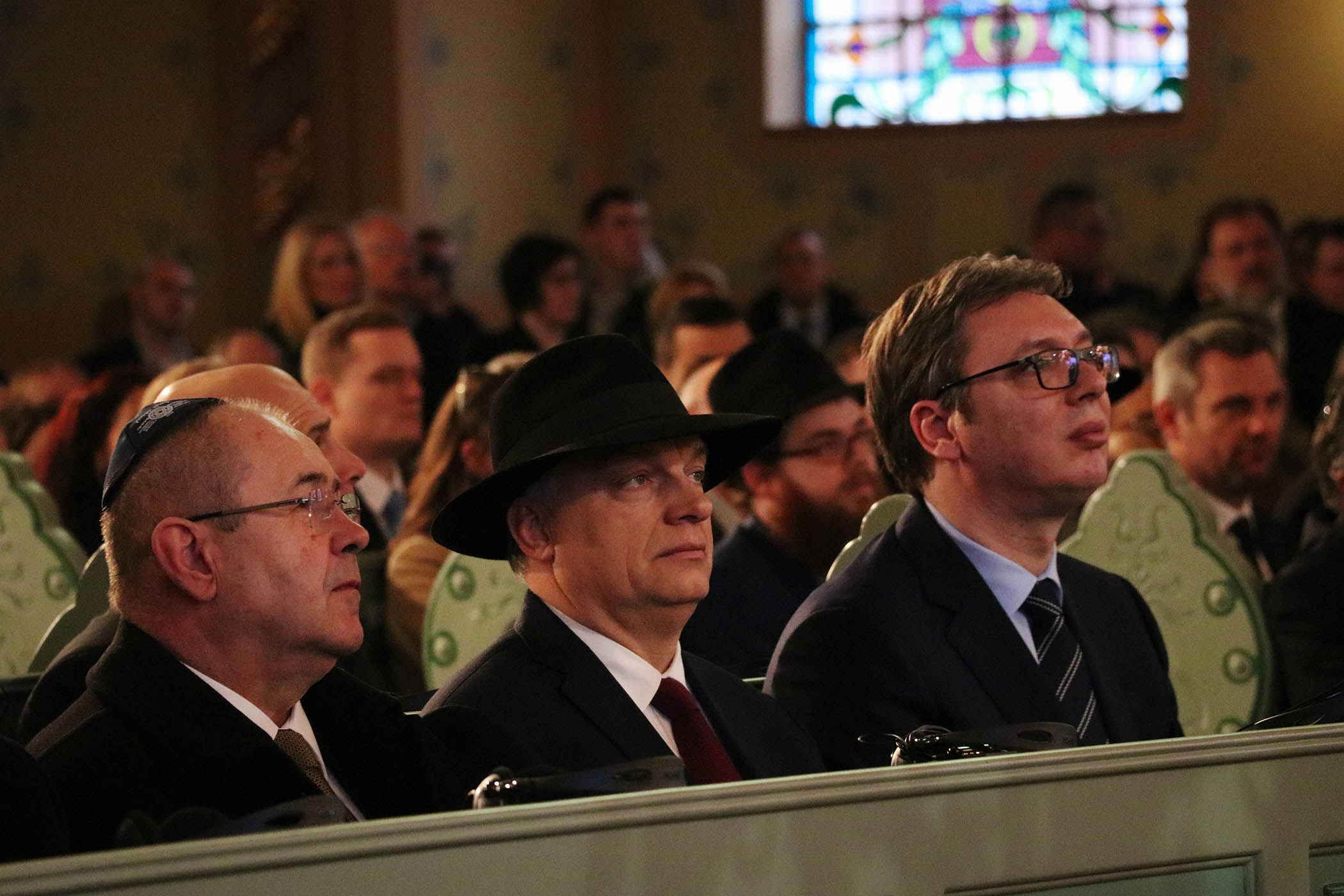
The first time I clapped eyes on Viktor Orbán, still in his pomp as prime minister of Hungary, he was processing through the second-largest synagogue in Europe sporting the wide-brimmed hat of the Chabad-Lubavitch tradition. Towering over him, at 6ft 6in, was his fellow Putin ally the Serbian president Aleksandar Vučić. The location was my cousins’ hometown of Subotica, in Serbia; the occasion was the restoration of their beautiful synagogue, long derelict after the Nazi horrors, to which the Hungarian government had contributed €2.5m.
The irony was stark. This was March 2018, two election cycles ago, and Orbán was then running the most explicitly antisemitic election campaign of the 21st century. Public enemy number one was the Jewish philanthropist George Soros, depicted on posters as a demonic puppet master coordinating a flood of migrants. Ten days before I saw him in a Subotica synagogue, Orbán used Hungarian National Day to declare war on a new enemy, a homeless race of “speculators” described in classic antisemitic terms.
But Orbán is nothing if not flexible. Across his southern border there were votes to be won in Vojvodina, a former Hungarian province now part of Serbia where 10% of the population still consider themselves Hungarian, including my relatives. Until his abrupt ejection from office last weekend, Orbán courted this population, smoothing their path to obtaining Hungarian citizenship and thus leapfrogging their ethnic Serb and Croat neighbours into the EU labour market. This meant giving them the vote while pouring cash into pork barrel projects to ensure those votes stuck with him.
One such project was the restoration of the Subotica synagogue, though attached strings meant it now serves primarily as a Hungarian-language cultural centre. There were still some Jewish voters in the room, however, so Orbán cut the talk about “globalists”. He saved the hate-mongering for his other favourite target, migrants from the Islamic world.
Through electoral politics Orbán came to power, lost power and may one day return to power
Through electoral politics Orbán came to power, lost power and may one day return to power
Orbán has always been a creature of the ballot box. Through electoral politics he came to power, lost power and may one day return to power. In the week since his dramatic ousting, Orbán’s apologists in Britain and America (many of them on his payroll, through influence networks like the Mathias Corvinus Collegium) have suggested that those of us who labelled him a “strongman” or an “autocrat” were somehow hyperbolic. As the New York Times columnist Ross Douthat tweeted: “If your entrenched ruling party can lose everything in a wave election, you are not living in an authoritarian state.”
This is bogus pleading. Over the past 16 years, Orbán has polished the Hungarian electoral process until it seemed the shiny surface could reflect only his image. By the 2026 election, 80-90% of Hungarian news outlets had been purchased by his allies, often with government loans. This led Hungarian democracy activists to take extreme measures: Nyomtass te is! (Print It Yourself!) is a movement of activists reduced to printing out and sticking up A4 sheets of independent news, samizdat-style.
Eventually, like all autocrats, Orbán presided over corruption so overwhelming that even unfree elections made clear he could either step down or see his opponents bring the nation to a standstill. As the American writer Scott Alexander pointed out last week, Augusto Pinochet lost power in much the same way – and we should have no problem labelling him a dictator.
For those of us of Hungarian descent, the promised return of media freedom in Hungary is reason enough to celebrate, whatever our caveats about the new prime minister, Péter Magyar, a former Orbán loyalist with an opportunist air. Yet he will have a daunting task to roll back Orbán’s mafia state. To understand why, we need to understand his networks in border regions such as Vojvodina.
These are the regions in which Orbán made himself indispensable to Putin, and filled local offices with Hungarians who shared his willingness to buy Russian energy. Days before the election, Orbán and Vučić claimed to have discovered a terrorist attack in Vojvodina on the TurkStream pipeline, which transports Russian gas to Hungary. The head of the Alliance of Vojvodina Hungarians (VMSZ) suggested the attack aimed “to bring down Viktor Orbán”: his group conveniently dominates the NGO that oversees the collection of Hungarian postal votes in the region. Many of its leading figures are ethnic Hungarian businessmen who owe their seed funding to Orbán’s government.
Magyar will have to tread carefully here. Already he has announced that Hungary remains committed to buying the cheapest energy sources, including from Russia, via the TurkStream. “Nothing can change geography,” he told his first press conference on Monday. He will have to work with Vučić, and with another Putin sympathiser on his borders, the Slovakian prime minister Robert Fico. If he fails, Orbán’s friends on both sides of the border still know how to work a ballot box.
Newsletters
Choose the newsletters you want to receive
View more
For information about how The Observer protects your data, read our Privacy Policy
Photograph by Talha Ozturk/Anadolu Agency/Getty Images