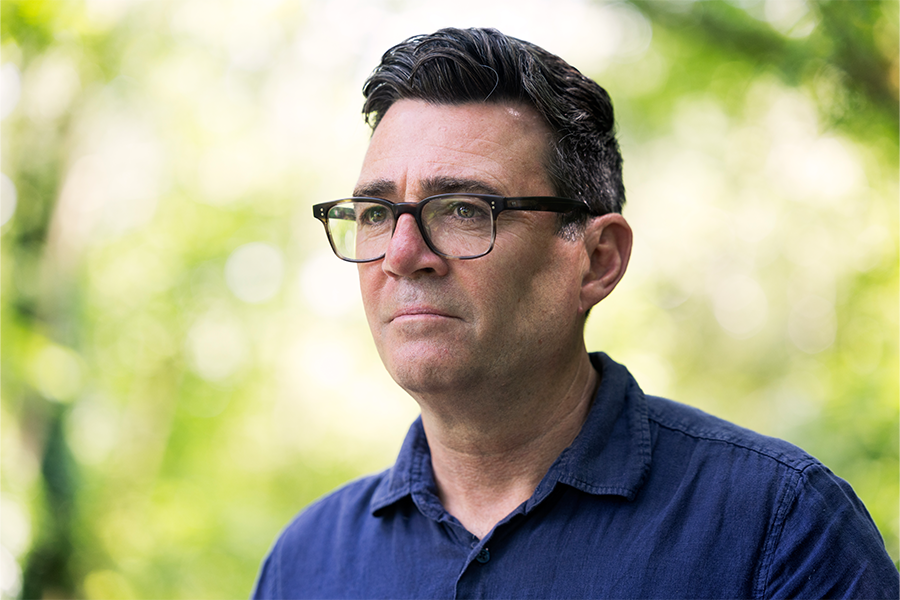


Andy Burnham has promised to introduce proportional voting at Westminster without a referendum, putting Britain on the brink of an electoral revolution.
The Greater Manchester mayor, who is expected to challenge Keir Starmer for the Labour leadership if he wins the Makerfield byelection, told The Observer a manifesto commitment would be sufficient to push through the biggest change in the country’s democratic system for over a century. “I am committed to proportional representation,” he said. “I think it would change the political culture. I don’t see how first past the post and the point-scoring inherent within it lifts Britain out of the doom loop it is in.”
Allies say that if Burnham becomes prime minister he will launch a national commission on electoral reform to determine which voting system should be used. A pledge to introduce the change would then be included in Labour’s manifesto.
The mayor said it would be important to have a popular mandate for such a huge reform, but insisted this could be delivered through a general election rather than a standalone referendum. “I would prefer a manifesto commitment,” he said. “When I came into politics, my dad said, ‘Never commit to a referendum on anything.’ I look back and think how wise he was.”
The introduction of proportional representation (PR) would be the biggest change in the conduct of elections since women over the age of 30 got the vote in 1918.
Burnham said he had been persuaded to back the change when he stood for the Greater Manchester mayoralty, which was fought under a supplementary vote system. He realised he had to knock on every door to try to secure second preferences. “It made every vote count,” he said. “I think its time has come.”
Electoral reform is also supported by the Liberal Democrats, the Greens and Reform UK. Labour’s deputy leader, Lucy Powell, a close ally of Burnham, has called for the party to build a “progressive alliance” across party lines.
The public voted against changing the electoral system in a referendum held by the coalition government in 2011, but supporters of the reform believe the fragmentation of politics raises questions about the sustainability of first past the post. At the 2024 general election, Labour won 63% of the seats on 34% of the vote.
Neal Lawson, one of the founders of the soft-left Mainstream network, said changing the voting system would be Burnham’s “clause IV moment” if he became Labour leader, similar to the landmark moment in 1995 when Tony Blair rewrote the Labour party’s historic commitment to nationalisation. “Blair’s reworking of clause IV was symbolic, but this really changes the culture and nature of our politics and provides the basis for a new political and economic consensus,” Lawson said.
The Green party leader, Zack Polanski, urged Burnham to introduce legislation to change the voting system before the next general election if he gets to No 10. “Anyone committed to proper democratic renewal in this country must commit to bringing in fair and genuine proportional representation at the earliest possible opportunity,” he said. “And that’s just the first step. We also need to get big money out of politics, stop disinformation, and scrap the archaic and undemocratic House of Lords. We’ve heard lots of promises and warm words from many Labour figures – but when it comes to it, we see inaction, U-turns and half-measures. Fixing our broken democracy will require genuine boldness.”
Newsletters
Choose the newsletters you want to receive
View more
For information about how The Observer protects your data, read our Privacy Policy
The former Green leader Caroline Lucas, who has urged her party to stand aside in the Makerfield byelection, said: “Greens have always been open to cross-party working, especially where the prize is the transformation of our utterly distorted and undemocratic electoral system. I believe that’s even more urgent, given the very real risk of Nigel Farage being handed the keys to No 10. That’s why, if Andy becomes PM, he should introduce a Proportional Representation Bill before the next election.”
She added: “Andy’s right that PR is a vital way of changing the wider political culture as well as better reflecting the wishes of the electorate. And, crucially, it’s also our best way of protecting our political system from a far-right government elected on barely a quarter of the national vote.”
The Liberal Democrat leader, Ed Davey, said: “My door will always be open to working with any government to do the right thing – whether that’s for a much better deal with Europe for our economy, fixing the broken care system to save our NHS, or creating a fair voting system to fix our broken politics. But we need to end the flipflopping we’ve seen from too many Labour leaders and Andy Burnham can only show he means real action with deeds, not words.”
There is growing support for reform in the House of Commons and in Labour. According to a recent Survation poll, two-thirds of Labour members support PR, making this a key issue at any leadership contest. A motion in favour of electoral reform was voted through at the Labour conference in 2022.
Laura Parker of the Labour for a New Democracy campaign group said: “Things have shifted. The public already know that the current system doesn’t work and the overwhelming majority of Labour members agree. It’s great that we now have a very serious prospect of updating the way we vote.”
Earlier this year, more than 50 academics and constitutional experts wrote an open letter to the government, warning that the current voting system will struggle to cope with the UK’s increasingly fractured political landscape.
They warned that first past the post risks producing distorted results on an “unprecedented” scale at the next general election and lead to “random and arbitrary” outcomes, further damaging public trust in politics.
Vernon Bogdanor, a professor of government at King’s College London, has said the “electoral system has become a serious threat to the quality of British democracy”.
Photograph by Gary Calton