Related articles:
In November 2011 the then universities minister, David Willetts, arrived in Cambridge to pitch his vision for a market-driven reform of higher education. He never got to speak.
As Willetts cleared his throat, 30 members of the audience stood up to reveal themselves as “embedded” protesters, who disrupted the event by chanting a lengthy poem inspired by Greek tragedy. (“Your name / is anathema to us. You are not a welcome guest / because you come with a knife / concealed beneath your cloak” reads one section of the transcript.) In the end, at least a third of spectators who had booked tickets turned out to be a prearranged part of the protest. Or, as they put it: “All your questioners have been planted. So we, too, have planted ourselves in your audience.”
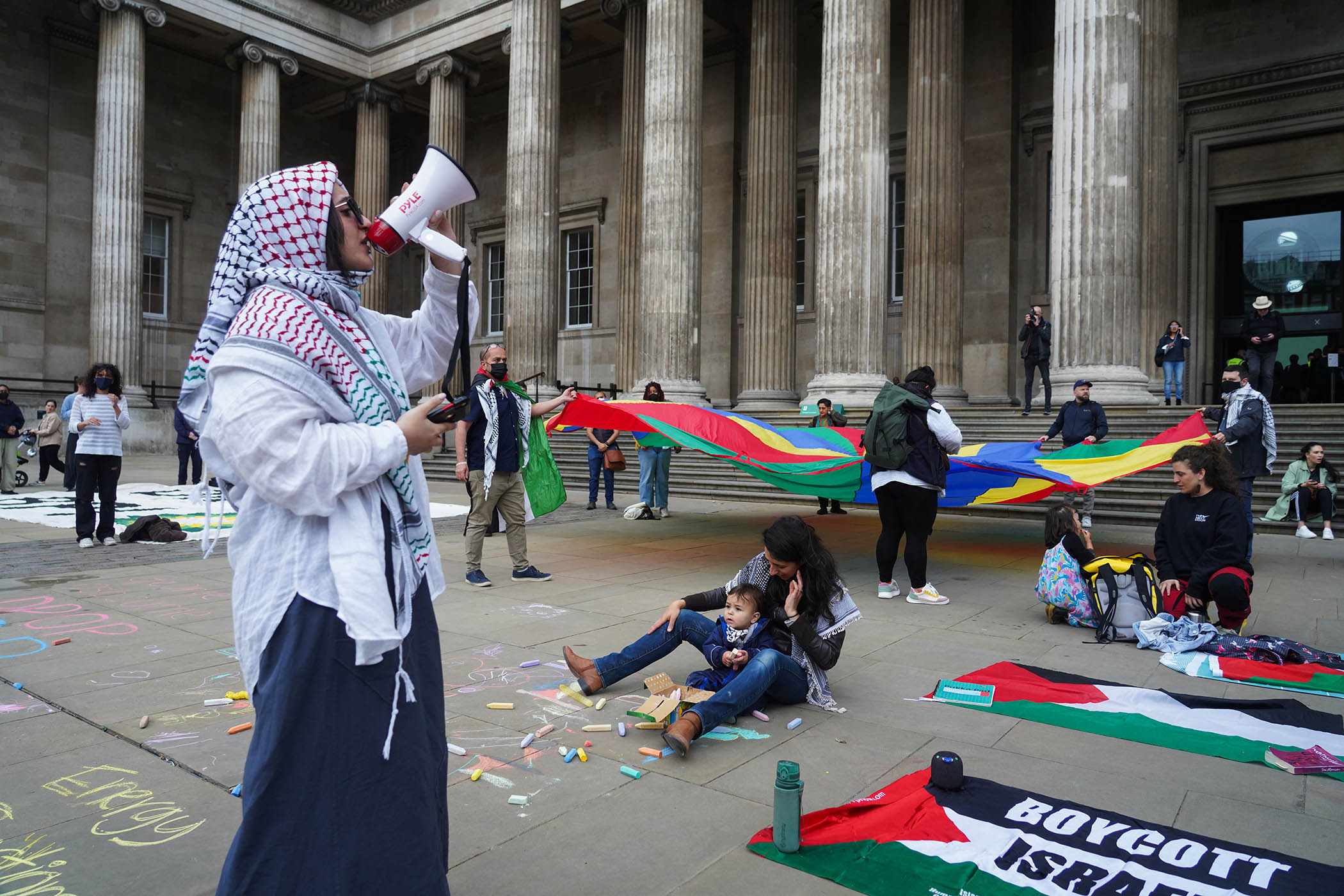
This is something like the scene that would have awaited the British Museum at a talk originally planned for the end of May by the keeper of its Middle East department, Dr Paul Collins – had the museum gone ahead with it. A few days beforehand, staff noticed that an unusually high number of individuals had purchased group blocks of 10 tickets each, and that each bore the name of a longstanding anti-Israel activist. Given that the subject of the talk was the archaeological record for the ancient kingdoms of Israel and Judeah – a historical reality that some anti-Israel activists would like to scrub from the record – this rang alarm bells.
When I spoke to insiders at the museum, they told me that further investigations and private “intelligence” suggested that between 25% and 50% of the tickets had been booked by “well-known” activists from “highly organised groups” planning a coordinated stunt to prevent Collins from speaking. Faced with little time to weed out these ticket-holders and resell their seats to genuine parties, the museum felt it had little choice but to postpone the event. Despite the decision being denounced by everyone from the Conservative leader, Kemi Badenoch, to the veteran BBC broadcaster John Simpson as complicit in Jewish erasure, the museum had in fact made this choice in partnership with the Board of Deputies of British Jews, which was hosting the event as part of Jewish Culture Month. A new date will be announced this week.
It’s no surprise that Jewish observers were upset by the initial story. Whatever your views on the modern State of Israel, much Palestinian activism depends on denying that the Jewish people have any indigenous relationship with the Middle East. This doesn’t affect just Israelis, or even Zionists. Theoretically, a reasonable person could recognise that Jewish people were exiled from the Middle East in AD70 without believing they have a right to a state there in 2026. But in a political landscape shaped by the US left, obsessed by indigenity and origin, a concerted effort to deny the ancient presence of Jews in Israel regularly results in the spectacle of “progressives” trying to explain to people of Jewish descent that we’re not actually an ethnic group.
The museum is not the villain. It’s an easy target: a crumbly institution with a PR problem
The museum is not the villain. It’s an easy target: a crumbly institution with a PR problem
Since October 7, we’ve seen viral traction for the vicious conspiracy theory positing that Ashkenazi Jews are actually Khazars from Crimea who stole the history of an extinct Jewish culture in order to aggrandise themselves. This theory has been repeatedly, incontrovertibly, debunked by geneticists – but it has never been more popular. When the British Museum is unable to host a lecture explaining its own archaeological record of Jewish history, that looks an awful lot like we’re being written out of our own story.
Except that the museum is not the villain. It’s an easy target: a crumbly institution with a PR problem, already cartoonishly blamed for every evil of the British empire. But ranting and raging at it is only a distraction from the greater threat facing Jews, historians and anyone committed to the norms of civil society. We are living in an era in which even basic history is bitterly contested. Spend too much time on social media – and most of us have – and we end up unable to agree on the language with which to frame our political disagreements. If you’ve ever watched an argument between someone who uses the phrase “trans ideology” and someone who uses the phrase “trans liberation”, you’ll understand what I mean.
We can’t even make movies about myths without ending up at each other’s throats. Christopher Nolan’s upcoming film of the Odyssey – a story that features six-headed monsters and a one-eyed Cyclops – has already been consumed by a race row because Elon Musk can’t cope with the idea of a black actress, Lupita Nyong’o, playing the beautiful Helen of Troy. Let’s hope no one tells Elon about Romare Bearden’s stunning A Black Odyssey, a series of paintings reimagining Odysseus as a black hero in Africa, displayed at the British Museum in 2019.
Related articles:
The British Museum is guilty of naivety. Anyone who’s spent time at Jewish cultural events knows the threat these face from antisemitic disruption – the failure to foresee this suggests it didn’t consult enough people who have. This latest crisis also follows a series of rows about the decision to replace the words Palestine and Palestinian on exhibit captions written 27 years ago, when these terms were understood differently. That incident was also wildly misreported, and should have served as a lesson.
But it is only the latest institution to struggle with a burden it has not chosen: a mission to police culture wars far beyond its control.
Newsletters
Choose the newsletters you want to receive
View more
For information about how The Observer protects your data, read our Privacy Policy
Looking back at Willett’s 2011 visit to Cambridge, the whole thing looks like a vignette from a vanished world. The celebrity professor who organised it, Simon Goldhill, has just resigned after an investigation upheld complaints of sexual misconduct. Tuition fees are here to stay, organised opposition abandoned. Protest in Cambridge remains, but it takes less inspiration from Euripides and more from Arafat. Last summer the university obtained a year-long injunction preventing protesters from disrupting graduate ceremonies in the name of Palestine.
To those of us who don’t like to get our history from TikTok and our ethics from Leila Khaled, this is a moment of profound despair. But it isn’t the fault of the British Museum, any more than it was Cambridge University’s fault. It is the expression of a civic society in flames. To fight back, we can start by teaching young people the basics of digital literacy, a more robust attitude to truth, and how to recognise the propaganda that sets out to radicalise us. When we blame cultural institutions for all the ills of polarisation, we only distract ourselves from the problem.
Photograph by Kristian Buus/In Pictures via Getty Images