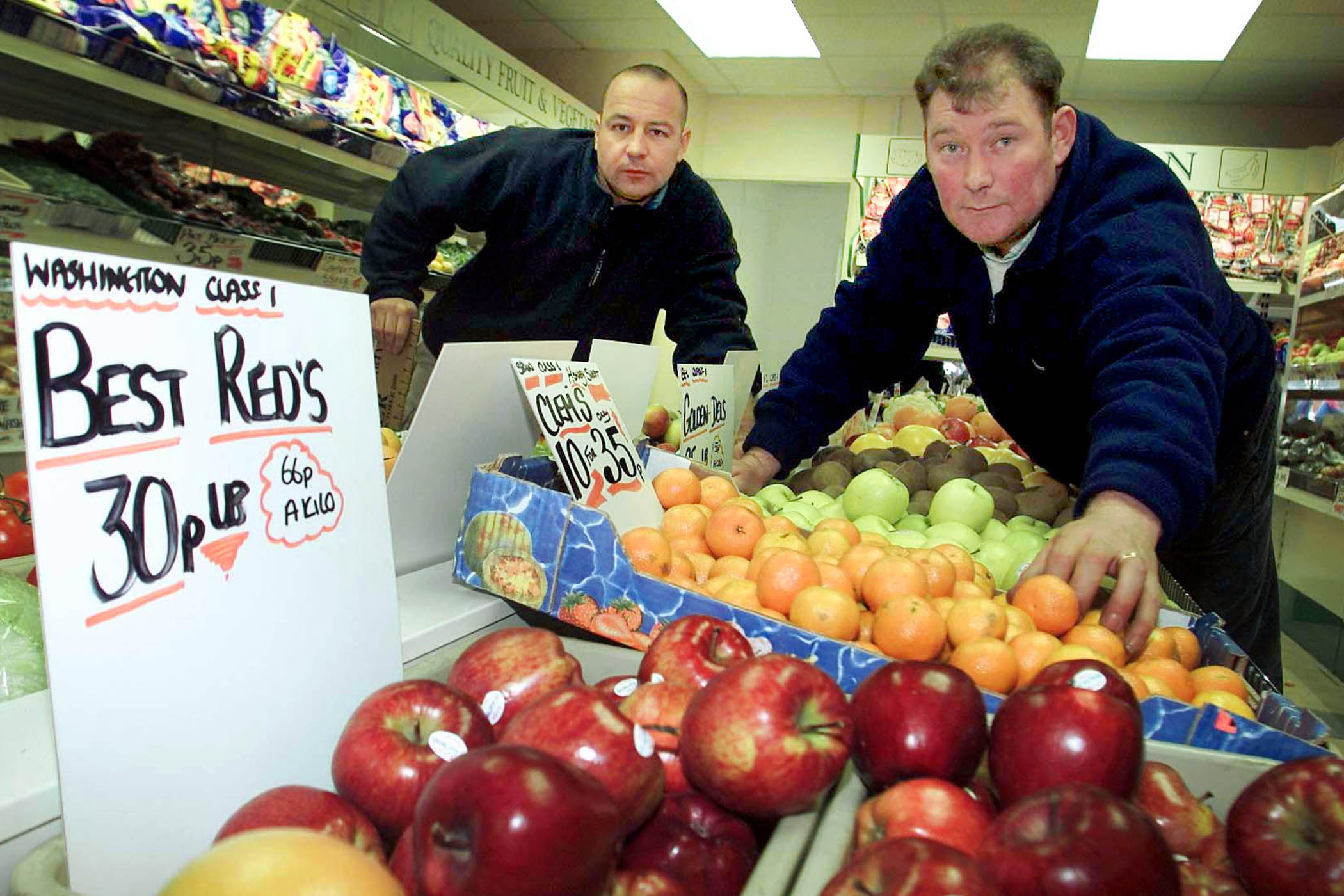
In August 2000, Neil Herron and a friend travelled from Sunderland to London and headed to Parliament Square to get arrested.
The friend was Steve Thoburne, a greengrocer who’d had a run-in with a trading standards officer for selling bananas in pounds and ounces. Herron was a fishmonger who agreed with Thoburne and many, many others that not being allowed to sell fruit in units of your choice was nuts.
They brought some weighing scales and bananas with them, set them up within sight of Big Ben and asked a policeman to come and have a look. “‘We are criminals, please arrest us’,” Herron said. “And the copper said ‘what am I going to arrest you for then?’ And we explained what it was for and he asked if he could sign our petition instead.”
Only one politician came over, and he wasn’t an MP. He was an MEP who Herron remembers as young-looking, name of Nigel Farage.
Next week Farage’s Reform UK party, with a little help from the Greens, is expected to sweep Labour into oblivion in local elections across about a third of England. Herron, the ex-fishmonger, won’t say who he plans to vote for, but he will say he thinks British politics and the British political class are due an upheaval on the scale of the Brexit vote ten years ago.
“Once you get on the ground you’ll see there’s a very, very strong undercurrent of being let down by our current government,” he says. “I think the days of two parties are over. I think from May 7 onwards (the day of the local elections) it’s going to be a five-horse race.”
That would be a race between Reform, the Tories, Labour, the Liberal Democrats and the Greens, all in a brutal street fight for vote share, Reform with a striking financial edge thanks to record-breaking donations from the Bangkok-based crypto billionaire Christopher Harborne.
Herron is not of the political class, but definitely worth listening to. Soon after his stunt with Thoburne in Westminster the Sunderland trading standards officer walked into Thoburne’s shop in Southwick, a short walk from the Stadium of Light, and confiscated his scales.
The two of them were ready. Herron had written an article in a local paper saying if traders were going to be forced to go metric then at least the government should be honest about it. Tony Blair was prime minister at the time and his wife, Cherie, had recently given birth to Leo, who weighed in at 6lbs 12oz.
“If pounds and ounces were good enough for him, they were good enough for a haddock,” Herron says. “Anyway, Steve called me up and said ‘the fuckers have just taken my scales’ and an hour and a half later he was the most famous greengrocer in the world.”
Herron had swung into action by calling local media. Three satellite trucks turned up outside Thoburne’s shop. John Cleese, Elaine Page, Sterling Moss and Eddie Izzard backed his cause. The anti-EU press picked it up, too, conflating metrification and EU laws and anointing Thoburne and Herron the “metric martyrs”. The rest is a typically distorted piece of Brexit history. It’s fair and yet not fair to draw a line from imperial bananas to Britain’s departure from the EU (because British metrification began in the 1960s but did ultimately have to be enshrined in EU law), but the Telegraph did it anyway.
What Herron believes now is that “the whole case was firmly about who governs Britain”. He says it was “the crystallisation of the frustration of many ordinary British people. Is this what the EU’s all about? We can’t sell bananas in pounds and ounces to someone who asks for them in pounds and ounces?”
It turns out the EU was all about much more than that. Looking back on the Brexit vote, Herron says it didn’t surprise him even if it did surprise a generation of politicians who weren’t reading the room, just as many are failing to read it now. But he also wonders, casually and a bit wearily, why and how Brexit has failed.
He offers some reasons: Covid, energy price shocks and a failure to “scrutinize” Brexit properly as an opportunity. One way or another it’s been a tough decade for small businesses including his own, he says (he’s now in tech, not fish). “It’s been an interesting time, and a very hard journey.”
How much easier would it have been with free movement and full access to EU markets, I ask. He’s not falling for it, but it’s a question likely to dominate the five-horse race of the new British politics, starting next week.
Photograph by PA/Alamy
Newsletters
Choose the newsletters you want to receive
View more
For information about how The Observer protects your data, read our Privacy Policy