

On his first day in Downing Street, Keir Starmer was given the codes for the nuclear weapons. Like all prime ministers before him, one of his first tasks was to write four identical “letters of last resort” to the commanding officers of the four submarines that provide Britain’s continuous deterrent. These hand-written memos contain orders about what to do if an enemy nuclear strike has destroyed the British government and killed or incapacitated both the prime minister and his second in command. Nobody knows what they say and, assuming nuclear Armagaddon does not occur before Starmer leaves office, they will be destroyed without ever being opened. For any new prime minister, writing the letters is the moment when the responsibility of the office really hits home, a vivid reminder that “uneasy lies the head that wears the crown”.
What nobody likes to highlight, however, is that the United Kingdom’s supposedly independent nuclear deterrent is actually entirely reliant on the United States.
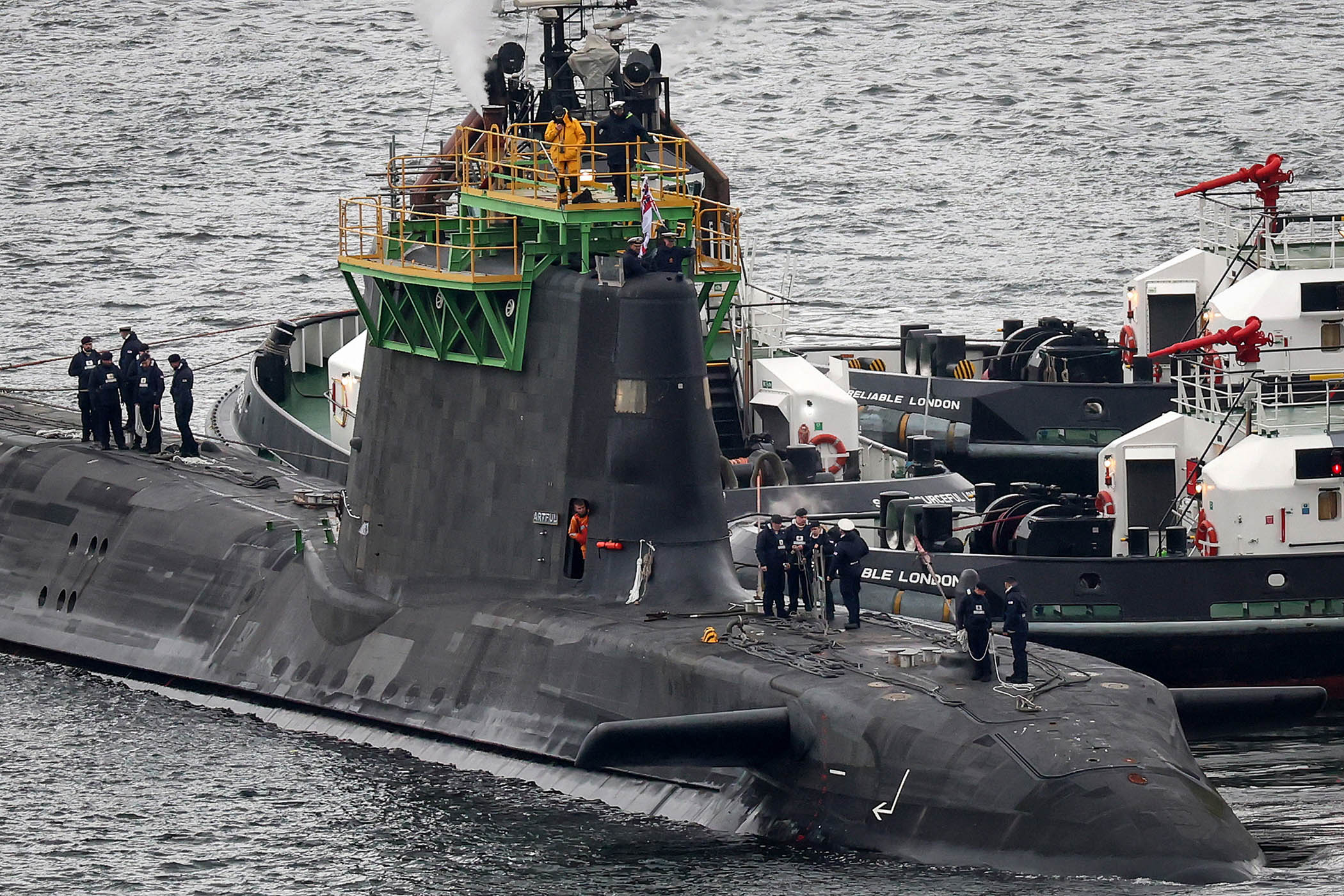
The submarines and the warheads are made in Britain but the Trident missiles themselves are owned by the Americans. They are leased by the UK but are manufactured, maintained and stored in the US. British submarines have to travel to the US Strategic Weapons Facility at King’s Bay, Georgia, to pick them up before taking their turn patrolling the oceans.
Darya Dolzikova, senior research fellow at the Royal United Services Institute, says there is a legally-binding contract which gives Britain control of the missiles in return for a fee. “At any given time there is a UK submarine out at sea with 16 missiles on it that the prime minister has the sole authority to use. He doesn’t need to ask anyone’s permission for that. If the UK tomorrow decides we’re going to launch a nuclear weapon we can do that.” But she says questions remain about how independent the deterrent really is. “They are US-owned missiles. We lease them out so hypothetically speaking they could turn around tomorrow and say ‘we’re going to tear up this agreement, don’t pay us any more, we won’t give you the missiles’.”
The UK-built submarine missile compartments are designed to take the American weapons. No other missiles can be used in them – so if the US suddenly pulled the plug, the UK would be without the nuclear capability that the prime minister describes as the “bedrock” of national security. The new Dreadnought submarines which are currently being built, supporting 30,000 jobs around the UK, will also take only the American Trident missiles.
It is an arrangement that dates back to the era of Harold Macmillan, who decided that Britain could not afford to go it alone after the second world war. But the current Labour government has doubled down on the collaboration. Just weeks after the 2024 election, the defence secretary John Healey tabled an amendment to the UK-US Mutual Defence Agreement – which allows for the transfer of nuclear materials, technology and information – ending the requirement for crucial clauses to be renewed every ten years.
Peter Ricketts, the former national security adviser, says: “We depend completely on the Americans for the supply of the Trident missiles. It would be a colossally expensive and long-term effort to replace that with another system. So in practice, we are locked into reliance on the Americans and the relationship would have to get into a pretty terrible state for the Americans to somehow restrict or cut off our access to the Trident missiles.”
Before Donald Trump, that was never a realistic threat. But with an increasingly unpredictable and unreliable US president in the White House there are growing concerns in Whitehall about Britain’s dependence on America for its nuclear weapons. Trump has not held back from seeking to humiliate Starmer over his refusal to support the war on Iran. The “rupture” between the US and Europe over Greenland has raised questions about whether there is any longer even an alliance of values.
The truth is the Ministry of Defence budget is already over-stretched. The UK could not afford to develop its own nuclear missiles, even if it were practically possible. But the pivot away from the US towards the EU on defence cannot ignore the nuclear dimension. Ben Judah, who was David Lammy’s special adviser at the Foreign Office, believes there needs to be a fundamental rethink in the longer term. “We have an America problem,” he says. “Our closest ally around which we have built our entire security has become profoundly erratic, unpredictable and emotional. Trident and the nuclear special relationship with America simply has to continue, but if I was still in government, I’d be urging we begin to diversify with a new nuclear special relationship with France.”
Behind the scenes, that cross-channel alliance is already underway. The Lancaster House Treaties – a 50 year defence partnership between the UK and France, agreed in 2010 – included a pledge to collaborate on nuclear weapons.
Newsletters
Choose the newsletters you want to receive
View more
For information about how The Observer protects your data, read our Privacy Policy
Decisions about military hardware take decades to implement. In 2028 the new Dreadnought submarines will start to be deployed, but Dolzikova says it is time to start thinking about what happens after that. “As we look at what the future fighter jet for the UK looks like – could you put nuclear weapons onto that? Could they be French? They’re the right questions to ask. For a capability that’s as fundamental to UK sovereignty and security as our nuclear deterrent, we need to prepare against every contingency.”
Photograph by Jeff J Mitchell / Getty Images