

Photographs by Antonio Olmos for The Observer
On 26 November 2024, a 15-year-old schoolgirl was raped by two 14-year-old boys in the Hampshire market town of Fordingbridge. Two months later, the same boys threatened another girl with a knife and forced her to walk to the local recreation ground, where they raped her too. She was 14. The boys filmed the assaults on their phones and shared footage online. Yet the attackers were spared custodial sentences because of their ages. Speaking in court earlier this month, Judge Nicholas Rowland told the boys: “I have to remember that you are not small adults.” The judge said he had decided to hand down youth rehabilitation orders because he wanted to “avoid criminalising these children unnecessarily”.
For one of the girls, it was like a “rock straight in my face”. She said it “made it seem as if what the boys did was… OK in the eyes of the law because they were still children”. The other victim said she was left feeling as if she was being “punished” for the crime committed against her. She said she is often too terrified to leave her home, describing herself as “overwhelmed, anxious and emotionally exhausted”.
The cases, which have now been referred to the court of appeal by the attorney general under the unduly lenient sentences scheme, have been met with universal revulsion across all political parties. The prime minister said he found them “distressing as a politician” and “as a father” and praised the “courage” of the girls.
The same week the sentences were handed down, however, the government published plans to cut the number of children sent to custody. Despite criticism of the Fordingbridge sentences, the trend in the criminal justice system over the past 20 years has been to drive down the use of incarceration for young people. A white paper on youth justice proposed reducing the number of children held on remand in secure settings by a fifth, and said ministers would consider raising the age of criminal responsibility in England and Wales from 10 to 14.
The apparent contradiction highlights the political sensitivity of criminal justice reform, particularly when it relates to children.
Jake Richards, the youth justice minister, insists the government is not trying to stop young rapists and murderers from being locked up. “Custody is always an option for the most serious offenders, even if they are children,” he says. “Nothing in our agenda compromises that. Custodial sentences are necessary for public safety and because serious offending needs to be punished and seen to be punished.” He argues that a “dramatic overhaul” of the youth justice system is required to stop young offenders turning into hardened criminals. “Our prisons and especially our youth prisons need to have a focus on rehabilitation to cut reoffending. That’s absolutely central to cutting crime.”
The evidence suggests something is going seriously wrong in the youth justice system. Two-thirds of young offenders go on to commit more crimes and 80% of adult persistent offenders first entered the justice system as children. The number of young criminals being detained has dropped dramatically over the last 20 years because of a focus on community sentences. Twenty years ago, close to 3,000 children were locked up at any one time. Now it is just over 400. These are the most dangerous and damaged young people in the country, but young offender institutions (YOIs) are violent, dysfunctional places that are doing little to rehabilitate those held within their walls.
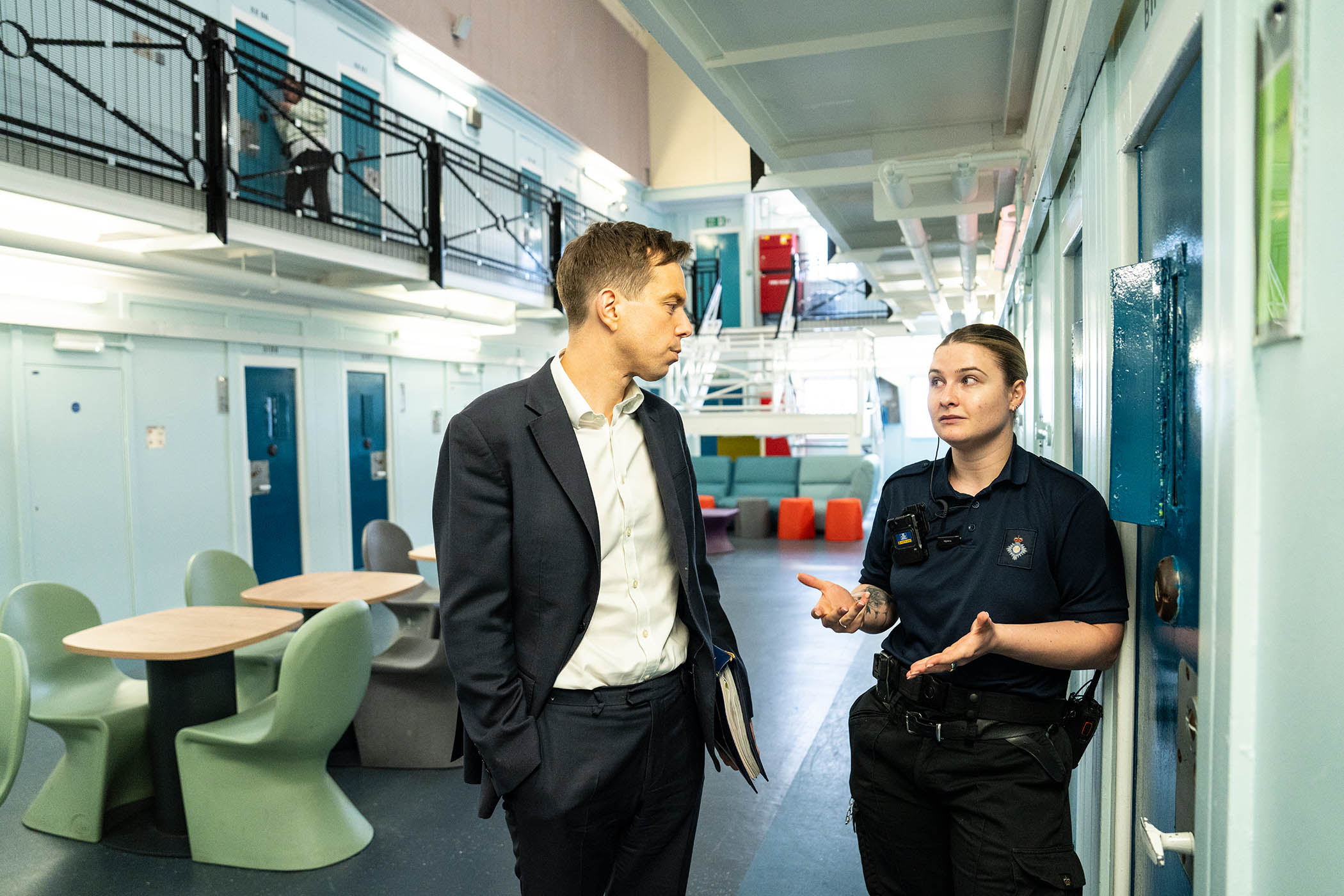
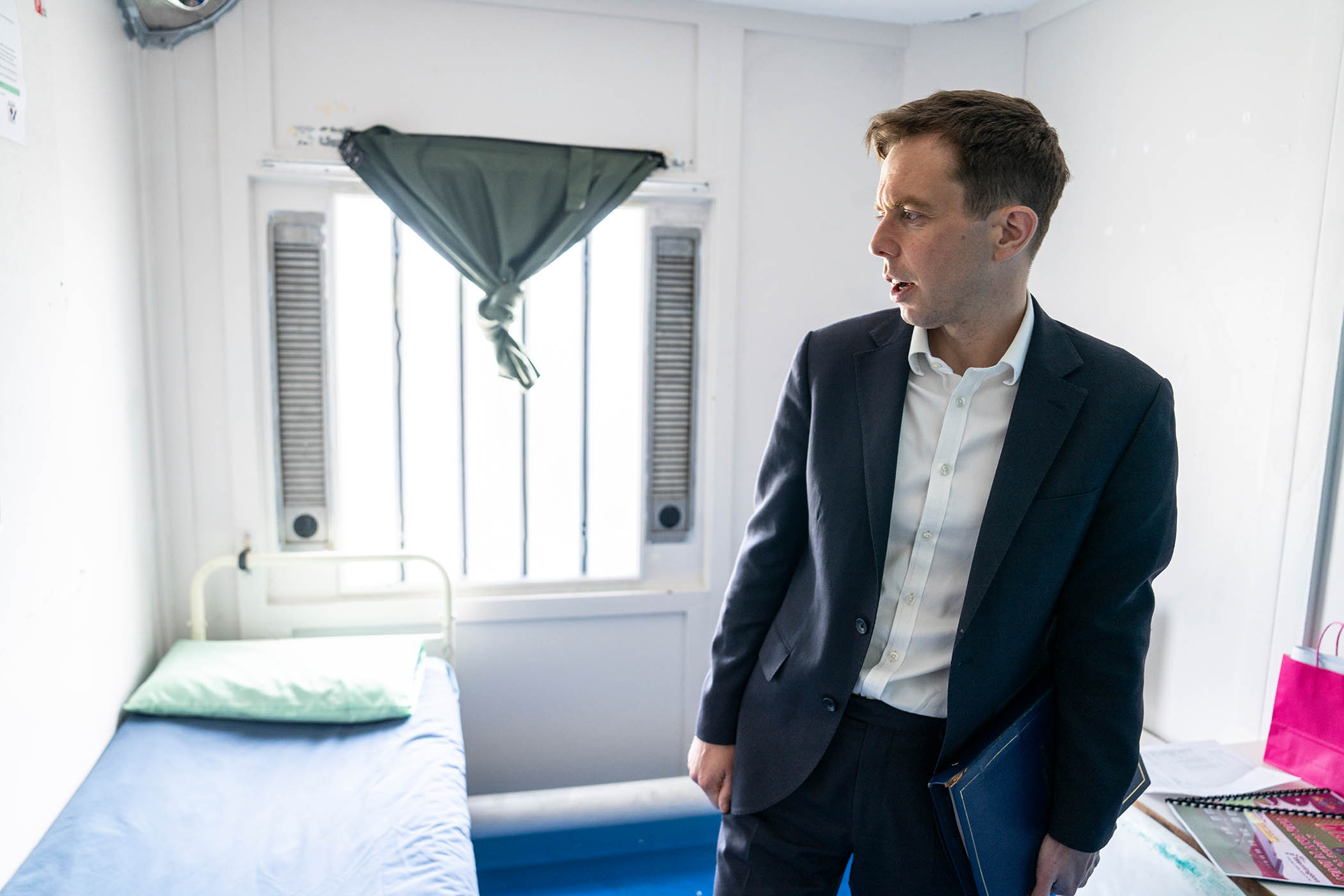
Youth justice minister Jake Richards talks to prison officer Ms Manson at Werrington YOI, near Stoke-on-Trent.
The latest report by Charlie Taylor, the chief inspector of prisons, found that 43% of children in custody felt unsafe and 61% had experienced some form of bullying, violence or victimisation. The three public sector YOIs – Feltham in west london, Wetherby in West Yorkshire and Werrington near Stoke-on-Trent – are “by far the most violent jails in the entire prison estate”, Taylor says. “Everybody is hypervigilant and defensive. You often see people getting their retaliation in first. It creates this vicious cycle where you get more of this really reckless, scary violence.”
The chief inspector of prisons, who used to run a school for children with behavioural problems, says it is “outrageous” that teenage boys are often locked up for 20 hours a day or more. On average, only 61% of those in YOIs spend more than two hours a day out of their cell and in some it is as low as a third. Institutions operate a cat’s cradle of “non-association orders” to separate offenders who are in rival gangs and might attack each other if they are allowed to meet. “It means everybody’s locked up for much longer because you have to keep people apart,” according to Taylor. “You’re feeding the worst kind of grandiosity of these kids, which is: ‘I’m so big and tough and scary that I can’t mix with anybody, and also, if I do see that person, I’ve got to go and punch them to prove I’m worthy of my status.’ That’s not effective behaviour management – that is just a way of getting through the day.”
Newsletters
Choose the newsletters you want to receive
View more
For information about how The Observer protects your data, read our Privacy Policy
Former chief inspector of prisons Nick Hardwick says he was always “much more wary” visiting YOIs than adult jails. “You have a group of emotionally very immature but physically very big and strong boys. The violence is unrestrained. Adults think through the consequences a bit; these kids don’t do that, so there’s a randomness to the violence. If you were a parent of a boy in one of these places, you’d be terrified.”
A place at a YOI typically costs about £130,000 a year – twice as much as Eton. The Oakhill Secure Training Centre, a custodial facility near Milton Keynes, costs about £360,000 a year for each child. “It’s basically as expensive as the Ritz,” Richards says. “It’s costing the taxpayer £200m a year for 400 children to be locked up with terrible outcomes. This is failing the taxpayer, it’s making our country less safe, and it’s not helping those children turn around their lives. In fact, the opposite is the case. If a child spends time in custody, that makes it far more likely that they will commit more crimes.”
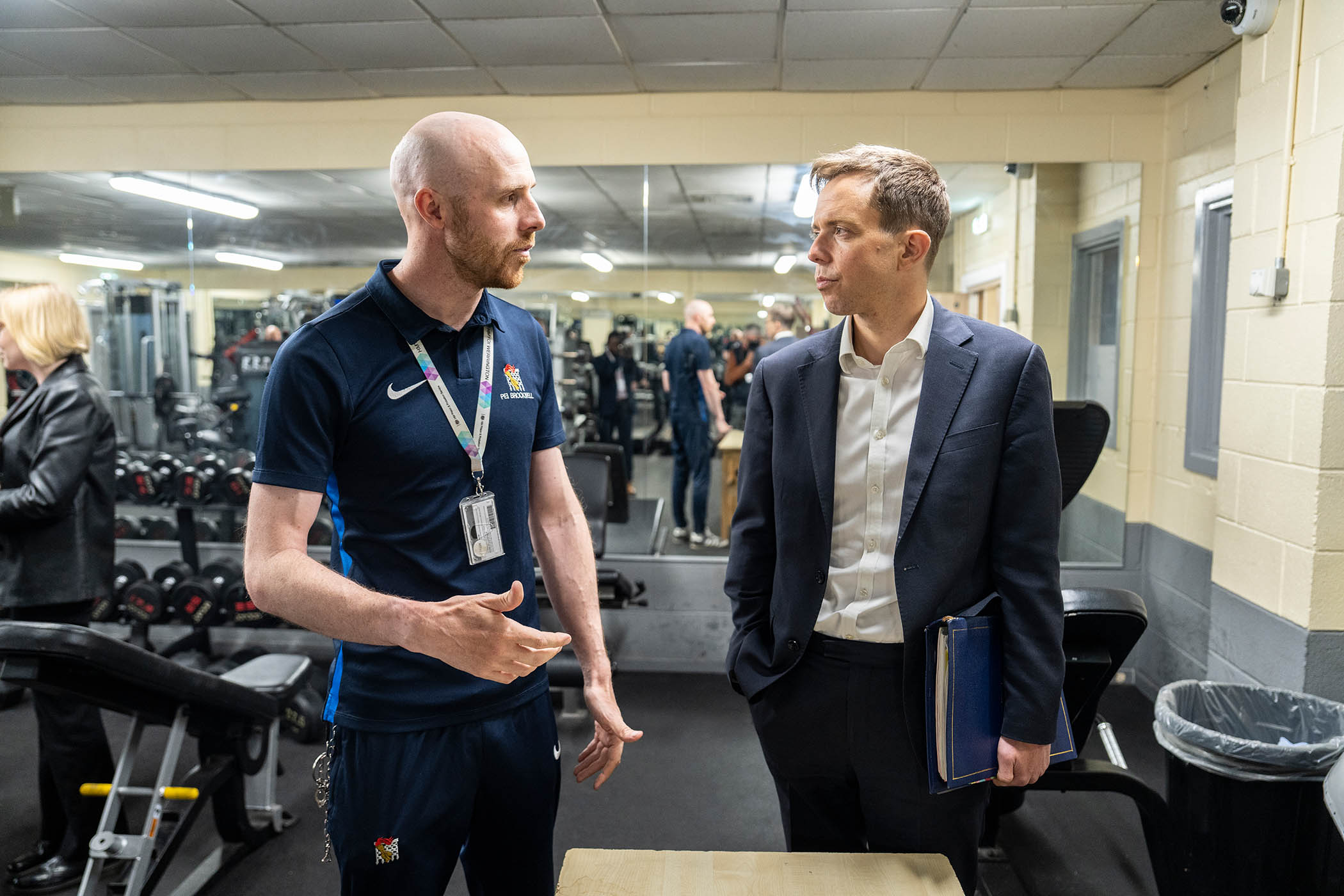
Richards talks to prison officer Dan Brockwell at Werrington YOI
At Werrington YOI, there are 10 metal gates and doors between the children in their cells and the outside world. Staff carry huge bunches of jangling keys. The prison holds 82 boys, and last month there were 79 non-association orders in place keeping teenagers apart. One young offender has 11 different people he cannot cross paths with. The governor, Jasmin Steadman, has instituted a “weapons strategy” and a “group assault strategy”, but it is hard to keep things under control. There has been a spate of boys kicking through windows and walls. “The boys shout insults to each other at night,” Steadman says. “The last violent incident was at the weekend – a three-on-one assault. A boy was stabbed in the head and a staff member was pushed.”
On the education block, young offenders are taking a media studies course. One 16-year-old, who is serving time for car theft and possession of a firearm, has recently been transferred from Wetherby YOI. While he was there, he assaulted another boy with a weapon he had created out of a toothbrush and a razor blade, melted together using the element of a kettle. “He pulled a weapon on me and so I pulled a weapon on him,” the boy explains. “At Wetherby, there were lots of weapons and lots of violence. You’d be surprised what you can make a weapon from: spoons, forks, pens – people even melt down TV remotes. I used to carry one because I thought I needed it to be safe. If I was going into the yard knowing there would be 20 weapons, I had to protect myself.”
Steadman says about 70% of the boys at Werrington are in custody for violent offences. “We’re dealing with young people who have been convicted of murder,” she says. “But a lot of them have been victims themselves; they’ve witnessed domestic violence or been in care or are neurodivergent. Society doesn’t see that vulnerability.”
Many of the children in custody share the same characteristics. Two-thirds have spent time in care, more than half are from an ethnic minority, and almost 90% live in the poorest parts of the country. There are regional clusters of youth criminality. Analysis conducted for Rachel de Souza, the children’s commissioner for England, found that 36% of children in secure settings had attended schools in the West Midlands and – astonishingly – 20% went to the same six schools.
Most young offenders have struggled with education. A third have literacy and numeracy levels at, or below, those of a seven-year-old. Three-quarters have a history of persistent absence from school, a quarter have been permanently excluded, and two in five have special educational needs. Children in custody are five times more likely to have an education, health and care plan than pupils in regular schools. Steve Chalke, founder of Oasis Restore, a secure school in Kent, which will reopen next month, says the noise and chaos of a YOI could almost have been designed to exacerbate the vulnerabilities of these children. “You can’t harm someone to heal them,” he says. At Oasis Restore, there are no bars on the windows, children have bedrooms rather than cells, and locks are opened by magnetic fobs.
De Souza, who is now conducting a government review of education for young people in custody, has been “repeatedly shocked by the Dickensian conditions” when visiting YOIs. She describes “children locked in cells for 23 hours a day and missing schooling due to inadequate staffing. Instead, boys are getting ‘ready’ for the adult estate, learning from each other.” She argues that YOIs should be replaced with secure children’s homes. “Education is central to this. It is the most powerful tool we have to prevent offending in the first place, and it remains vital for those in YOIs who have already fallen through the cracks.”
According to the children’s commissioner, only 20% of children who sit an English or maths GCSE in a YOI pass, compared with about 70 % of pupils not in custody. Often, young offenders do not even get the chance to take their exams.
Sally Coates, a headteacher who advised former justice secretary Michael Gove on education in prisons, describes one of her pupils who got into trouble with the police a few weeks before his GCSEs. He was sent to Feltham YOI on remand while awaiting trial. “He was very bright, heading for top grades, but we weren’t allowed to give him any books so he had no revision material. Then, when the exams came round, he failed to take a single GCSE even though we had made sure he’d been entered for all the right exams. When English and maths were on, the prison was on lockdown and so nobody was allowed out of their cell.”
Almost immediately after the GCSEs were over, the boy was released without charge, but as he lacked the necessary grades, he could not join the sixth form. “About two years later he almost stabbed somebody to death and was imprisoned for attempted murder. If he’d been able to take his GCSEs, I really believe it would have changed the trajectory of his life.”
In the year ending March 2025, 44% of children held in custody were on remand, which means they have not been tried or sentenced. Almost two-thirds of these cases did not result in a custodial sentence. A quarter of those involved were acquitted. Hundreds of innocent youngsters are being locked up each year – often for months. The average time spent on remand was 125 nights in 2021-22, the most recent data available, and 14% of remand cases were held for more than 182 days.
The government is promising to reduce the number of children held on remand, with more specialist fostering of those awaiting trial. Richards also wants to integrate YOIs with multi-academy trusts and use artificial intelligence and predictive data to identify young people at risk of getting involved in crime. The long-term aim, he says, is to close the “big institutions” and send children to secure children’s homes or schools.
The minister recently visited one of the Diagrama youth prisons in Spain, where the focus is on rehabilitation. Staff are educators instead of guards, and children are rarely locked up. Reoffending rates are far lower than in the UK and violence is virtually nonexistent. “They say it’s because they’ve given the children a purpose,” Richards says. “They’ve got a progression model where good behaviour is rewarded and bad behaviour is not.”
Natasha Porter, founder and chief executive of the prison reform charity Unlocked Graduates, says YOIs are “heart-wrenching” to visit. She remembers seeing books by the children’s author Jacqueline Wilson piled up outside the cell of a boy who had to be unlocked by three prison officers wearing riot gear. Staff, she argues, need much more specialist training. “These are the children who the teachers, social workers and police haven’t managed to reach. It’s the equivalent of being a brain surgeon – the most challenging job in the public sector,” she says.
She adds: “This is the group who are going to be the most expensive and the most damaging to society if they continue offending. But, because they are children and their brains are still developing, you’ve also got this incredible opportunity to support them to change their lives.”
The Fordingbridge cases show that children are capable of committing appalling crimes and, whatever the ruling from the court of appeal, some young offenders will always need to be locked up. But if they are not rehabilitated, as well as punished when they are sent to custody, there will ultimately be more victims of crime.