
Keir Starmer won the last general election with a one-word slogan – “Change” – but disillusioned voters do not believe the prime minister has delivered it as they prepare to go to the polls in crucial local, Scottish and Welsh elections this week.
Focus groups around Britain for The Observer found that Labour’s vote is fracturing to the left and right as the cost of living crisis combines with a growing sense that life in this country is unfair for working people.
Although the elections on Thursday will be characterised by political fragmentation, research in five areas by the pollster More in Common revealed a remarkable level of similarity between former Labour voters now planning to vote Reform UK and those intending to back the Greens.
From Essex to Merseyside, Scotland to Wales and London, the same frustrations, disappointments and anxieties were repeatedly expressed by different demographic groups.
In Tottenham, north London, Labour supporters now considering voting Green said they believed the “social contract” had broken down. Zebie, who works in customer services, said: “It seems like a lot of the people that don’t follow the rules get treated better and you get penalised for following the rules.”
Shaikho, a dentist, said he has paid £30,000 of his student loan but the balance has only gone down by £4,000. “I’m a young person who’s done everything right, got good grades, done a good degree, but I’m having to live like a student in a flatshare. Every January, like clockwork, I start looking at how can I leave the UK? How can I leave the NHS? I don’t care any more – I don’t want to be here. Where am I supposed to find any comfort in this country?”
Starmer was, in his view, “completely spineless”, but he hoped the Green leader, Zack Polanski, would be “radical” enough to make a difference. “Maybe he’ll promise 100 and deliver 70 – I’ll take it. It’s better than Labour not delivering,” he said.
Patricia, a teacher, said billionaires avoided paying tax while “people who work their arses off” have their money taken off them. “It’s the opposite of Robin Hood,” she added.
‘Underpinning their frustrations was a consistent theme: hard work, doing the right thing, isn’t rewarded’
‘Underpinning their frustrations was a consistent theme: hard work, doing the right thing, isn’t rewarded’
Luke Tryl, More in Common
The same message came through in Newport, south Wales, from a different political perspective. Jody, also a teacher, said Britain had become a “pushover nation” and she planned to switch from Labour to Reform. “I won’t ever vote for Labour again,” she said. “I don’t feel like they represent people that work. They represent people that don’t want to work and want to take advantage of the system.
“It’s always the people on benefits that get given support. It’s never the working people. My husband and I are at the point of thinking: ‘Do we actually want to stay in this country, because it’s breaking us.’”
Newsletters
Choose the newsletters you want to receive
View more
For information about how The Observer protects your data, read our Privacy Policy
Lucy, who is retired, agreed. “You can take the great out of Britain at the moment,” she told the group. “We’re giving the money away left, right and centre; it doesn’t matter whether it’s to illegal immigration or benefits – it’s all going out and nothing’s coming in.” She had concluded that Reform “can’t be any worse than what we’ve got”.
In Sefton, Merseyside, Dave said: “It just doesn’t pay to work any more.” He thought it was unfair that those on benefits are eligible for free after-school clubs and summer camps, while working parents struggle to make ends meet: “I’ve voted Labour all my life and I’m frustrated. They don’t seem to be putting any effort into helping the working person. It’s like we’re not getting anything back.”
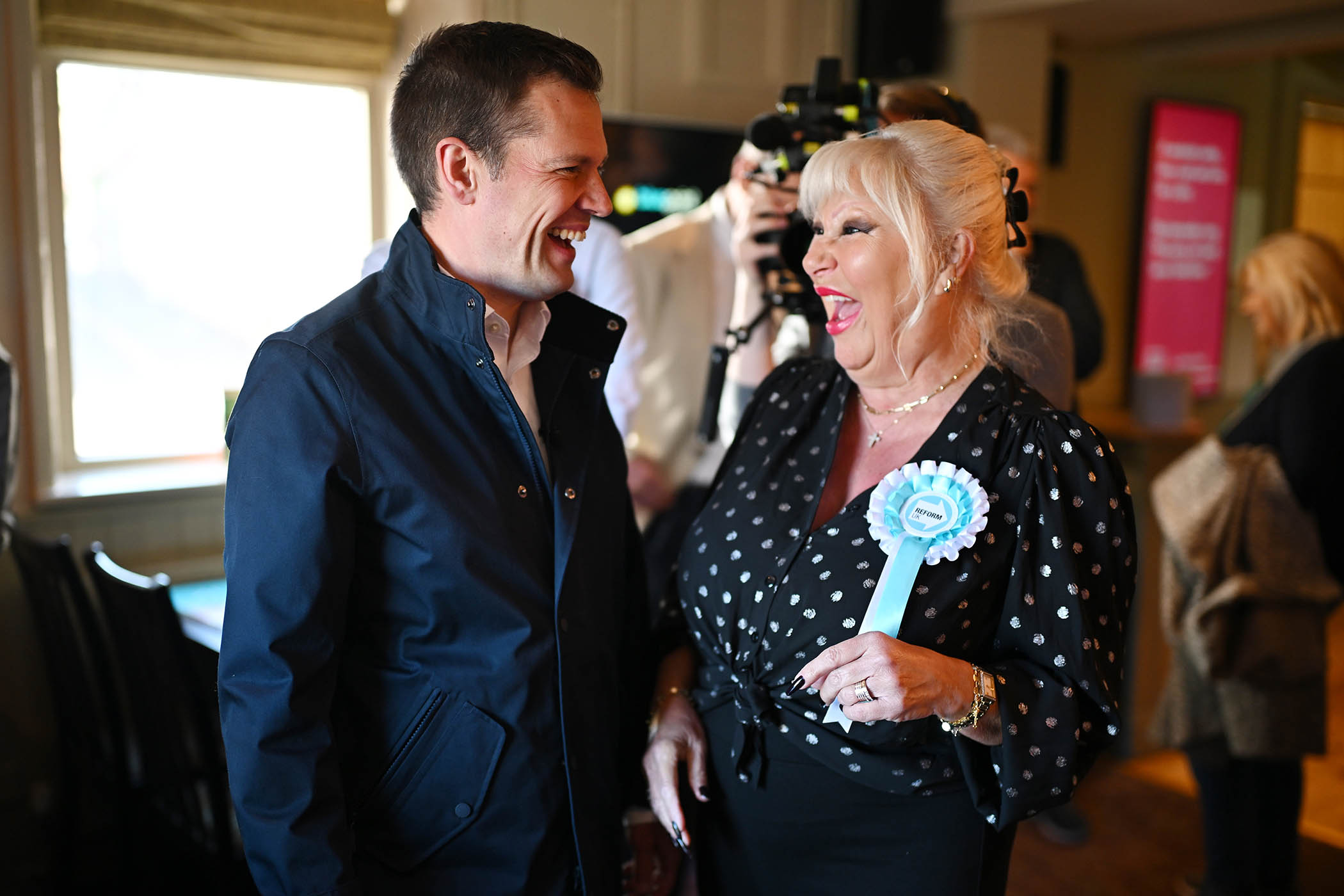
Reform UK’s Robert Jenrick meets supporters at the Green Dragon pub in Thetford
Asked in the same group whether the country was heading in the right direction, Matt replied: “Is that a trick question? I think we’re doomed – it’s just a mess.”
The mood was just as grim in Rutherglen, South Lanarkshire, where voters were torn between Labour and the Scottish National party. “You think: ‘What am I working for?’” said Laura. “I’ve got no money to do a holiday, I’ve got no money to go on a night out or for a nice meal.”
Meanwhile, in Braintree, Essex, Nicola felt Starmer was “failing drastically”. She added: “I struggle to find a demographic group of people that he hasn’t upset. They’ve had the farmers, the pensioners, the self-employed, the small businesses – I’m not sure there’s anyone left.”
An Opinium poll for The Observer confirms the disintegration of the political landscape, with no party securing the support of a third of voters. Reform is on 27%, eight percentage points ahead of Labour, which is on 19%. The Tories are on 18%, the Greens 15% and the Liberal Democrats 12%.
But Luke Tryl, UK executive director of More in Common, said it was “eerie” how similar it was speaking to very different voters in all parts of the UK. “Underpinning their frustration was a consistent theme: hard work, doing the right thing, isn’t rewarded, while those that don’t do their fair share are looked after,” he said.
“While the groups differed about who those groups not doing their fair share were – big business and the rich for those going left; asylum seekers and benefit claimants for those on the right – the consistent theme was: you’re a mug for playing by the rules.”
The two-party system dominated by Labour and the Conservatives “is at the weakest it has been in years as voters splinter in all different directions”, he said.
“That splintering is driven by one thing above all else – a sense that the status and social contract are broken beyond repair.”
Photograph by Ian Forsyth/Getty Images, Leon Neal/Getty Images