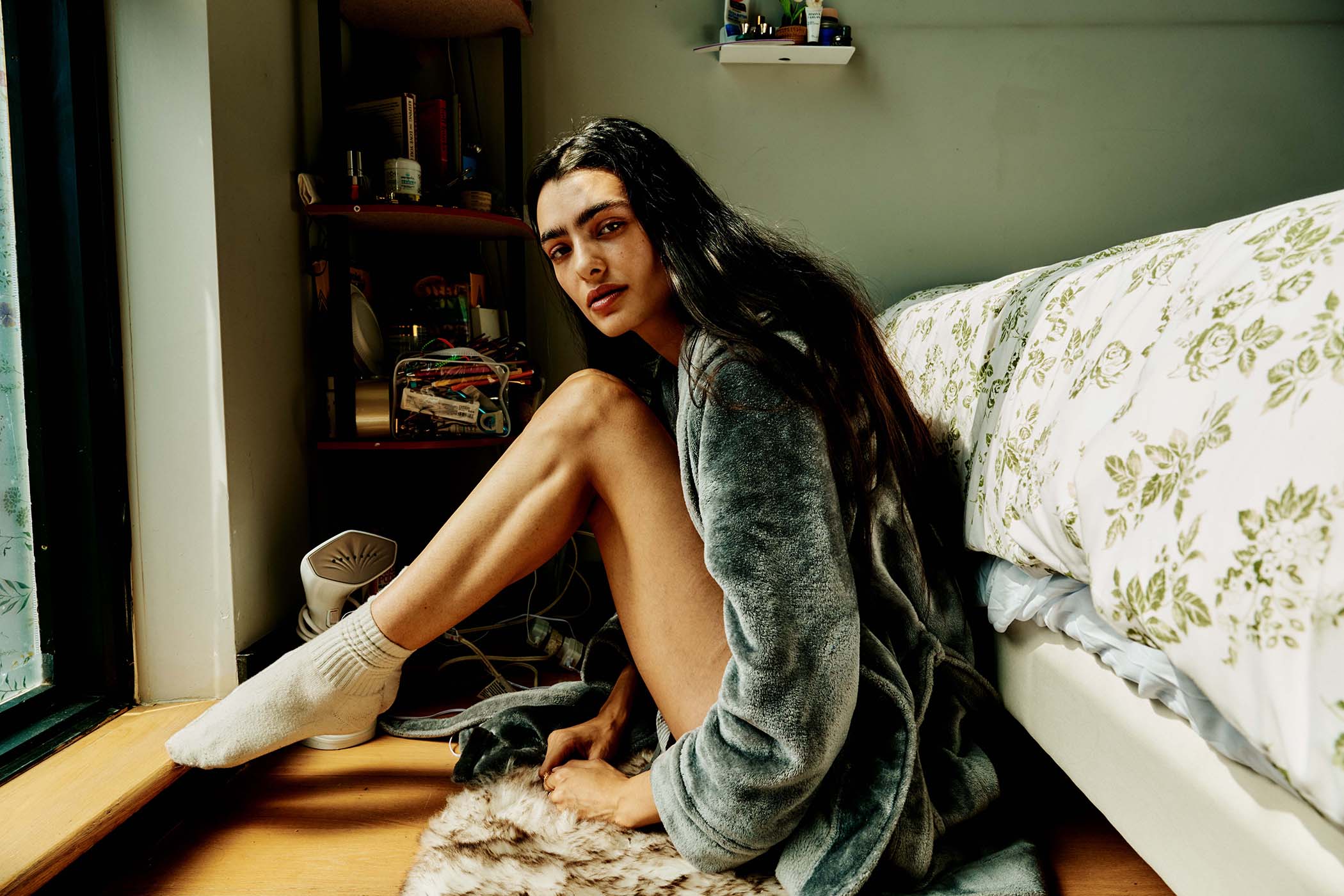

Danielle Littleford, the Pakistani-British model, grew up in the care of at least seven different foster families, though that number is most likely to be higher. Littleford, who uses the pronouns they/them, was 18 months old when they entered care, and they can only rely on the memories of their older siblings to reconstruct those early years. Being placed in care at such a young age meant Littleford missed out on a lot of the developmental experiences most of us take for granted: how to cook basic meals, how to take care of a home, what to do at a post office. It recently dawned on Littleford that “actually, I wasn’t taught anything. Like, really, at all.”
Littleford was talking over Zoom from the corner of a bedroom with pale grey walls against which was propped a full-length mirror. They were wearing shorts and a dark, high-necked vest, in the model mode, and several thin silver rings. Littleford is established in the fashion industry. They have starred in large campaigns for Pandora and Birkenstock, and walked in Dior runways. But we were meeting to discuss the many years they spent in the UK foster system, of which more than 56,000 children are part today. Littleford was born and raised in Birmingham. They and their siblings were placed in foster care at the same time, but split between several families. Littleford, the youngest, was paired with their brother closest to their age; they were allowed to visit their other siblings just six times a year.
Soon after placing her children in care, Littleford’s mother became pregnant again, and gave birth to twins. This time she gave the children up for adoption. “My mum made a huge sacrifice to give two of her children to other people,” Littleford told me. If the twins had been fostered, Littleford’s mother could have continued seeing them; if they were adopted, she would lose access. But she had witnessed how poorly her elder children were treated within the system, so she let her youngest two go. Most of these systems are put in place without consulting the affected children themselves, and Littleford believes families would benefit from allowing adopted children to retain access to their birth family. “Your mum is your mum,” they told me.
When Littleford reached puberty, at 13, they were moved to live with a family in Bridgend, Wales, where local children found it difficult to understand Littleford’s intense and fluctuating emotions, and where Littleford struggled to fit in. The disruptive nature of Littleford’s upbringing was amplified by the fact that some of their foster parents did not treat them with sufficient love, the exception to which was a Caribbean couple who lived in Birmingham and who looked after Littleford and their brother between the ages of three and 10, before they were moved on. “I truly believe they gave me the ability to be a person,” Littleford told me. Foster children often come to feel they must present a public face of boundless gratitude to foster parents, otherwise they might once more be abandoned, but these parents allowed Littleford to act like a child, to be naughty, to push boundaries, loving them unreservedly, without conditions.
I asked Littleford how this foster mother has shaped them.
“I think she’s every single good part of me,” Littleford said. “Actually, the older I’ve got, the more I’ve realised that my birth mum and my foster mum were very similar. They are women who care about people, who taught me that you speak to everybody the same. If everyone could sit with my mums, both of my mums… it would change the world.”
I truly believe that couple gave me the ability to be a person
I truly believe that couple gave me the ability to be a person
Every time a child moves from one foster family to another, they are given a “memory box” – a collection of personal belongings – which social services are meant to ensure travels with them to their next home. In Littleford’s experience, the box rarely made it. And so they grew up with almost no physical history of their past.
When Littleford was 19, they visited the Caribbean couple in Birmingham for the first time since their separation almost a decade earlier. When they arrived, their foster parents showed them a whole cupboard of their things, which confirmed to Littleford that their recollections from that time were not rose-tinted: for those seven years, they’d really had a family. Three years later, the foster mother died of an aggressive form of cancer. Littleford reached her just before she died and they spent all day together. For that brief period, the rest of the family said, it was as if her sickness had lifted.
In Bridgend, a rural town that was a far cry from the diverse city Littleford had until then called home, they were subject to racism at school and on the street, as well as in more insidious ways in their new home. “My type of brown,” Littleford said, “you would either get ‘You’re a smelly refugee’ or ‘We’ll save you.’” Littleford’s biological father is Pakistani, though they’re not in touch. These days, Littleford told me, “I love that I’m brown. It’s like my favourite thing in the whole world. I would be so envious to come back and not be specifically who I am.” It reminded me of an artwork by Derek Jarman I saw recently, in which he had written out a prayer: “Dear God, if you insist on reincarnation, please promise me that I’ll be queer.”
Since Littleford’s teenage years, in the 2010s, reports of racism against foster children and carers have intensified. In 2025, the Nationwide Association of Fostering Providers (NAFP) cited growing concerns over “incidents of racial hate directed towards foster carers from diverse ethnicities and the children in their care” across England. “It was things like young people in foster care feeling as if they couldn’t leave the house because they thought it would be unsafe,” NAFP’s chief executive Harvey Gallagher elaborated, connecting the rise in racial abuse towards foster children with the expanded influence of the far-right and increased normalisation of racist sentiment in Britain over the last few years.
Newsletters
Choose the newsletters you want to receive
View more
For information about how The Observer protects your data, read our Privacy Policy
Their white foster mum instructed Littleford to pluck their eyebrows, shave their sideburns, bleach away their moustache
Their white foster mum instructed Littleford to pluck their eyebrows, shave their sideburns, bleach away their moustache
For Littleford, there was no respite to be found in their new home. Their white foster mum instructed Littleford to pluck their eyebrows, shave their sideburns, bleach away their moustache, and called it “pampering”. “Pain is beauty,” she would say, though such acts subtly undermined Littleford’s sense of identity and self-worth. Later, the same foster mother would find ways to affect Littleford at school, allowing them to stay at home when they were sick but later telling their teachers that Littleford had been playing truant. At the time, Littleford couldn’t understand their foster mother’s behaviour. Now they realise, “She fucking hated me.”
When Littleford was 16, they were sent to another home in Wales, this time without their brother. By then they’d had so many foster parents that they turned up ready to do battle. “I’m gay, I smoke,” Littleford declared defiantly, as soon as they arrived. “Good for you,” their new foster dad replied. It took Littleford aback.
For several years of their adolescence Littleford struggled with alcoholism, getting blackout drunk every night of the week, an expression of the feeling that “I did not want to be in the world.” They credit their final foster dad with teaching them to drink in moderation. After a year, Littleford received a picture frame containing a photograph of the whole family, Littleford included. “I was like, Oh my God,” they told me. “I have a family.”
But when they turned 18, they were asked to leave the house in Wales. Littleford and their step mother had an enormous fight, and the next morning they woke to find a note stating, “You have one month to find somewhere to live. If you do not find somewhere, you have to leave the house regardless.” That day soon came. Their foster father drove Littleford to a hostel, gave them a £5 note, and left. The average young person leaves home at 24. Until 2014, young people in foster care in England had to leave at 18, though recent legislation now permits foster children to remain with their former foster carer or a new foster carer until 21.
Their foster father drove Littleford to a hostel, gave them a £5 note, and left
Their foster father drove Littleford to a hostel, gave them a £5 note, and left
For the best part of a year, Littleford moved between hostels. Eventually, the government rehoused them in a flat, an hour from anyone they knew. They were still finishing college, so to sustain themselves they worked nights at a petrol station. Other than that, their only financial support came from a government Education Maintenance Allowance (EMA), providing them with £30 a week.
They told me that they saw a post on Instagram the other day that expressed something like: “I started thinking of homeless people differently when I realised that most of them were foster care kids that age out of the system.”
“My first thought,” they said, “was ‘Why are you thinking of homeless people in a negative way to begin with?’” And secondly, “Let’s put two and two together. Where do you think we go? What do you think happens to us?”
At 20, Littleford decided to become a model, and signed with a “mother agent” called Leah Hibbert. Hibbert had noticed Littleford on Instagram and reached out for a coffee, and they’ve worked together ever since. A mother agent is a figure who provides models with specialised, personal support in their career, beyond just bookings. It’s hard not to notice the pertinence of the moniker in this case.
In one way, Littleford’s experiences in the foster care system left them well prepared for the peripatetic existence of modelling. It’s a silver lining as well as a poignancy of their childhood in foster care, that unlike models with more stable families, Littleford is freed up to travel for work at a moment’s notice, to stay as long as they’re needed.
Their first paid gig was for Topshop, where the team taught them how much of modelling is about your movement on set, which seems, given their nomadic childhood, a lesson Littleford did not need to learn.
Inevitably there are challenges to being a South Asian model in an industry that prioritises whiteness. “I’ve witnessed so many black and brown models who are out of this world brilliant not be given the same opportunities,” Littleford told me. “The white people next to them, who are at the same level, are getting more opportunities, and these people are being told to shut up and put up, because they’re here, right? They finally got this – be grateful.”
Littleford knows they should never have had to undergo such traumatic experiences as a child. And yet, reflecting now upon their years in care, they told me, “It’s completely done something for my love of myself. I’m like, ‘Why don’t I deserve it? Have you not seen what I just went through, and what I came from, and where I’m at?’”
Look at the Tiffany Haddishes of this world, they said. Haddish, an American comedian and actor, spent several years in the foster care system with her siblings during her teenage years. “You’re going to see someone that strong, that brilliant, and then be shocked they went through something? I think we really need to look at the world and go, ‘Oh, the people we believe in generally have had to do emotional labour to get here’.”