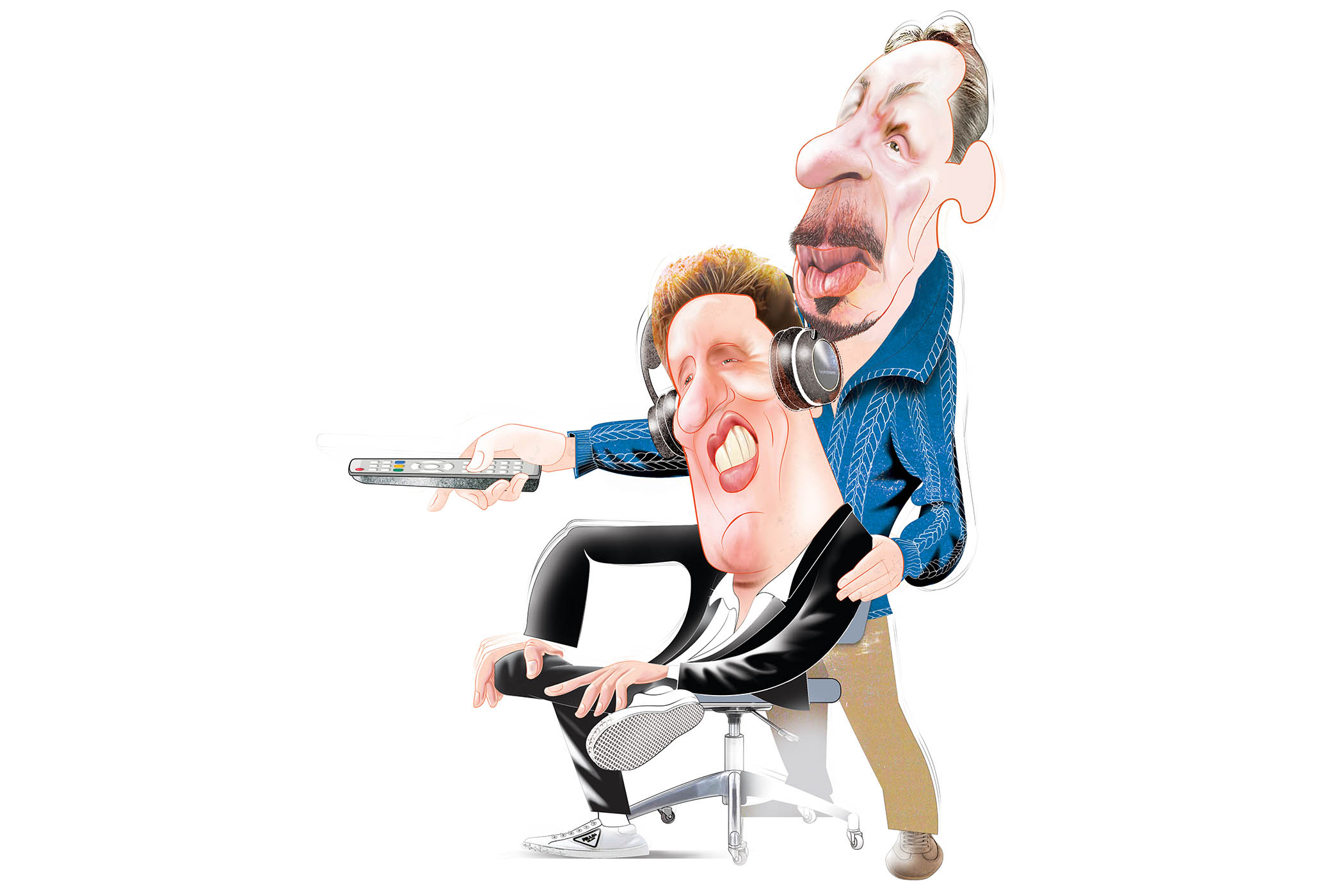


Illustration by Andy Bunday
The father and son team, Larry and David Ellison, owners of Paramount Pictures, the CBS Network, Comedy Central and the Channel 5 in the UK, are on the brink of adding Warner Bros Pictures, CNN, HBO and an array of channels across the world to their portfolio, as well as DC Comics and the US arm of TikTok.
If they pull it off, they will have gone from having a successful database software company and a moderately successful movie studio, to creating one of the world’s largest media dynasties in a little over a year. The source of the Ellisons’ wealth, cloud-computing giant Oracle, may have had a turbulent week after missing an earnings target, but the duo remain starry eyed about their $108.4bn hostile bid to snatch Warner Bros studios from under the nose of suitor Netflix.
Analysts aren’t impressed. “No one’s seen what happens if a family owns a social media platform like TikTok, as well as news providers like CNN and CBS,” says Tom Harrington, analyst at Enders Analysis. “The regulatory questions are opaque. Movies are a boom-or-bust sector that is difficult to model – especially now. This is all about emotions and personalities. It feels like they haven’t thought it through.”
Hollywood is not impressed. “David Ellison is managing to do the impossible – simultaneously make Warner Bros CEO David Zaslav look like a genius and allow Netflix, the ruthless engagement machine and destroyer of movie theatres, to appear sympathetic,” according to Matthew Belloni, the founder and editor of trade gossip bible Puck.
The Ellisons’ case was not helped by the excruciating detail of a timeline of the Paramount-Warners courtship sent to the regulator, the Securities and Exchange Commission, by David. On 4 December, David Ellison’s lawyers sent a letter eviscerating Zaslav, also Warner Discovery’s CEO, for choosing Netflix over Paramount. Hours later, David sent a fawning text: “Please know despite the noise of the last 24 hours I have nothing but respect and admiration for you and the company,” he wrote. “It would be the honour of a lifetime to be your partner.”
The Ellisons are as mercurial as this flip-flop suggests. Both come from complicated homes. Larry, 81, was born in the Bronx in 1944 to a Jewish single mother who gave him to her aunt and uncle in Chicago to raise in a two-bedroom flat in the city’s south side. Larry was devoted to his aunt Lillian but clashed with her temperamental husband, Louis, who would tell Larry he was “good for nothing”. Despite excelling in maths and science, Larry dropped out of the University of Illinois where he was studying science and pre-med – he was named science student of the year – when Lillian died. He struggled to find his feet and eventually headed to California where he bounced from job to job for eight years before, in 1977, founding what would become Oracle with colleagues from computer company Amdahl.
Part coder, part salesman, Larry read a research paper by IBM programmer Edgar Codd on a new way to build and search huge databases. With this, Oracle became a billion-dollar company in 1986 and has found new life in the AI era – “How Boring Oracle Became Cool Again” one CNN headline from September put it, just before Larry briefly became the richest man in the world, his wealth of $393bn overtaking Elon Musk’s $385bn.
Larry didn’t shun the pleasures of wealth in favour of work, like Bill Gates or Steve Jobs. He failed to give his keynote talk at Oracle’s annual convention in 2013 because he was on his yacht winning the America’s Cup. And he spent like a sailor – buying the sixth-largest Hawaiian island Lanai for $300m in 2012, then setting it up with a Nobu and a Four Seasons. He snapped up mansions in San Francisco, Palm Beach, Lake Tahoe and Newport and tried to import a decommissioned Russian MiG-29 while dating, marrying and divorcing with zeal – he’s on his sixth wife, 34-year-old Jolin Zhu, who rented a flat near Oracle’s HQ following her graduation from the University of Michigan. He likes to shoot hoops on the basketball court of his 288-ft yacht, Musashi: when the balls bounce into the sea, a minion shoots off on a motorboat to retrieve them.
David, 42, was born in Santa Clara County, California, to Barbara Boothe, the third of Larry’s wives and the mother of his two children. When David was three and his sister Megan was three months old, Barbara filed for divorce and moved to a horse farm in the San Francisco Bay Area. She tried to instill the kids with strict values and nurtured their love of film. David once told a journalist that she only gave him a $5 a week allowance and made sure he did his chores, as well as his homework.
Newsletters
Choose the newsletters you want to receive
View more
For information about how The Observer protects your data, read our Privacy Policy
Larry took his children around the world on his superyacht Ronin in the summer holidays and taught David to fly when the boy was 13, in an effort to give him a sense of personal responsibility. But David’s love of daredevil stunt flying led to him leaving school and heading to Hollywood, a move Larry did not approve of.
Despite this, he agreed to bankroll his son’s disastrous acting career, then took keener interest in his career as a producer, injecting cash when needed and introducing him to mentors David Geffen and Steve Jobs. “David tried to buy his way into acting but then had to settle on bankrolling Paramount films – this has been up and down but that’s the film game,” explains Kim Masters, editor-at-large at Hollywood Reporter. “Whenever a rich newcomer puts money into a bomb, the sharks start to circle.”
David’s production company, Skydance, struggled to make hits until it got together with Paramount to co-produce Tom Cruise movies. Finally, father and son came together on the acquisition trail. In 2024, Larry bankrolled David’s $8bn drawn-out takeover bid for Paramount, which succeeded after Donald Trump intervened. His recently appointed, Trump-loyalist Federal Communications Commission boss Brendan Carr blocked the deal until an Ellison agreement with the White House was reached.
Trump claims David promised him $20m advertising and programming, as well as installing a form of oversight including an agreement to move CBS News – currently top of the White House’s Offender Hall of Shame list – to the right. Trump also got David to greenlight Rush Hour 4, halted after #MeToo allegations against director Brett Ratner. The Wall Street Journal has reported that David “offered assurances to Trump that if he bought Warner, he’d make sweeping changes to CNN”.
Perhaps the biggest bait-and-switch is the father and son’s ability to get Trump onside. “They are more interested in power than in supporting any particular party or politician,” says Rodney Benson, professor of media, culture, and communication at New York University. “David has been a major donor to Democrats, right up through the 2024 election. Larry doesn’t seem to have strong or consistent ideological views. He has also given to Democrats in the past. He’s given to Bill Clinton. He’s close to Tony Blair.”
David has only ever donated to Democrats, including $1m to Joe Biden in 2024 and around $10,000 to Kamala Harris. Larry backed Bill Clinton and Republicans standing against Trump, including his secretary of state, Marco Rubio, in 2016, and the Republican senator Tim Scott in 2024. Larry hosted a fundraising dinner for Trump in his first term as president in 2020 at his South Carolina golf course but failed to show up, telling people – including a reporter from Forbes – that he was sick. In 2018, Ellison told the Fox Business channel he tended to be neither right or left but “in thedispassionate middle. The kind of boring, dispassionate middle.”
Trump appears to have twigged. The day after CBS News interviewed the departing Republican congresswoman, Marjorie Taylor Greene, who levelled Epstein-related allegations against the president, he told the press he would be involved in any final decision in choosing between Netflix and Paramount, adding “none of them are particularly great friends of mine”.
The comparisons with the HBO drama Succession are irresistible. Back in October, David told Bloomberg’s Screentime conference that his father had been a “phenomenal mentor”, and “we couldn’t have a better relationship”. They speak every day, he explained and, while Larry is the largest shareholder in Paramount Skydance, has pulled together the funding for the Warners bid and is always emphasising shareholder value: “I run the studio day to day. Make no mistake about that.”
Which sounds like Kendall Roy’s final empty cry as he realises he will never be CEO – “I’m the eldest boy. I’m the eldest son. I’m the man in charge.”