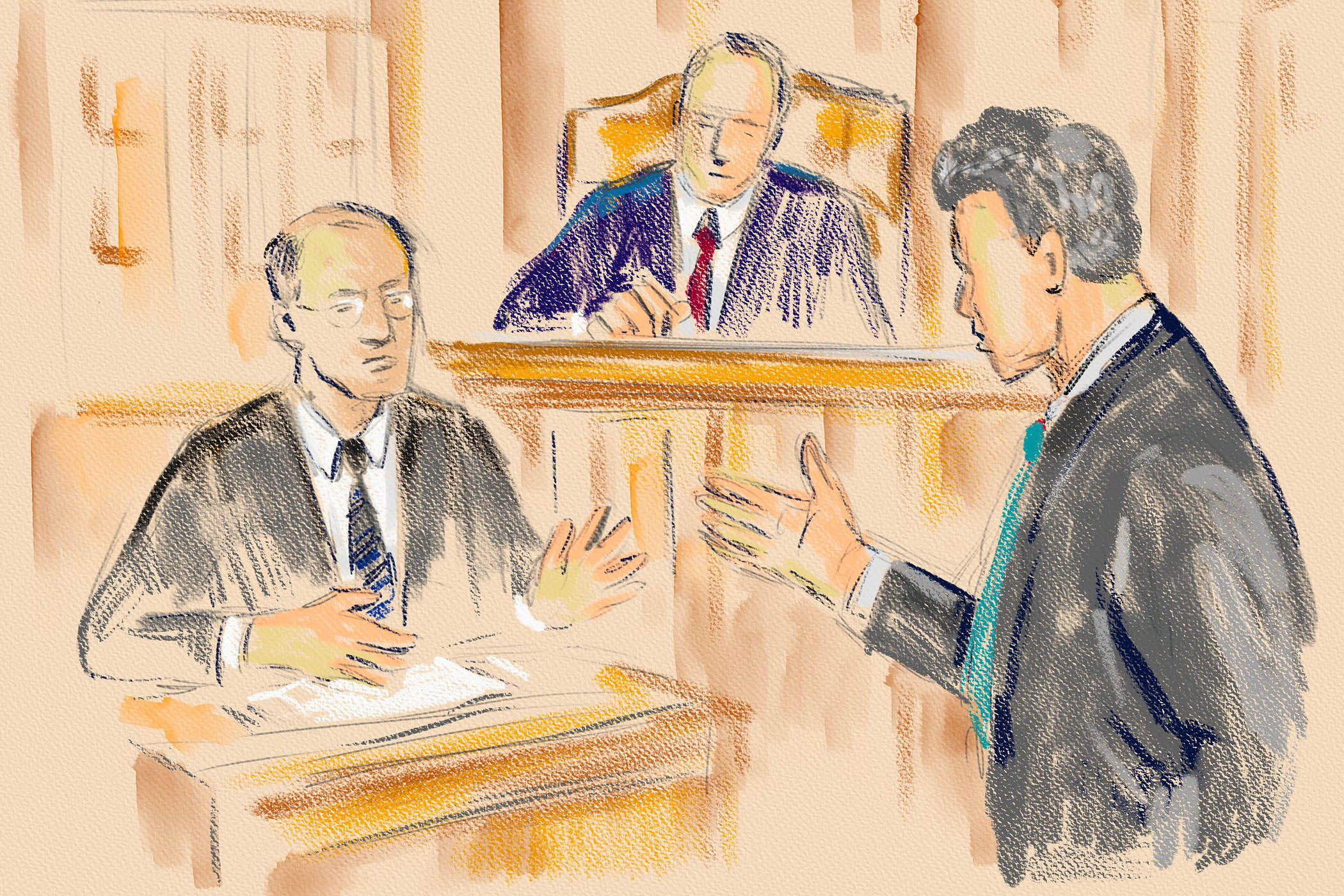



In May 2025, Marc Gunnarsson walked into court alone, ready to persuade a judge that he was entitled to more than £13,000 in Covid support payments. The web developer had found himself in a dispute with the UK tax authority four years earlier, and when his case was finally heard, he presented a series of case law to back up his claim: Patel v HMRC, Ali v HMRC and Kamran v HMRC.
The problem? None of those cases were real. Gunnarsson had decided to face the court without the help of a lawyer and instead armed with an AI chatbot – which had made the case law up entirely.
It was not the sloppy use of AI that ultimately lost Gunnarsson his case in July 2025. But the judge did issue a warning, saying inappropriate use of AI should be taken “very seriously”, and that others may face sanctions.
In the months since that judgment the number of individuals replacing lawyers with AI chatbots appears only to have increased. Legal experts even have a term for it: “vibe lawyering”. It’s a phenomenon that led Sir Geoffrey Vos, the second-most senior judge in England and Wales, to warn in a speech earlier this month thatthe judiciary should prepare for an “AI revolution”.
In the long term, that revolution could empower individuals to navigate an intimidating and expensive legal system, particularly as the technology becomes more accurate. For now though, AI chatbots are flooding the already-overstretched courts with error-ridden submissions, piling extra work onto a system that the one senior lawyer described as “almost completely broken”.
Lawyers themselves are prone to vibe lawyering. In June 2025, the High Court issued a warning after two separate cases submitted by lawyers featured rafts of fake citations, hallucinated by an AI chatbot. But practitioners say people who represent themselves using AI create a particular kind of pressure on the legal system.
Often, the most important piece of advice a lawyer can give is not to sue at all. Part of their job is assessing the merits of a claim, and discouraging people from bringing it forward if it’s disproportionate to the costs or the risk of losing is too high.
AI doesn’t work on that basis. Designed to be helpful and conversational, chatbots are optimised to respond in ways that feel supportive. In practice, that often means validating users’ instincts – even when they’re misinformed. They generate answers based on patterns learned from vast amounts of data of varying degrees of accuracy, from international court judgments and legal blogs to Reddit threads.
The end result is chaos for UK courts.
Antony Sendall, a barrister specialising in employment law, recalled a defendant relying on ChatGPT to plead a complex discrimination claim, producing submissions so legally incoherent that a judge spent much of a one-hour hearing explaining why they were impossible.
Newsletters
Choose the newsletters you want to receive
View more
For information about how The Observer protects your data, read our Privacy Policy
Another lawyer described a litigant who used a chatbot to “dash off” a claim, valuing it at more than £200,000, before abandoning the case when it became clear the argument was unsound, wasting time and money for the lawyers on the other side of the case.
Others spoke of AI-generated claims filed under the wrong procedures, stuffed with irrelevant material, or borrowing US legal concepts that do not exist in British law.
The fallout can be severe. Tarun Bhakta, from the housing charity Shelter, said he knew of cases where tenants had been left at risk of losing their homes because of incorrect legal advice from chatbots.
UK courts don’t immediately rule out pleadings just because a chatbot helped draft them, but the person filing a claim must still sign a statement acknowledging that what they are arguing is true.
This could lead to a risk of contempt if their arguments contain AI hallucinations but, for the most part, the legal system has so far been sympathetic to the plight of the vibe lawyers.
In the case of Gunnarsson, the web developer with a £13,000 tax dispute, the judge reasoned that “he was under time pressure given his other competing responsibilities and doing his best as a lay litigant.”
In the meantime, judges and lawyers are absorbing the extra work. Under existing ethical guidelines, the judiciary is supposed to help ensure that unrepresented opponents understand what is required of them.
While some nonsensical cases are dropped relatively quickly, judges and lawyers say they are spending time explaining basic procedures to litigants, and untangling lengthy, AI-generated documents in court, adding to the workload in an overstretched system.
The number of people representing themselves in court had already been rising for the best part of a decade, for reasons unrelated to AI, including cuts to legal aid and rising lawyers’ fees.
But since 2022, the year that ChatGPT launched cases with lawyers on both sides in the civil courts have fallen from 53% to 41% in 2025.
At the same time, the number of cases being brought in civil and family courts is increasing, as are wait times. As of November 2025, there are more than 64,000 open employment tribunal cases, the highest on record. AI could be a factor, as lawyers say chatbots can nudge people towards issuing proceedings that might otherwise have stopped at an initial solicitor’s letter, or a negotiation.
A consultation by the Civil Justice Council (CJC) into the use of AI in preparing court documents is ongoing. In its interim report, the CJC noted that AI chatbots “may be the only source of advice or assistance some litigants receive” and that people “may not be aware that they are prone to error”, and emphasised the judiciary’s duty of care to vibe lawyers.
It’s not all bad news. Others say that chatbots could help people advocate for themselves, making an expensive legal system accessible to those who need it most. When it comes to employment tribunals in England and Wales, for example, 77% of companies show up with a lawyer to defend themselves, while only 41% of individuals have legal representation at their final hearing, an imbalance that leaves the majority of employees to navigate the complex tribunal system alone.
“It is a mistake to think that ‘justice’ means exactly the same thing to the people of 2026 as it meant to the people of 1873 when our current civil justice system was enshrined in the Judicature Acts,” Sir Geoffrey Vos said in his speech earlier this month. “In 2026, our citizens and businesses want to see a system where justice is available equally to the least privileged and the most vulnerable in our society as it is to the most wealthy and the most privileged.”
Perhaps, he suggested, AI could play a part in that. Chatbots could empower people to access and understand legal advice in an era of devastating cuts to support services such as legal aid and community law centres.
Some savvy businesses have already seized the opportunity. Alex Monaco runs a law firm called Grapple Law. On its website, the company promises to help “tens of thousands of people against unscrupulous companies & corporations” on a no-win-no-fee basis. Monaco, himself a qualified lawyer, says he wants to help people “stand up for justice”. His ‘team’ of lawyers is – of course – an AI chatbot.
Monaco says the company's model is specialised to perform specific legal functions, such as letter writing. He says the technology is built on a version of the chatbots ChatGPT, Gemini and Claude but adds that his team of engineers fine-tune the model which is additionally trained on a dataset derived from his existing law firm. He says that makes it less prone to errors.
Mark, who spoke to The Observer on the condition of anonymity, was involved in a messy employment tribunal, and spoke to a human lawyer who charged £300 an hour. When that service became unaffordable, he turned to Grapple. He eventually settled his case for tens of thousands of pounds, paying Grapple a 15% fee – a fraction of what he would have paid a traditional lawyer.
Grapple Law has dozens of five-star reviews. The reality, though, is that many AI tools are still riddled with inaccuracies. And, in the short term at least, an influx of new lawsuits will only put pressure on a crumbling system.
One day, perhaps, AI could help with that too. Vos suggested that the technology “offers the only viable way to process the sheer volume of disputes in modern society quickly and efficiently”, adding that it could one day decide outcomes in small claims courts. (Monaco had already tried to do that too; a couple of years ago he applied for a grant to help him build a “virtual judge”. It was rejected.)
In the meantime, vibe lawyering is here to stay. The question is how quickly the courts can adapt.
Photograph by Aloysius Patrimonio / Alamy