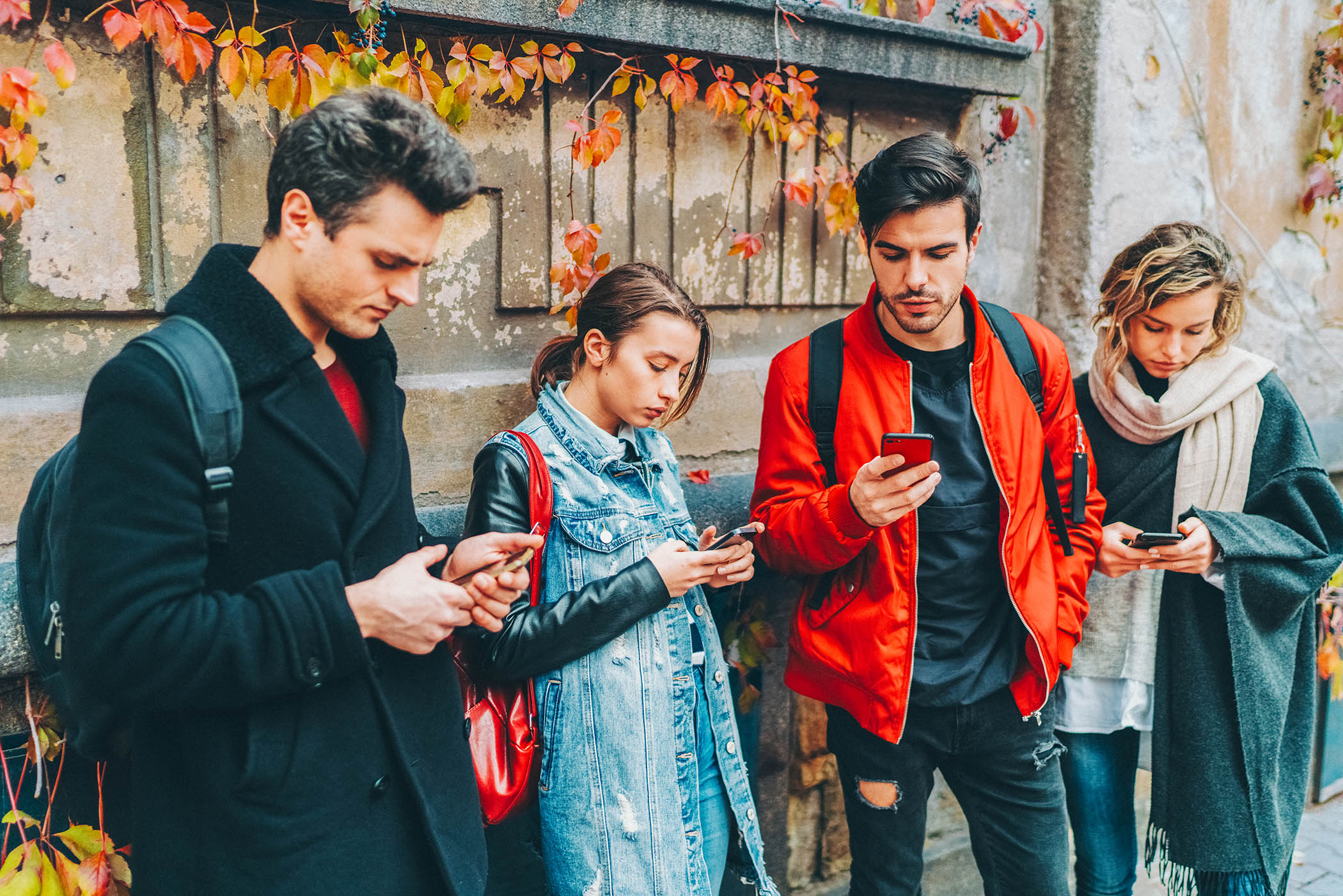


Next time you’re out in public and have time to kill, imagine you’re an anthropologist and do some people-watching. Notice that almost everyone who’s on their own — in a cafe, a train, waiting for a bus, queueing to board a plane — is looking at their phone. And what are they doing? Mostly scrolling or flicking endlessly through a feed of images, short videos or text messages. I once stood behind a young woman in a queue to board a delayed Ryanair flight, and for the best part of 30 minutes she simply scrolled through Pinterest images without stopping at a single one. She was clearly bored out of her mind.
Occasionally, you’ll see someone listening to a podcast or reading an article but even then they’re not typing or interacting with the device. And, like the woman in the queue, they often seem listless, displaying a quiet passivity that reveals an awkward truth: we have morphed into mobile couch potatoes — consumers of content curated by algorithms, transmitted by people we don’t know to be viewed on the tiny screens we now carry with us everywhere.
This passivity is a real phenomenon. The idea that the “unprofessionalised, uncommodified, unrefined masses” are quietly opting out of public posting — has hardened from speculation into something closer to empirical fact. Internal Meta charts unsealed during US antitrust hearings showed that the share of content posted by users’ actual contacts on Facebook fell from 22% in 2023 to 17% in 2025, and nearly a third of users now post less than they did just a year ago. On Instagram, it dropped from 11% to 7%.
There’s also the discovery that time spent on social media peaked in 2022 and has since gone into steady decline, according to an analysis of the online habits of 250,000 adults in more than 50 countries carried out for the Financial Times. And the decline is most pronounced among teens and 20-somethings, the groups whose attention tech companies crave most. “In years to come”, writes the FT’s John Burn-Murdoch, “we may well look back on September 2025 as the point at which social media jumped the shark and began rapidly accelerating its transition from the place to be seen (through a flattering Instagram filter), to a gaudy backwater of the internet inhabited by those with nothing better to do.”
Newsletters
Choose the newsletters you want to receive
View more
For information about how The Observer protects your data, read our Privacy Policy
What’s happened is that social media has progressively become less “social”. As Ian Bogost pointed out, when this technology first emerged in 2002, it was called social networking: it enabled users to post content and see material posted by people they knew (or at least knew of) rather than from across the entire world. But sometime around 2009, between the arrival of the smartphone and the launch of Instagram, social networking morphed into social media and everything changed. Instead of connecting people, the technology offered platforms through which you could publish content well beyond your network of immediate contacts. “Social media,” wrote Bogost, “turned you, me, and everyone into broadcasters (if aspirational ones). The results have been disastrous but also highly pleasurable, not to mention massively profitable — a catastrophic combination.”
The transition to unsociable social media confirms Cory Doctorow’s observation that all platforms go through the process of enshittification over time. “First, they are good to their users; then they abuse their users to make things better for their business customers; finally, they abuse those business customers to claw back all the value for themselves.” This is probably one reason why many users are now reluctant to post on the platforms. But the deficiency of organic human content seems to be regarded by Meta and the like as an opportunity — as a gap to be filled by AI-generated spam, pages, news outlets, ads and the manipulative creations of influencers.
The tech industry is doubtless unfazed by any talk of the “death” of social media. After all, active users of Facebook, Instagram, TikTok and X currently total 5.6 billion, with most of the growth coming from Africa and Asia. So although numbers may have peaked in the west, there’s life in the old monster yet. To survive, the platforms are morphing into something else: short-form video entertainment networks with a comment section and messaging utilities. And, of course, plenty of doomscrolling opportunities for new generations of those with nothing better to do.
What I’ve been reading
Changing course
Freedom of Navigation is a salutary blog post by Scott Galloway about the systemic implications of Trump’s war on Iran.
Different class
There’s a lovely satirical piece about Harvard by Richard Amesbury called We’re Diversifying by Hiring More Crackpots.
Straight to video
Kevin Hunger’s In the Belly of the MrBeast is a remarkable analysis of the world’s most successful YouTuber.
Photograph by Getty Images