

On a sweltering July afternoon, I walk along a Suffolk farm track with two large buzzards mewling overhead. I pass crumbling stone barns and a field studded with apparently abandoned farm machinery, and there is not a person in sight.
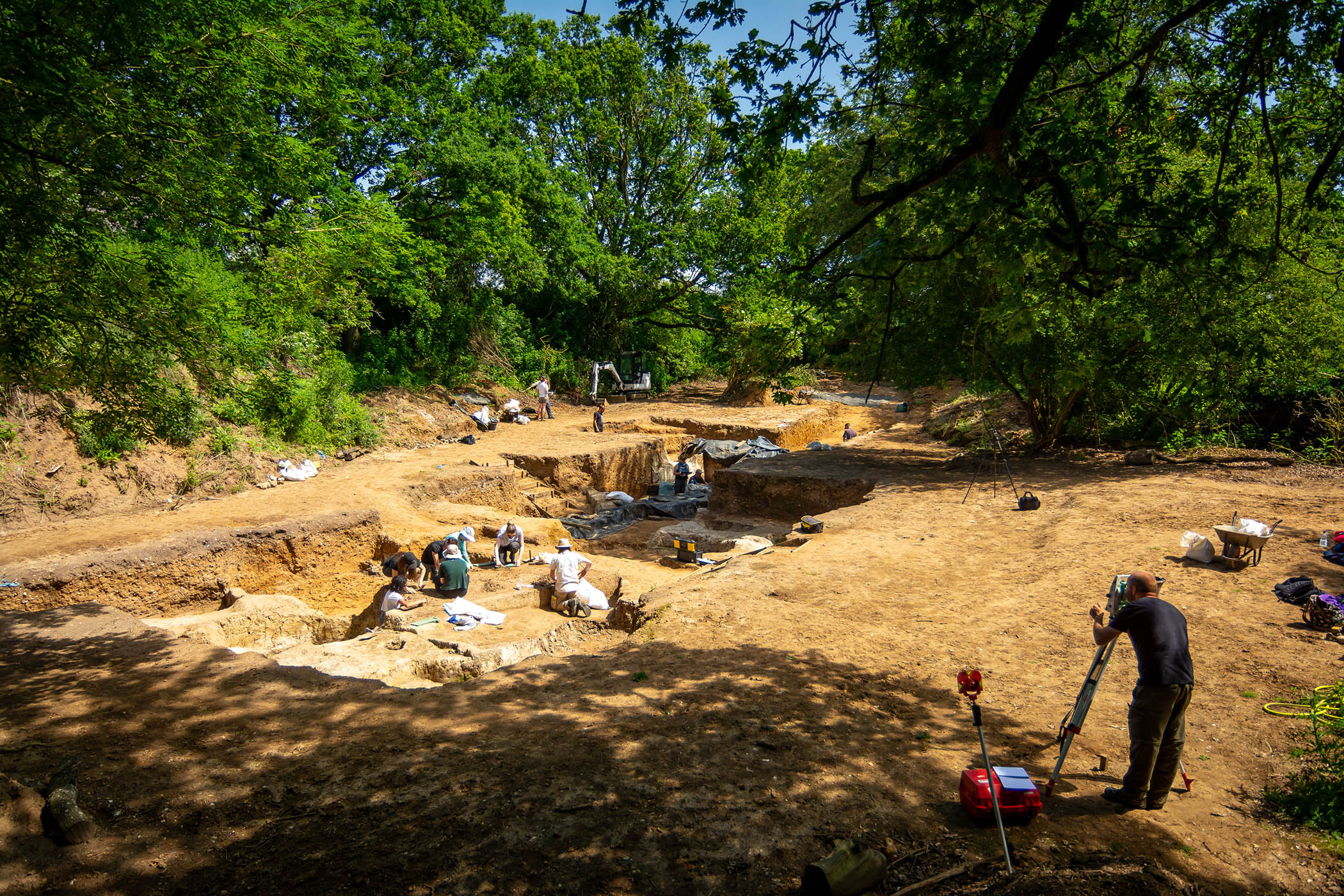
Ahead of me, though, on this patch of farmland outside the village of Barnham, there is a stand of trees, and tucked away behind it, I discover some temporary cabins and a man washing something in a bucket; the first clues to what lies hidden here.
Four hundred thousand years ago, in a 30,000-year warm gap in the very long ice age, there was a water hole where the trees now stand. Giant, straight-tusked elephants, rhinos and lions twice the size of modern African lions all came to drink in this pond. So did humans. Not modern humans like us, of course, but a mysterious archaic species of human currently labelled “early Neanderthal”.
Barnham has been a known archaeological site for decades, but as of this week, the importance of this place, just south of Thetford, has shot into the stratosphere. This patch of trees, and what lies within, is now arguably one of the most important prehistoric sites in the world.
That’s because about 415,000 years ago, a man or woman lit a fire here, a few yards back from the edge of the water hole, and what’s more, left evidence of having done so. This quiet, rural place can now boast being the site of the first place in the world where humans can actually be shown to have lit a fire. I am about to see the most important fireplace ever found.
Professor Nick Ashton, the man who discovered this fireplace, emerges from the temporary cabins to meet me. He is a curator of the Palaeolithic collections at the British Museum and has had an extraordinary career out in the field. As well as discovering this fireplace, he also led the team that discovered nearly one million-year-old human footprints on a beach not so very far away at Happisburgh in Norfolk. “They are still the oldest human footprints found outside Africa,” he tells me as we make our way into the stand of trees.
The professor first shows me the area that was once a pond measuring about 40 metres (130ft) across. Some of his team are at work here, digging slowly down through the ancient layers. Ashton says that this place used to be a good source of clay for the making of local bricks. Then, in the late-19th century, the workers started finding strange bits of animal bone in the glade, and archaeologists entered the scene, returning time after time over the decades to collect ancient animal bones and the small number of human-made flint tools found here. And why not? It’s a lovely place to dig, under the shade of the oaks, and it’s a great place for training archaeologists.
“Within these pond sediments, we get fantastic preservation of bone, teeth, shells, and a full range of animals,” says the professor. “You can imagine it as a sort of water hole with animals grazing, feeding in the water hole. There’s also access to good quality flint here. So you’ve got freshwater, you’ve got flint for tools, and animals grazing. Also, it’s a safe part of the landscape. It’s well back from what would have been the main river valley. It’s a sort of backwater.”
Archaeologists have found bones from lions and other huge creatures of the deep past here in the pond. Elephants in England were far larger than their modern counterparts; too large to hunt, in reality, although our ancestors would have certainly eaten them if they found them dead or struggling.
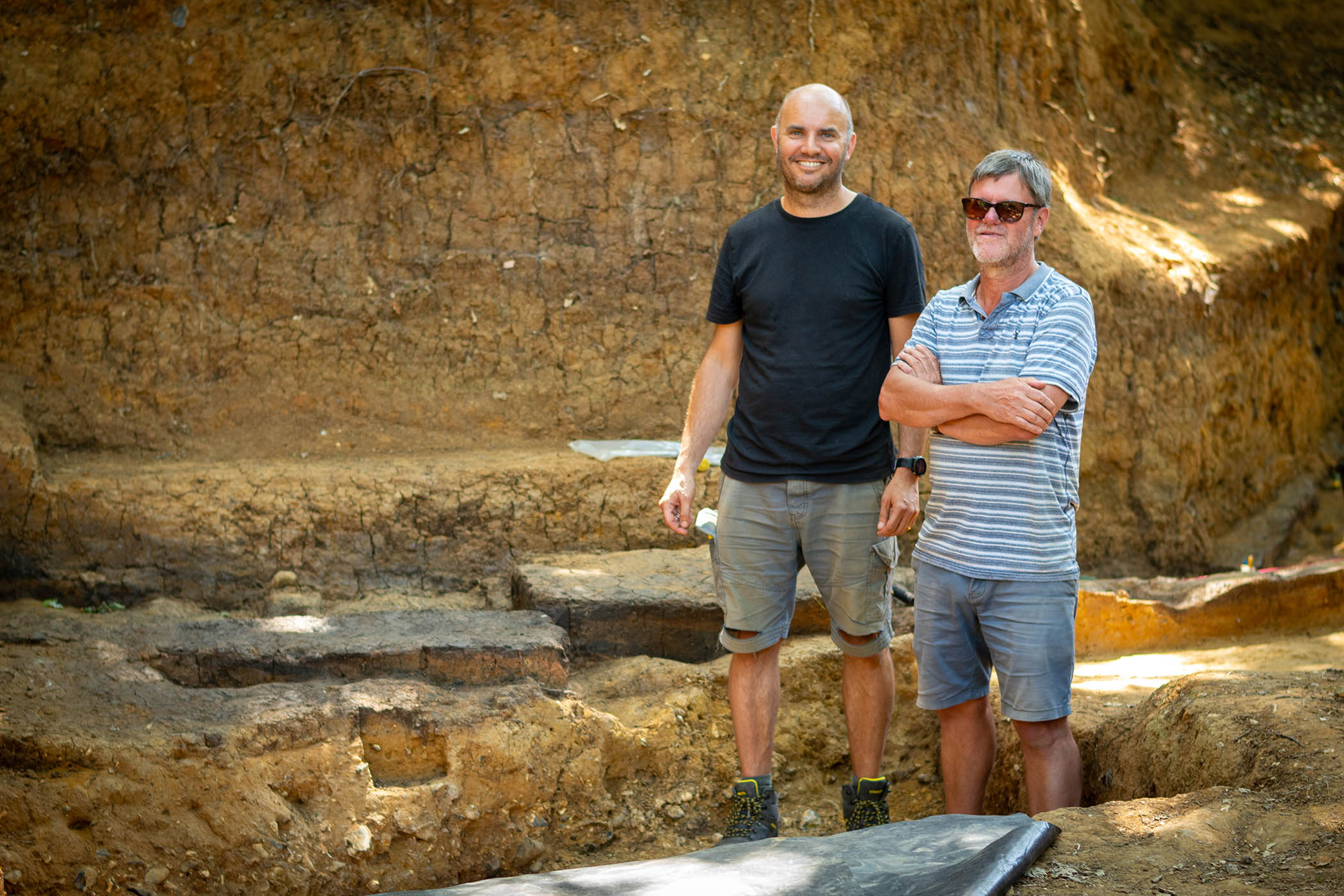
Dr Robert Davis, on left, with Prof Nick Ashton, who discovered the fireplace
But those big animals would have largely stuck to the main river valley, so it was safe here. The deposits also reveal, rather charmingly, that alongside the exotic bones of lions, pond terrapins and tree frogs, there are also the bones of far more familiar English creatures such as otters, wild pigs, cattle and even badgers and water voles. I had no idea there were badgers here 400,000 years ago.
Newsletters
Choose the newsletters you want to receive
View more
For information about how The Observer protects your data, read our Privacy Policy
So, a great prehistoric site with some evidence, in the few handaxes found, of humans present in this brief period when it was warm between 415,000 to 400,000 years ago. This has long been one of the most important sites in the UK, perhaps in Europe, in terms of ancient fauna. Nothing to write home about, though, unless you were really into old animal bones.
Then one day during the summer dig season in 2021, Ashton went to lie down near the edge of the site for an after-lunch nap. He laid himself out under an oak tree, but instead of going to sleep, he found himself thinking about the time, two years before, when the team had used their mechanical digger in the exact spot he was lying on. He remembered seeing some blackened soil they had never had a chance to investigate. Blackened soil could mean soil coloured by fire. Instead of napping, he got out his trowel and began to dig down through the layers … and hit a hearth. In doing so, he made scientific history.
There are older sites in the world where it looks as if humans used fire; perhaps carrying it to a campsite from a lightning strike elsewhere. But the oldest evidence of a place in the world where humans could be shown to have started a fire, and used it, was until now only 50,000 years old. The team working here now have pushed that figure back by 350,000 years.
Why is that a big deal?
Well, before we could reliably light and then control fire, our world was a much darker and more dangerous place. We also had to eat our food raw. Fire was a game changer both in personal and in evolutionary terms. After we had fire, we could protect ourselves; wild animals were scared of it. We could sit around a fire at night telling each other stories; there was a cultural aspect. We could go into deep caves and paint in there, which had artistic, cultural and perhaps religious aspects to it. And, of course, we could cook our food. That meant we gained more calories from it.
After we became masters of the flame, our brains changed, our physiology changed, our jaws changed. The human story crashed into the fast lane. And as far as we know, it could have all started right here in Suffolk.
The professor and his longtime collaborator and deputy, Dr Robert Davis, now show me the fireplace. Several pieces of tarpaulin are very carefully moved aside.
It is, as you might imagine, an area of blackened soil. Modest enough to look at, compared to the Sutton Hoo treasure, say, but then this fireplace was made at least 100,000 years before our species, Homo sapiens, had even evolved.
So the professor found the amazing fireplace. Why has it taken four years to publish that discovery (in Nature magazine this week?
The axes weren’t the clincher. What makes this site extra exciting is that we found two pieces of iron pyrite
The axes weren’t the clincher. What makes this site extra exciting is that we found two pieces of iron pyrite
It turns out that proving this patch of blackened soil was both a fireplace and that the fires in it had been set by humans was not at all straightforward.
First the team had to establish that the soil had been darkened by fire, not natural chemical processes. Then they needed to establish that the fireplace was somewhere many fires happened; not just a one-off wildfire event. Finally, they had to ensure that the chemistry of the fireplace had the distinctive heavy hydrocarbon markers that are associated with human fireplace use. The fireplace passed all these tests with flying colours, but none of that proved that the fire hadn’t been carried to the site many times from somewhere else.
Luckily, the team didn’t just have the fireplace. Next to the hearth, they found four heat-shattered flint axes; quite a number, when only eight axes have been found at the site. The axes weren’t the clincher, though. “What makes this site extra exciting is that we found two pieces of iron pyrite,” says Ashton.
Iron pyrite, those lumps of red, rather metallic stone you sometimes find in fields, was used as a fire starter in prehistory. If you strike it with, say, a flint axe, it will give out a spark and small pieces of pyrite will break off the main block. Small pieces just like the two small pieces of pyrite found here.
The archaeologists asked a local flint knapper, Will Lord, to come to the site, and he quickly showed them how the axes they had found could easily be used to make fire.
But what if bits of iron pyrite were lying around everywhere in the area 400,000 years ago and these small pieces were merely lying next to the ancient fireplace, at the exact same level as it, by pure chance?
A great deal more work then ensued before the team were confident that it was vanishingly unlikely that the pyrite pieces found hadn’t been created right there while a fire was being made.
“An analogy might be of the policeman finding a burnt-out car with an empty petrol can beside it in a remote bit of woodland,” says the professor. “The policeman might not be able to directly relate the petrol can to the car. But it definitely looks very fishy.”
So who were these fire starter people, the early Neanderthals? We probably have their DNA from a site in Spain, although not from the UK. They were thickset, tough, people, who lived in small hunter-gatherer groups. They were the ancestors of the Neanderthals who came later, with whom we interbred.
They were perhaps far more sophisticated than you might think. They hunted with 6ft-long javelins. They were expert butchers and workers of wild cattle hide. They may well have had clothing and tents. And we now know that these humans in Britain in those distant days had fire.
“As soon as you start cooking, it tenderises meat so you can digest it much better,” says Ashton. “It removes poisons or toxins from some roots and tubers. So suddenly your food range has increased. It means your populations are more sustainable, perhaps leading to larger groups. It also frees up energy … and one idea is that it frees up energy for development of the brain. So it’s really a key moment in human evolution.”
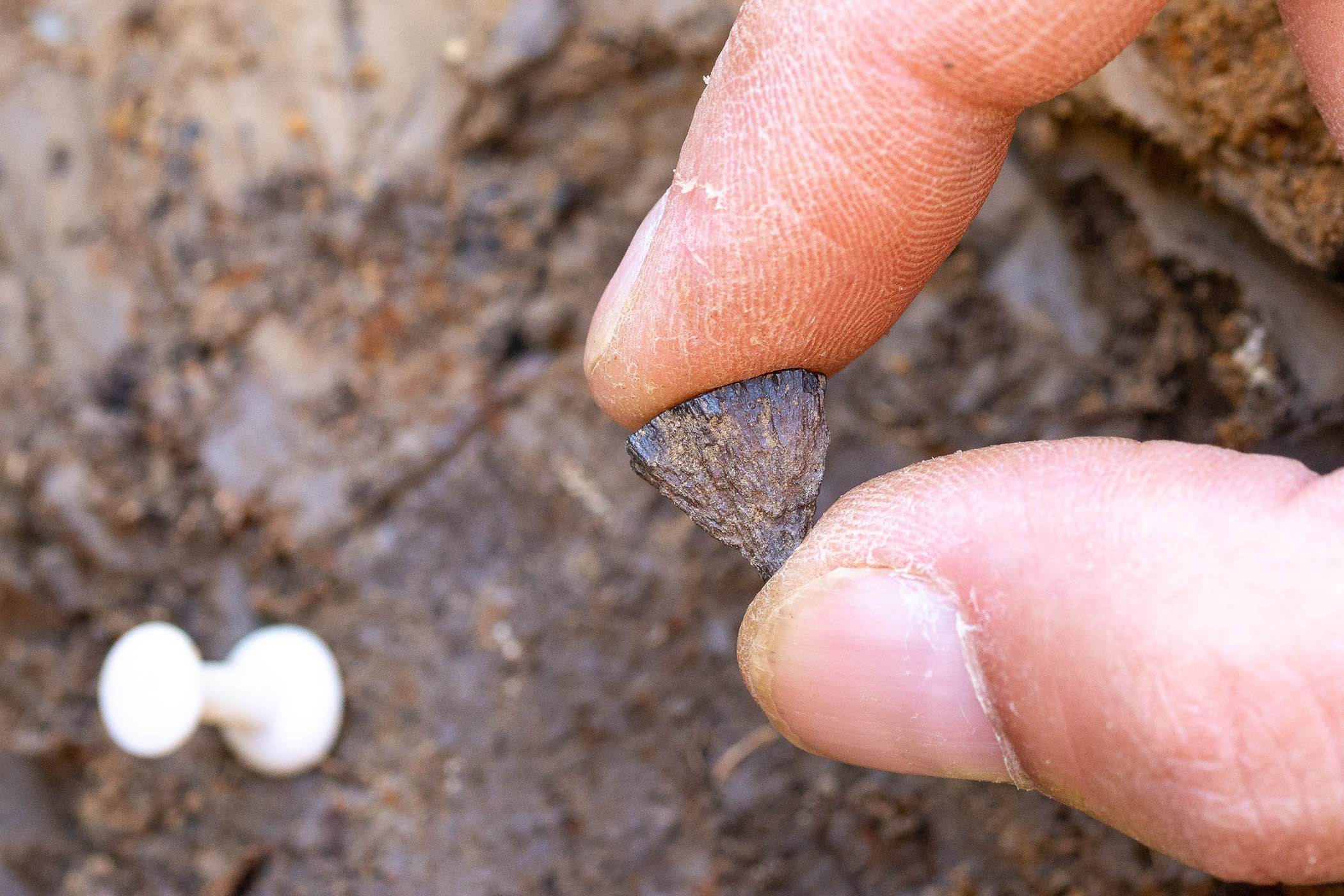
Iron pyrite, which was used as fire starter in prehistory
Interestingly, the Barnham excavations show that two groups of people visited the water hole and made camp during this brief warm window in the ice age. The first group make perfectly good stone tools but they are relatively simple. “Later, we suddenly get a different human population coming in, probably very soon after the first, where they’re making hand axes.”
Could they have ousted the first group? “We don’t know,” says the professor. “It could be a few generations [between the groups] or it could be overnight. They might even have integrated, or they might have killed each other. It feels like a huge jigsaw.”
The long-term aim is to try to preserve the fireplace, ideally by building a roof over it. Four years after first being excavated, the hearth is inevitably starting to crack and show signs of environmental damage.
I leave the team to their huge, ancient jigsaw and make my way back to the road, and the modern world. A few weeks later, however, I phone Davis with some follow-up questions about the site. I ask him why two such important finds – the million-year-old footprints at Happisburgh and the Barnham fireplace – lie so close together geographically.
“Fortuitous circumstances,” is his answer. With the footsteps, he says, the team were just incredibly lucky that someone recognised them for what they were while they were briefly visible on a beach.
With the fireplace, it’s a matter of geology. “That part of East Anglia has a really incredible record for this particular period of site from about 400,000 years ago [simply] because of the geological circumstances.”
The big glacial ice sheets eroded the landscape and, in this area, hollows formed beneath the sheets. The hollows later filled up with sediment. Then along came the Victorians, who wanted clay for bricks and found it in said hollows. “And you see that was happening after Darwin,” says Davis, “and you had all these Victorian antiquarians going around visiting all these pits and identifying fossils and stone tools.” In other words, a series of coincidences led to the discovery of the rare ancient land surfaces at Barnham.
So where does the Barnham fireplace rank in terms of a career highlight, I ask Davis.
“The top, absolutely,” he says, without hesitation. “[Footprints offer] an amazingly tangible connection to the past, but there’s only a limited amount of information you can get from them whereas [at Barnham you can] start thinking about these people 400,000 years ago actually making fires and all the implications that has for the way they could use the landscape. It’s just such a transformational discovery in human evolution.”
Emily H Wilson is a former editor of New Scientist, and the author of a trilogy of novels set in the cities of Ancient Sumer. Ninshubar, the final book, was published in August
Photographs by Jordan Mansfield