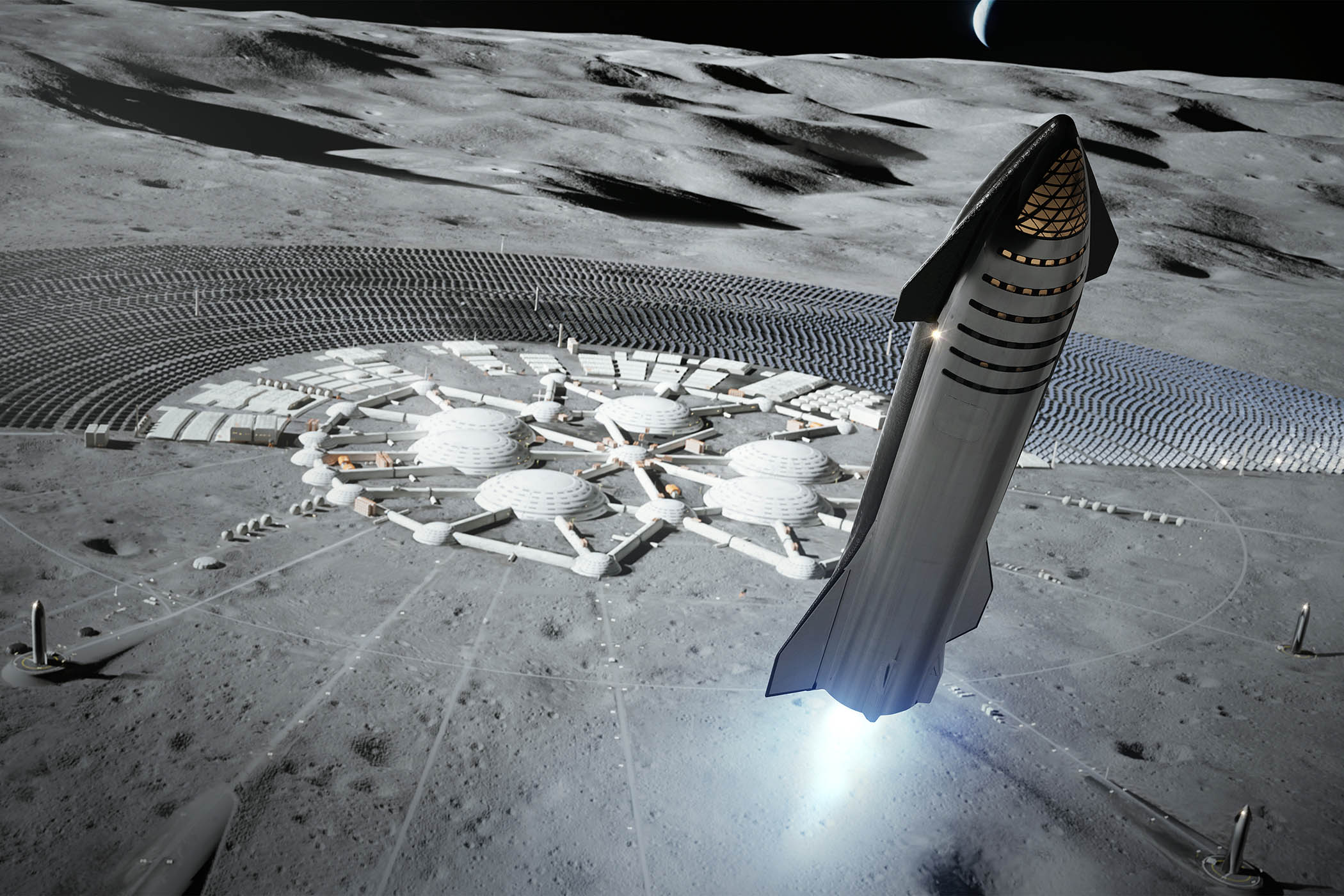

In February, Elon Musk lobbed an informational grenade into the highly strung community of people who would like to go to Mars. He posted a message saying he was no longer focused on going there himself. Instead, he said, his SpaceX rocket company was going to build “a self-growing city on the moon”.
For true believers this was a stab to the heart. For millions more it was a slow puncture. That soft pssssht you may have heard was the sound of hopes deflating all over the world – hopes that however odious his politics, Musk was going to take humanity on the greatest adventure of all time.
Instead, it’s back to the moon, and thereby hangs a tale.
A couple of days after posting his fateful message, Musk tried to explain himself. In a speech to SpaceX staff he said the idea was to build solar panels from lunar silicon dioxide, then fire them back towards Earth to power huge orbital data centres.
Mad as it sounds, this is in fact Musk’s plan. It would require hundreds of rocket launches and hundreds of billions of dollars to build equipment that would be much easier and cheaper to build on Earth. Will Lockett, a British tech writer who has earned a large following depicting Musk as an emperor with no clothes, says the moon plan “is so stupid in so many ways that it’s actually hard to explain why it’s stupid”.
Yet, oddly, it has pedigree. It was first sketched out in 1976 in The High Frontier, a book by Gerard K O’Neill, a Princeton particle physicist with a thing for space colonies. O’Neill went into detail about the lunar panel factory and an electromagnetic “mass driver” (like a rail gun) to hurl packages of panels into space. He also envisaged millions of humans living in space in enormous tubes, big enough for farming, lakes and wild birds.
O’Neill’s ideas served the twin goals of getting industry and power generation off Earth at a time when oil prices were out of control and environmentalism was catching on. They attracted a lot of attention, including that of a young Jeff Bezos, who as a high school valedictorian gave a speech on colonising space and turning Earth into a giant national park (and who then went to Princeton himself).
Bezos is still intent on moving humans to space, starting with the moon. Lately he has been teasing Musk with images of tortoises on X, the obvious inference being that slow and steady wins the race. So has he got to Musk? What is behind Musk’s moon shift, really?
There are plenty of theories, and one is that Musk would hate Bezos to grab the spotlight by setting up a moon base first. Ditto China. Also: Musk’s enormous Starship rocket keeps blowing up. And: he was spooked years ago by a conversation with Demis Hassabis, founder of DeepMind, who pointed out that whatever imperfections Musk wants to leave behind on Earth would follow him to Mars thanks to AI. This is the theory favoured by Peter Thiel, who set up PayPal with Musk in the 1990s. The Hassabis conversation happened in 2012. People who were there say it left Musk speechless. Thiel believes Musk spent 12 years mulling it over, and finally gave up on Mars in 2024.
But there is a problem with these theories. They forget the true believers, the most articulate of whom is Robert Zubrin, president of the Mars Society and author of The Case for Mars, who sees Musk as “a hero in the Homeric sense”. It’s ironic, he says. “Musk is the richest person who has ever lived and I don’t believe his driving motivation is money.”
Newsletters
Choose the newsletters you want to receive
View more
For information about how The Observer protects your data, read our Privacy Policy
In the Zubrin narrative Musk’s motivation remains Mars. But going there is expensive, which is why he’s taking SpaceX public in what could be the biggest IPO in history later this year, and why he’s switching temporarily to orbiting data centres, to show investors he understands the prodigious compute requirements of AI.
“If you have a space company right now, it behoves you to say your rocket is the ship that’s going to take you to Treasure Island,” Zubrin says. This is the only way he can explain Musk’s otherwise “fantastical” moon plan – as a stepping stone to Mars.
The stepping stone idea is part of Nasa’s official narrative too, and there is some validity to the idea that you should experiment with off-Earth base-building and manufacturing on the lunar surface before venturing further afield. If something goes wrong, it’s not so hard to get home. But Zubrin knows, and he knows Musk knows, that there are flaws in this thinking.
First, Mars has the raw materials for the relatively cheap manufacture of rocket propellant needed for the return trip; the moon doesn’t. And it requires more propellant to get from low Earth orbit to the surface of the moon than to the surface of Mars, because Mars has an atmosphere to slow you down, whereas approaching the moon at 17,000 mph, the only way to decelerate is to use rocket engines and precious heavy fuel.
Sometime soon, Musk says, his Starship will fly again. On the evidence of 11 launches so far, the chances are close to 50:50 that it will experience a catastrophic failure.
Lockett says the whole project is doomed because the Starship is so heavy it can barely carry itself to orbit, let alone a payload. Zubrin, who is a rocket scientist himself, reckons Musk will have fixed Starship’s glitches and perfected orbital refuelling within five years. Then the only question is whether he goes “half-loaf” to Mars via the moon, or more direct.
Except for Zubrin it’s not even a question. “He’s going for the full loaf.”
Illustration courtesy Space X