
It is 20 years since Arsenal bade farewell to their home at Highbury and moved 500m down the road. “The heart wants to stay at Highbury but the brain wants to go somewhere else,” said Arsène Wenger at the time. That somewhere else was a 60,000-seat stadium – an attempt to usher Arsenal into a new era of more fans, higher ticket prices and proper hospitality offerings. Initially earmarked to be called Ashburton Grove, it became the Emirates as a result of a naming rights deal, and so it has stayed for the past two decades.
The finale of the 93-year Highbury era could have been a first Champions League title. Arsenal contested the final for the first time in 2006, playing Barcelona in Paris in a match marked by Jens Lehmann’s famous dismissal after 18 minutes. Despite Sol Campbell still managing to put a ten-man team ahead, they eventually lost 2-1. Dennis Bergkamp watched on from the bench, his final appearance for the club already made. He was not the only departure that summer. It was also the last time Campbell, Robert Pires, Ashley Cole and José Antonio Reyes would don the shirt.
To move grounds is a profound change, one that James McNicholas on Tifo Football Podcast called “traumatic in some ways”. Of course, the location did not change significantly. You could still come out of Arsenal Tube station and walk to the ground. But fans were further away from the pitch, the four rectangular sides replaced by the oval. For those who had spent their whole life watching their team in one space, it was a jarring shift. Sponsor logos left any features identifying the club battling for eyeballs. They chose not to spell out Arsenal in the seats for fear of being off-putting to anyone wanting to pay for advertising inches. There were efforts from the club to wrestle an atmosphere into the new space, including an attempt to make Elvis Presley’s “The Wonder of You” the pre-match song. It didn’t last.
The move to a new ground can become an existential struggle for the soul of a club. It is telling that two other London teams who have moved in recent years are spending the back end of the season circling the drain of relegation. At West Ham, tourists file into the unsold seats every fortnight whilst Tottenham Hotspur’s shiny home is full of mod-cons but little hope. Arsenal pay their own visit to the London Stadium today. It will no doubt be a reminder of how far their own stadium atmosphere has come.
That is because football rituals, much like Ernest Hemingway’s assessment of bankruptcy, can happen gradually then suddenly. Arsenal adopted “The Angel (North London Forever)”, a song by Louis Dunford about the area the club is in, as a pre-match song. Derided as artificial by rivals, the fact that it was written by a fan has undoubtedly been a reason for its genuine popularity among Arsenal fans. In recent years, the club has doubled down on its efforts to make the Emirates feel like a genuine home. It is working.
It helps when a team starts winning again. In the Champions League, Arsenal had seven consecutive round-of-16 exits between the 2010-11 and 2016-17 season. There was a six-season absence from the top tier of European competition entirely. Then under Mikel Arteta, the rejuvenation slowly began. A quarter-final in 2023/24. A semi-final last season. And then on Tuesday night, Bukayo Saka, four years old when that game in Paris was played, scored to send Arsenal through to the final.
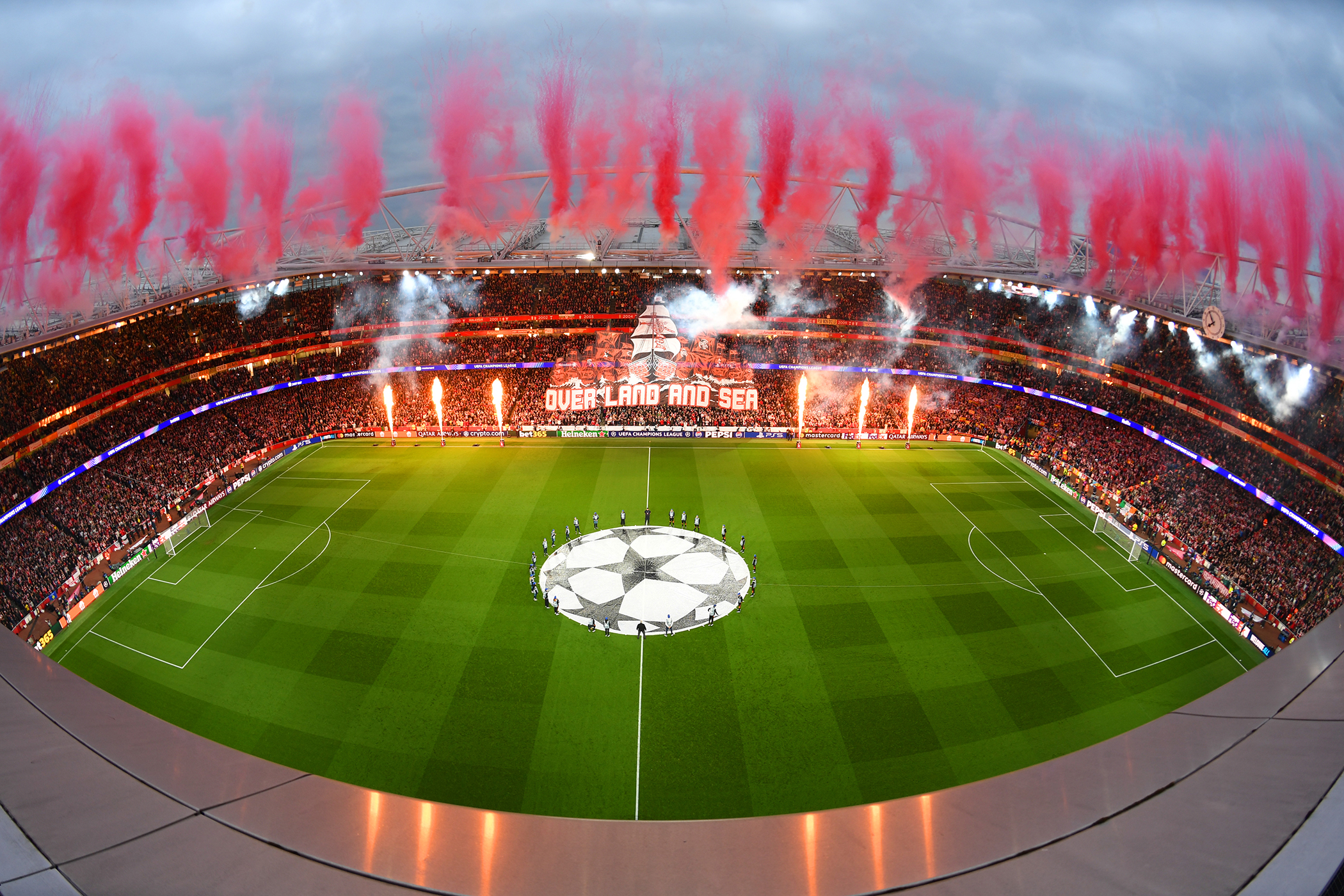
Everyone at the Emirates that night, including Saka, said it was an atmosphere unlike any they had ever experienced at the ground.
“I’ve never felt the Emirates like this in my whole career,” he told CBS after the match. “When the game started, they pushed us from the start to the end. It was a beautiful moment. This is probably the biggest game the Emirates has ever hosted. It was a successful one. All the fans that were here will go home and remember this night forever.”
The roundabout on Hornsey Road was engulfed in red flares before the match kicked off. Gunnersaurus was hoisted onto a fan’s back, conducting a rendition of “There’s only one Gunnersaurus”. Fans were in their seats early, part of a concerted effort of encouragement from Arsenal in order to build pre-match atmosphere.
It was a stark change from the more nervous and tetchy atmosphere that has characterised some of Arsenal’s recent home games. When they lost 2-1 to Bournemouth last month, there were boos at full-time. The struggle to get the title across the line has taken its toll on supporters who find themselves oscillating between anxiety and ecstasy. Nowhere was that clearer than their 2-0 win over Everton in March when they had to wait until the 89th minute to take the lead, before Max Dowman sent them into raptures with his first goal for the club.
Newsletters
Choose the newsletters you want to receive
View more
For information about how The Observer protects your data, read our Privacy Policy
The excitement tinged with optimism on Tuesday was undoubtedly impacted by the events of the night before. Manchester City contriving to draw 3-3 with Everton handed the advantage back to Arsenal in the title race that they had lost following their visit to the Etihad. Their own swashbuckling 3-0 win against Fulham on Saturday had also proved to be a relief, a departure from some of their more tense fixtures. Suddenly Arsenal seemed like a far more positive team with Myles Lewis-Skelly being used in midfield and a marauding Riccardo Calafiori at left-back.
It is not yet time to celebrate – although anyone who begrudged Arsenal fans enjoying themselves after reaching only the second Champions League final in their history should go touch some grass – but there is a sense that Arsenal have got through the worst that could happen to them. Regardless of what happens in Budapest, they have once again climbed to the summit of European football, despite fears that Arteta was not cut out for knockout football in the way he was for a league. And even though they fumbled their lead in that, it was their rivals who blinked first in the stand-off that will run until the end of the season.
There is still a possibility that they finish the season empty handed. Paris Saint-Germain are an imposing opponent to face in Budapest, their second leg against Bayern Munich showing that they can have the ability to take control of matches as well as to bully opponents with the rip-roaring attacking football that characterised the first leg.
Their remaining Premier League fixtures against West Ham, Burnley and Crystal Palace, who are in their own European final, look far more likely to be plain sailing. There will be no presumption but there has been a return of confidence, both on the pitch and in the stands, that the Premier League trophy will have red ribbons on it come the end of the season for the first time in the Emirates era. There could be no greater sign that the “Emirates generation” have finally come of age.
Photography by Stuart MacFarlane/Getty Images