

At this time of year, it is vitally important that certain conventions are upheld, no matter how tempting, or honest, it would be to break them. Football, after all, is not only inherently superstitious – nobody wants to tempt fate – but it takes a zero tolerance approach to anything that might even resemble presumptuousness.
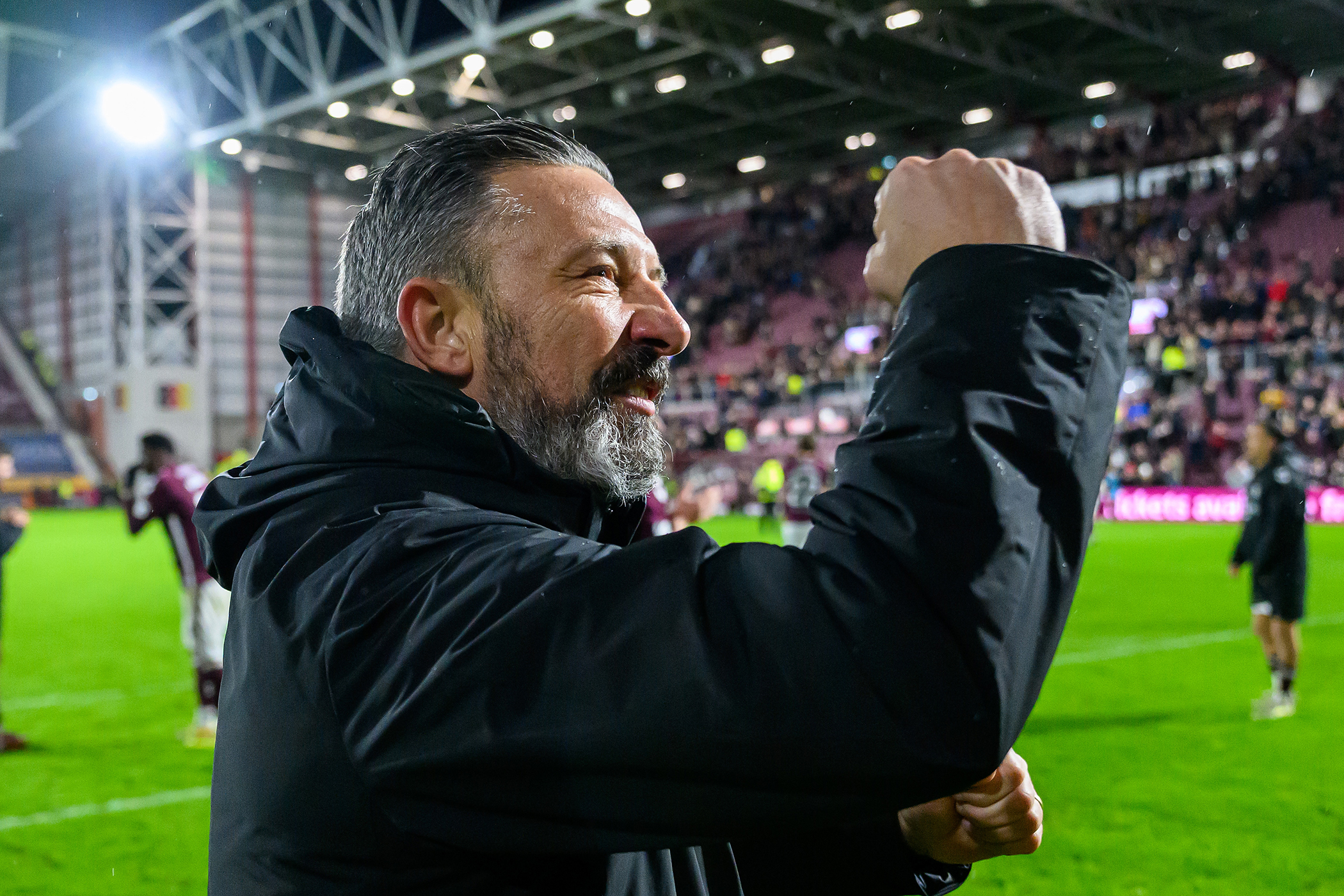
And so, as he stood on a pitch at Hearts’ Riccarton training ground a few days ago with a Sky Sports camera pointing at his face and a microphone hovering a couple of inches from his chin, Derek McInnes knew what he had to do. He was asked: “Is this the biggest managerial week of your career?” The Hearts manager’s answer, delivered with a straight face: “It’s certainly up there.”
It does not need to be pointed out that this is an understatement. McInnes probably had quite big weeks when leading St Johnstone and Kilmarnock to promotion. The few days before his Aberdeen team won the Scottish League Cup in 2014 would have felt significant, too. The denouement to his 2016 campaign, as Celtic pipped his Aberdeen side to the title, bordered on seismic.
It is meant as absolutely no disrespect to any of those achievements, praiseworthy as they are, to suggest they do not bear comparison to where he finds himself now. Starting with Hearts’ visit to Motherwell last night and encompassing today’s Old Firm game, then concluding with McInnes’s side’s visit to Celtic Park next weekend, the final week of this season is not just by some distance the biggest in McInnes’s career. It is the most consequential Scottish football has experienced – on the pitch, at least – for two generations.
Their late victory against Rangers at Tynecastle on Monday meant that Hearts found themselves three points clear of Celtic – and seven ahead of Rangers – at the top of the Scottish Premiership with three games to go. Nobody has been able to break the stranglehold of Glasgow’s duopoly on the Scottish title since Sir Alex Ferguson’s Aberdeen in 1985.
And now, Hearts not only might but arguably should. In taking it to the final week, they have already gone closer than most. Only the most unusual combination of results would mean the title is not on the line when they visit Celtic next Saturday; there is a chance that Hearts will travel to Glasgow needing not to win but only to avoid defeat.
That reality is slowly settling on the club’s players. Hearts have been top of the table, for all but a few hours, since the end of September; their lead has oscillated between eight points and nothing but goal difference, but they have clung on. It is only now, though, that winning the title is starting to feel like a possibility.
The scene that Cláudio Braga, the striker crowned as Scotland’s player of the year, painted of the Tynecastle dressing room after that victory over Rangers was one of wide-eyed astonishment. He and his teammates sat down, breathless and exhilarated, he said, all of them thinking the same thing: “Damn, three games to go.”
Born just south of Porto, a decent portion of his career was spent in the lower reaches of Norwegian football. He was steered to Edinburgh only because of the intervention of the all-seeing eye of Jamestown Analytics, the football data company linked to Hearts’ minority shareholder Tony Bloom. That Braga seems to grasp just how remarkable this season has been is, in its own way, quite powerful. It is an illustration of just how embedded the idea that Rangers and Celtic sit immovable and eternal at the summit of Scottish football has become over the past 40 years.
Most, in Scotland and elsewhere, assumed this was not just a function of economic strength or sporting history, but something more innate. In Glasgow, as fans of both clubs will tell you, second is nowhere. Neither of them has a catchy aphorism about coming third. This is, it has seemed, the natural order of things.
Newsletters
Choose the newsletters you want to receive
View more
For information about how The Observer protects your data, read our Privacy Policy
That hegemony has become inextricable from Scottish football’s identity. The Scottish Premiership has become a league designed to find out who gets to win a derby. Hearts are now 180 minutes, plus injury time, away from breaking that pattern, shattering the game’s most embedded glass ceiling, of doing something a whole country assumed could not happen. Is this the biggest week of McInnes’ managerial career? Yes, you could say it’s up there.