
In the minutes before Charlotte Dujardin entered the main arena at the London International Horse Show on Thursday afternoon, before the lights went up and the music started, she must have been thinking: “Is this a good idea?”
Over the last year and a half, she has been subjected to international condemnation, to death threats, to her business and income imploding as sponsors and owners raced to drop her. Her name, once painted proudly on golden postboxes in her home town of Enfield, and Newent, where she was living when she won two gold medals at the 2012 London Olympics, had turned, in one day, to something smelling more like horse dung.
This week, only a few months after completing her year-long ban for horse abuse, Dujardin was trotting back under the spotlights of the main indoor arena at the Excel Centre for the World Cup Grand Prix. It would be by far her biggest competition since her return. But beyond her performance lay an even greater test: how would the audience receive her?
If Dujardin had been allowed to name the horse she was going to ride in her comeback class, she couldn’t have done better than “Alive and Kicking”. Yet when she first started competing the 11-year-old mare (known in the stable as Audrey), she couldn’t have anticipated that she would have needed such proof of life.
At the 2012 Olympics, she and Valegro, her dancing partner, caught the imagination of the wider public, and in so doing, swept dressage into the mainstream. Once perceived (wrongly) as a niche interest for those not brave enough to jump or race, Dujardin and Valegro were the embodiment of strength, precision, artistry and an extraordinary symbiosis between horse and rider.
Together, they went on to win another individual gold in Rio in 2016, and handfuls of world and European championships. Dujardin’s OBE was followed by a CBE; there were rumours that she, like cycling’s Laura Kenny, would become a dame if all went well in Paris. A mews street was named after her in Enfield, where she grew up in – for the horse world anyway – modest circumstances.
And then the fall. Just days before the Paris games began, a video was released, showing Dujardin repeatedly whipping a horse. It made the evening news. To most of those who watched, it was shocking. Dujardin, on foot, was teaching a young girl who apparently couldn’t persuade her mount to do what was required. A third person, filming the lesson, is heard laughing.
The video led to almost universal condemnation; more whistles were blown, about other riders, but none of her stature. Dujardin immediately withdrew from the Olympics (her place was taken by the likeable Becky Moody, whose horse, Jagerbomb, has his own blog) and issued a statement, in which she claimed that “What happened was completely out of character and does not reflect how I train my horses or coach my pupils, however there is no excuse.”
As an apology, it came across as a bit lame. She later announced that she was pregnant, with her second child, and, like a hounded fox, went to ground.
There are still mysteries surrounding the video which, it transpired, had been taken four years earlier: why was she whipping the horse like that; was it out of character; who blew the whistle and why; and, most importantly, what did it say about dressage and, more broadly, about equestrian sport?
Newsletters
Choose the newsletters you want to receive
View more
For information about how The Observer protects your data, read our Privacy Policy
Although it’s believed that the video was released by an embittered former business associate, even Dujardin apparently doesn’t know for sure. There have been reports, however, that her determination to return to the top level of the sport was fuelled by a need to raise two fingers to her accuser. She spent the year – around the birth of her son – rebuilding her string of horses, training them and herself to a point where she could step out again, and win.
And she has. Up to this week, she was unbeaten in 11 starts, though they were at smaller events, away from scrutiny. She saved her big return for London.
In the warm-up arena, Dujardin, wearing a red down jacket over her navy tailcoat, is working with her horse. It’s been a tough couple of weeks: her old partner, Valegro, was put to sleep on December 1st (she released a polished statement about her loss).
There are no smiles, no banter with the other competitors. She has been drawn to go second; the highest-ranked combinations, including last year’s winner, Moody, and the current world champions, Lottie Fry and Glamourdale, will ride after the tea break.
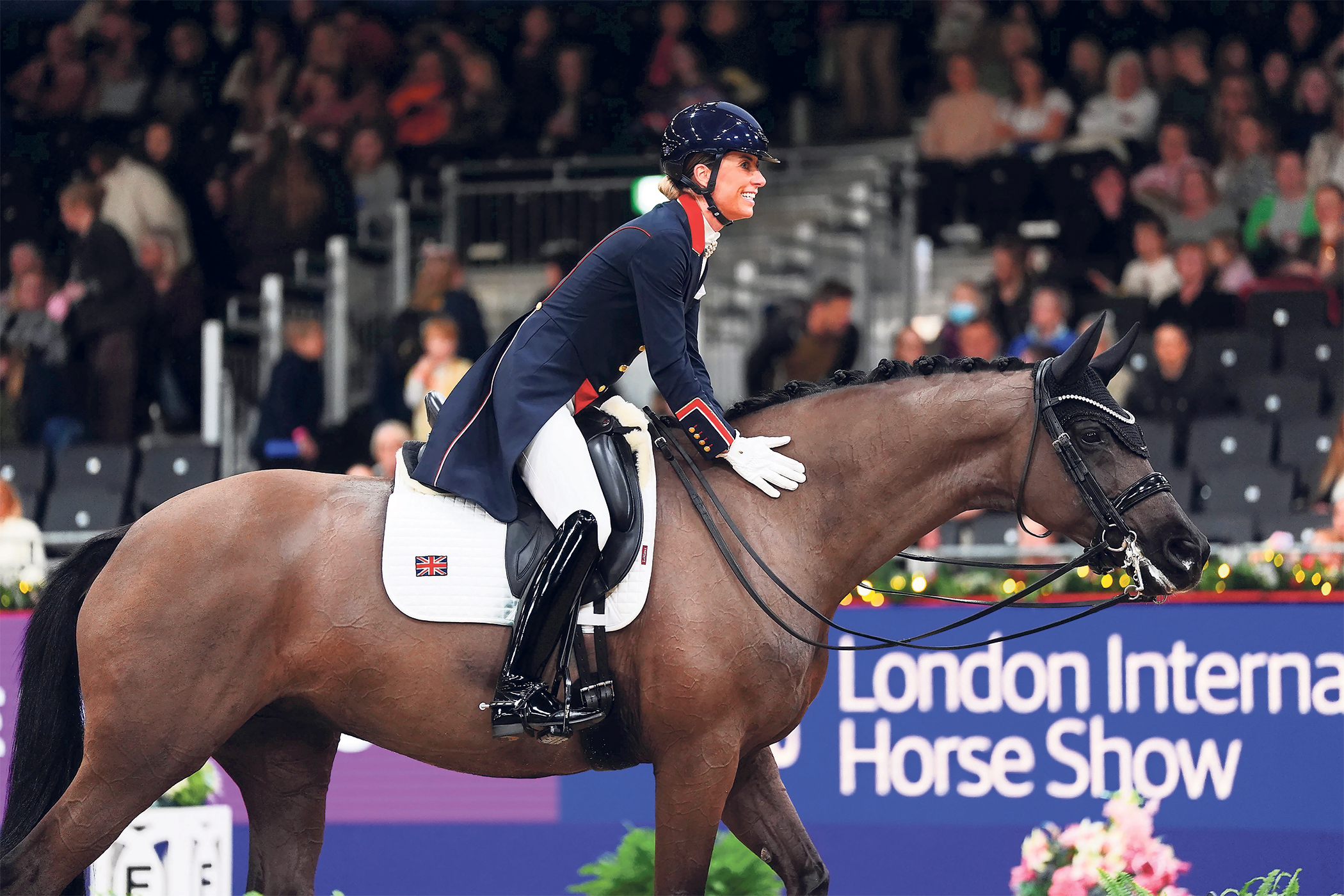
There are few empty seats; it’s unusually packed for dressage Grand Prix afternoon. Dujardin’s name flicks up on the large screens above that of her horse, Alive and Kicking. It’s a blatant statement (she could have chosen to ride her other top horse, Brave Heart II, which would have conveyed the same message, less powerfully). When they trot in, there’s a second of silence, as if people are waiting for a cue as to how to react, and then an upswell of applause. There are a few whoops, which almost tamp a single, low boo. And then silence as the music starts.
There are no questions around Dujardin’s ability. Once she enters the dressage arena, she and her horse meld into one. They float across the diagonal in a powerful extended trot, then skip back in faultless one-time changes; the piaffe has spring, the passage elevation; they maintain momentum in the tricky canter pirouettes. As she halts in front of the judges at the end of the test, for the first time, Dujardin smiles.
The score is announced: 76.544%. It’s good, higher than had been expected for a horse that was inexperienced at the level. She waves at the crowd as she leaves the arena, jumping off her horse to hug her partner, Dean Golding, and their son, who are waiting outside.
The consensus among the audience and members of the dressage fraternity at the Excel is that she has done her time and should be allowed to compete, without threats or abuse. They respect her ability, but, perhaps, will not be telling their daughters that, if they train really hard, they might one day be the next Charlotte Dujardin.
It remains to be seen whether what she did will have a lasting impact on the sport that, largely as a result of her actions and the publicity that surrounded them, has lost much of its glister.
The fairytale return survives until world champions Lottie Fry and Glamourdale, who score 80.783%. Dujardin, sitting in the stands with her family, apart from the crowd, claps. She has come second. And she was cheered.
Photograph by Ben Whitley/PA Wire