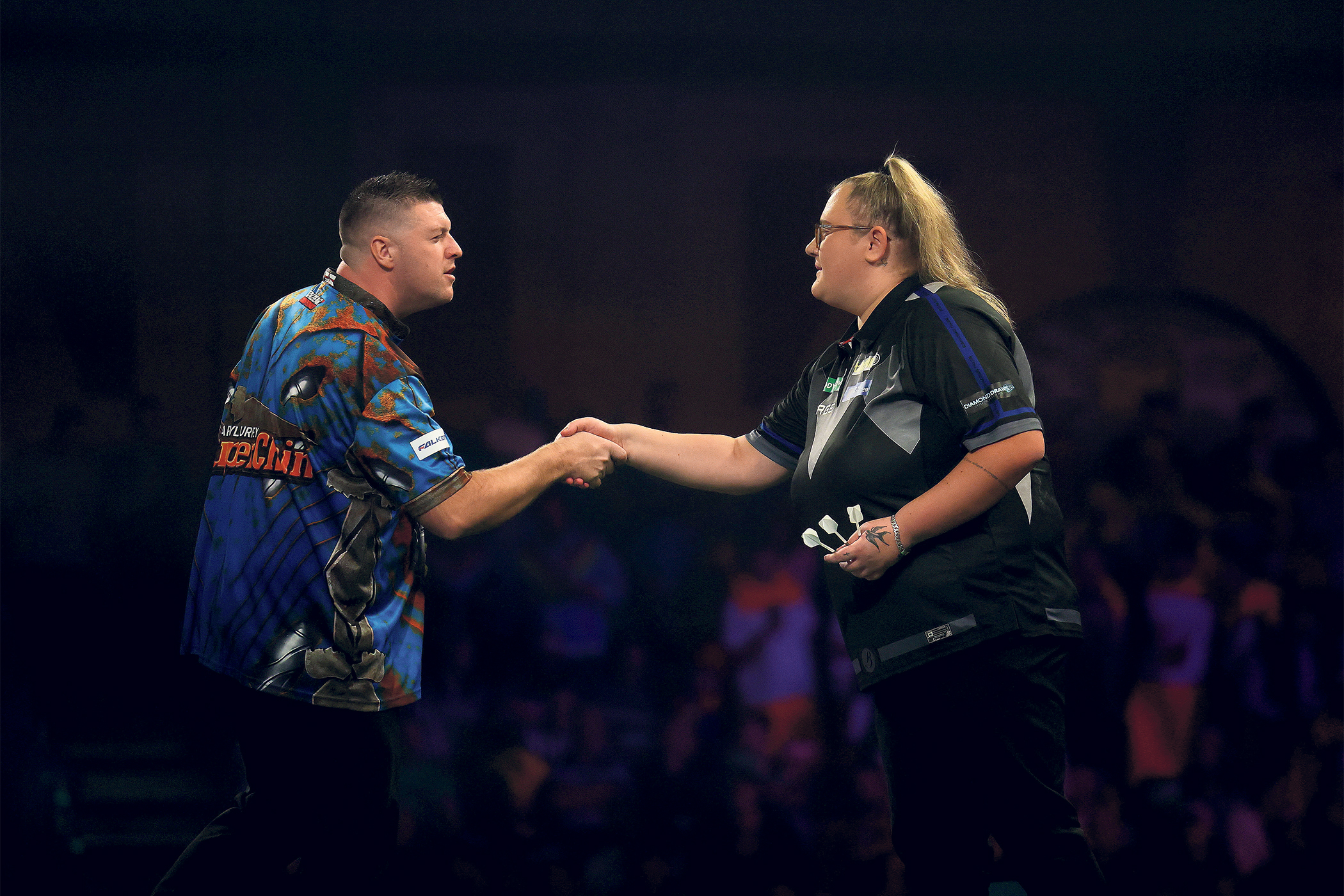


Beau Greaves stared past the board, lost in the noise, as Daryl Gurney roared in relief.
Still 21 and the best women’s player ever, Greaves did more than enough to vindicate her favourites tag in their World Championship first-round match. She hit the first 10-dart leg of this year’s event, having hit a 128 finish to break Gurney in the previous leg, averaging 108.75 in that second set. Hitting seven 180s and 38% of her checkouts, she had both the scoring power and opportunities to win a match she eventually lost 3-2.
In front of a crowd which gleefully cheered her every move, there was the sense she still does not quite understand how to harness the energy and adoration, let it bolster her rather than crush her. She started poorly by her standards, and veered wildly in quality. Gurney knew he would be cast as the instant heel and fed off it, grinning and snarling through the match, leaning into the wave.
Greaves is not naturally dramatic or outwardly emotional – she said pre-match: “When I was younger, they thought I was a mute” – and has played vanishingly few games in front of a crowd like this. Darts, particularly inside the Palace, likes to flatten everything into easily comprehensible stereotypes, a childlike world of heroes and villains, greats and no-hopers. It takes a certain type of player and person to thrive on that stage – Scott Williams and Ricky Evans are two who regularly produce their best performances of the year here, while Kevin Doets said after his first-round win: “The focus I have here is different to anywhere else.”
This year has been the first with an expanded field of 128 players from a record 34 nations, including a revamped first round where the seeded big names do not get a bye. Suspicions that this would lower the quality and entertainment proved ridiculous, as five seeds lost their first matches and 11 of the 28 debutants made it to the second round. Astronomers estimate that the Milky Way produces anywhere between three and seven new stars a year. One hall in north London has managed five this week alone.
The defining feature of the new format has been its prolific production of cult heroes. Last year, Bahamian debutant Rashad Sweeting was the Palace darling for hitting a 180 with 194 remaining and hitting the “Cold Palmer” celebration, but he won only one set. This year Paul Lim became the tournament’s oldest-ever winner, five weeks out from his 72nd birthday and almost 44 years since his worlds debut.
Nitin Kumar, an Indian based in Dubai, beat Dutch world No 48 Richard Veenstra. Australian Joe Comito, looking like an extra from the Sopranos, beat highly-rated young German Niko Springer. Players from five continents won a game for the first time. Darts has long been laying the groundwork to break the world, particularly in Asia’s soft-tip darts hubs. You suspect that this is only the start of another meaningful expansion and reshaping of the sport’s world order.
“I’ve opened the floodgates to a billion of them,” Kumar said. “I’m sorry, in 10 years down the line if you have eight people in the World Championship walking on to Bollywood music, don’t blame me. It’s happening!”
‘I believe that the more I dance, the more my darts fly well’
‘I believe that the more I dance, the more my darts fly well’
Motomu Sakai
Japanese No 1 Motomu Sakai’s ability to weaponise both the crowd and his theatrics was remarkable in 3-0 victory over Thibault Tricole, wildly celebrating every leg and set, milking the walk-on to its outer limit. The old cliché is that darts is a contact sport, but this increasingly includes the audience, who can influence proceedings more than any other sport. Of course, it didn’t help Tricole that he is French, which the Ally Pally horde find only minorly preferable to being prime minister, or sober.
“I believe that the more I dance, the more my darts fly well,” Sakai said. “I could hear everything, all the support from behind me, so that was giving me a lot of power.” His countryman Mitsuhiko Tatsunami clearly learned from him, taking a set off Michael van Gerwen later on Thursday.
Newsletters
Choose the newsletters you want to receive
View more
For information about how The Observer protects your data, read our Privacy Policy
The following day, American Leonard Gates gave the Sky presenter a dance lesson pre-match, before swinging onto the stage in ski goggles. “The Soulger” didn’t need to stop to sign autographs, because he had brought his own stamp. Of course, Kiwi Tim Pusey danced on stage after losing his first set to Keane Barry, then rapidly lost the next two. It is not a flawless defence mechanism.
Somewhere beyond all this, the sport is still at its best when authentic brilliance sneaks into the circus spotlight. Enter David Munyua, a 30-year-old Kenyan vet who first played darts in 2022, six years after his opponent, the 18th seed and 2024 Grand Prix winner Mike de Decker, turned professional. He boogied through his walk-on, because this was not just his first time at Alexandra Palace, but his first time outside Africa. He went 2-0 down in sets before producing a remarkable half-hour of finishing to win, including a stunning 135 checkout.
Munyua has gone viral, congratulated by the Kenyan president, only for his countryfolk to point out en masse that he had to be sponsored by an online gambling tips page to be here because the government refused to support him. But he said that the £25,000 that he has won so far will be used to further both his own career and darts in Kenya, which has just been opened to a new audience of thousands. In three years’ time, what fruits of Munyuamania will we see?
The temptation is to turn these cult heroes into novelty acts, but that undermines the size of their achievements. There’s a great line by Heinrich Heine, the German poet, that when the heroes go off the stage, the clowns come on. Here they’re one and the same.
Perhaps better than any other sport, darts has long understood the value of playing to the crowd, finding the perfect confluence between competition and entertainment. Behaviour at Ally Pally and elsewhere has degraded in recent years, with whistling and screaming at inappropriate moments commonplace.
Some players still try to fight it or let the baying mob get to them, but this is a reality that the sport is willing to accept when they can sell more than 100,000 tickets in 12 minutes. Learning how to live with the noise, or even take advantage of it, is now part of the game.
Greaves will join the open Pro Tour for the first time this year and is likely to play more and more big matches against the best and have more opportunities to learn the requisite timing and stagecraft. She is still only 21 and there is plenty to suggest that she is already among the 25 best players in the world. She has won 86 consecutive women’s games, largely away from TV cameras and crowds. But her next great challenge is finding her feet in the noise.
Photograph by Andrew Redington/Getty Images