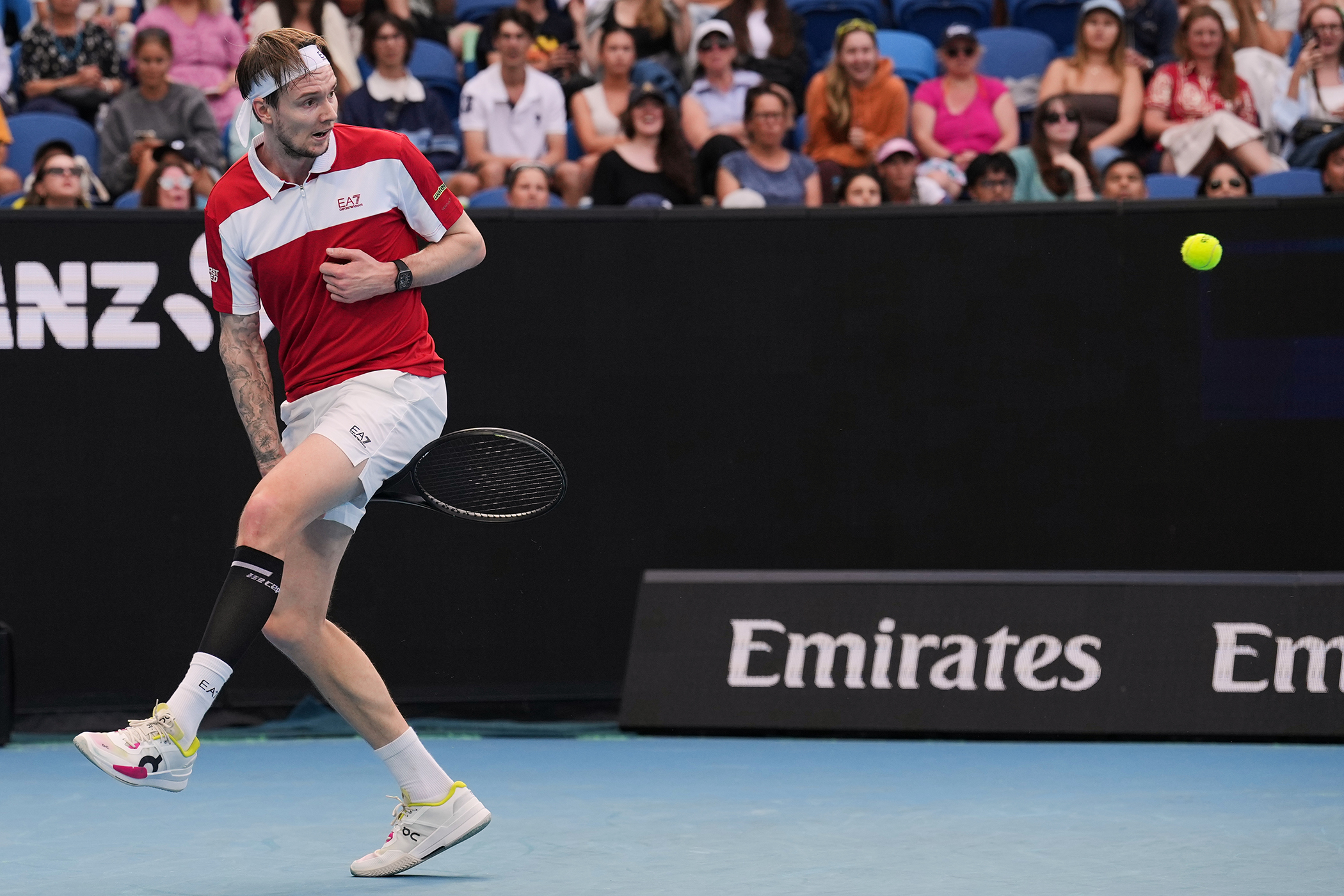
For most of his career, Alexander Bublik was a chaotic force of limbs and power and latent potential, predictably unpredictable, enduringly undurable. Lanky at 6ft 5in and calculatedly unkempt, he once hit six underarm serves in a single game and broke three rackets in one match. He has called his peers “robots”, tennis “a show” and doubles “not real tennis”, despite reaching the finals of the 2021 French Open men’s doubles.
“Ask who hit with the handle during the final of an ATP 250, they will say Alexander Bublik,” he says in an upcoming documentary. “Ask who won this tournament, they will not remember.” Nick Kyrgios once anointed the Russian-born Kazakhstani his successor as tennis’s bastion of nonconformism.
Having ended every year since 2020 in the world’s top 50, by March 2025 Bublik dropped to world No 82 and considered quitting, later saying: “I just burned out.” His solution? Three seemingly transcendental “Hangover” days in Las Vegas. After beating Alex de Minaur in the French Open two months later, he promised his coach he would focus on being professional and “staying in every battle, because I wanted to see if there was something inside me I could bring out”.
And since the start of June 2025, no player has won more than 28-year-old Bublik’s five ATP singles titles. He was the only player other than Alcaraz to beat Sinner last year, and it required Sinner to knock him out of the French and US Opens. Victory at the Hong Kong Open earlier this month lifted him to world No 10 for the first time.
In part, he has achieved this by limiting the theatrics and mind games, repressing his inner child. He is yet to attempt an underarm serve in the opening rounds of the Australian Open and Martina Navratilova called his 6-4, 6-4, 6-4 first-round win over Jenson Brooksby “buttoned-up tennis”. 5-2 down in the third set of his second-round match against Marton Fucsovics, a year prior he would have given up. Instead he won the set 7-5.
“I guess it all comes naturally – if you win more, you try to keep the wins,” Bublik said. “And if the thing’s going that way without doing many trick shots, why should I change?”
The impact of fatherhood on athletes is poorly understood, but anecdotally brings more difficulties than benefits. Yet Bublik says the birth of his now three-year-old Wassily and “thinking about how much I wouldn’t like him to see some of the bad behaviours I had in the past” was the main catalyst in his altered priorities.Now a self-described “full-time father, part-time tennis player”, he spent years not knowing who he was playing for. In September 2020 he said he hated tennis, predominantly because his dad forced him to play as a child, but by December 2023 he had decided he loved it again.
More than anything, Bublik wants to play less tennis – 18 to 20 of the 40 or so possible ATP events in a year. “If I lose, then I have to go back to a busy schedule,” he said after his first-round win. “I’m in Australia, there is no joy for me sitting here. I’d rather be home with my family, I came here for pure work and I have to deliver. Now I treat it like work – I used to like going out, sightseeing. I don’t care now. It’s just tennis courts and then deliver.”
Sport loves to mythologise its mavericks, but that flattens Bublik into something less interesting than he actually is
Sport loves to mythologise its mavericks, but that flattens Bublik into something less interesting than he actually is
In a way, Bublik is an avatar for tennis, and sport, as a whole. The more professionalised it becomes, the more money, power and prestige at stake, the less space for experimentation and frivolity, for the prioritisation of entertainment over success. The greater the pressure, the less incentive for risk. When invention occurs, it is primarily in the name of victory over joy – just look at the Premier League’s set-piece bubble.
But then where does real pleasure, real satisfaction, come from in sport? Is it not ultimately from success, from an appreciation of what has been sacrificed to achieve it? And what does it mean to be different and creative in tennis? Is it all tweeners and underarm serves, trivial dopamine hits, or is excellence thrilling in any form?
Newsletters
Choose the newsletters you want to receive
View more
For information about how The Observer protects your data, read our Privacy Policy
When Bublik plays something approaching conventional tennis, all gunshot forehand winners and devious drop-shots, it is magnetic and beautiful. In victory over Fucsovics, he still produced a tweener and regular drop-shots, but they were largely the best plays in the respective situations. In Melbourne, he has hit 95 winners and 85 unforced errors across six sets; still risk-laden, exhilarating tennis, but not pointlessly so. “Now I enjoy it more because maybe I’m gonna achieve something big that I never thought I could achieve,” he said last October. “It would be stupid to waste that.”
Nonchalance and not caring are defence mechanisms; it takes courage to risk everything, give everything, to win. There’s a temptation to call Bublik wasteful – so obviously possessing the requisite skillset to achieve more than he has but needing almost a decade to mature enough to take advantage of it. “You can’t really push someone,” he said after beating Fucsovics. “We learn from our own mistakes.”
He will likely play Carlos Alcaraz in the quarter-finals if he gets that far. Winning the Australian Open would send him to third in the world, a position he increasingly seems to deserve.
Sport loves to mythologise its mavericks, but that flattens Bublik into something less interesting than he actually is. Yes, he has played professional online chess and once ate a fan’s crisps having jumped into the crowd during a point. He was only able to survive on tour as long as he did by a preternatural talent almost squandered.
But Bublik is a fascinating example of how a player's game can evolve as they do and discover new purpose, supposedly too old to learn at 28. “I was happy doing what I did,” he said in his second round press conference. “I knew I wasn’t capable of being a stable top-20 player, but I was happy. I would not change a thing. “It’s important to keep yourself full, not to break parts or give pieces to someone because they told you this is the way to do it. If you go to work and you succeed, it’s nice. But what if you don’t? Hitting a great forehand never put my self-esteem higher or lower.”
Photograph by AP Photo/Dita Alangkara