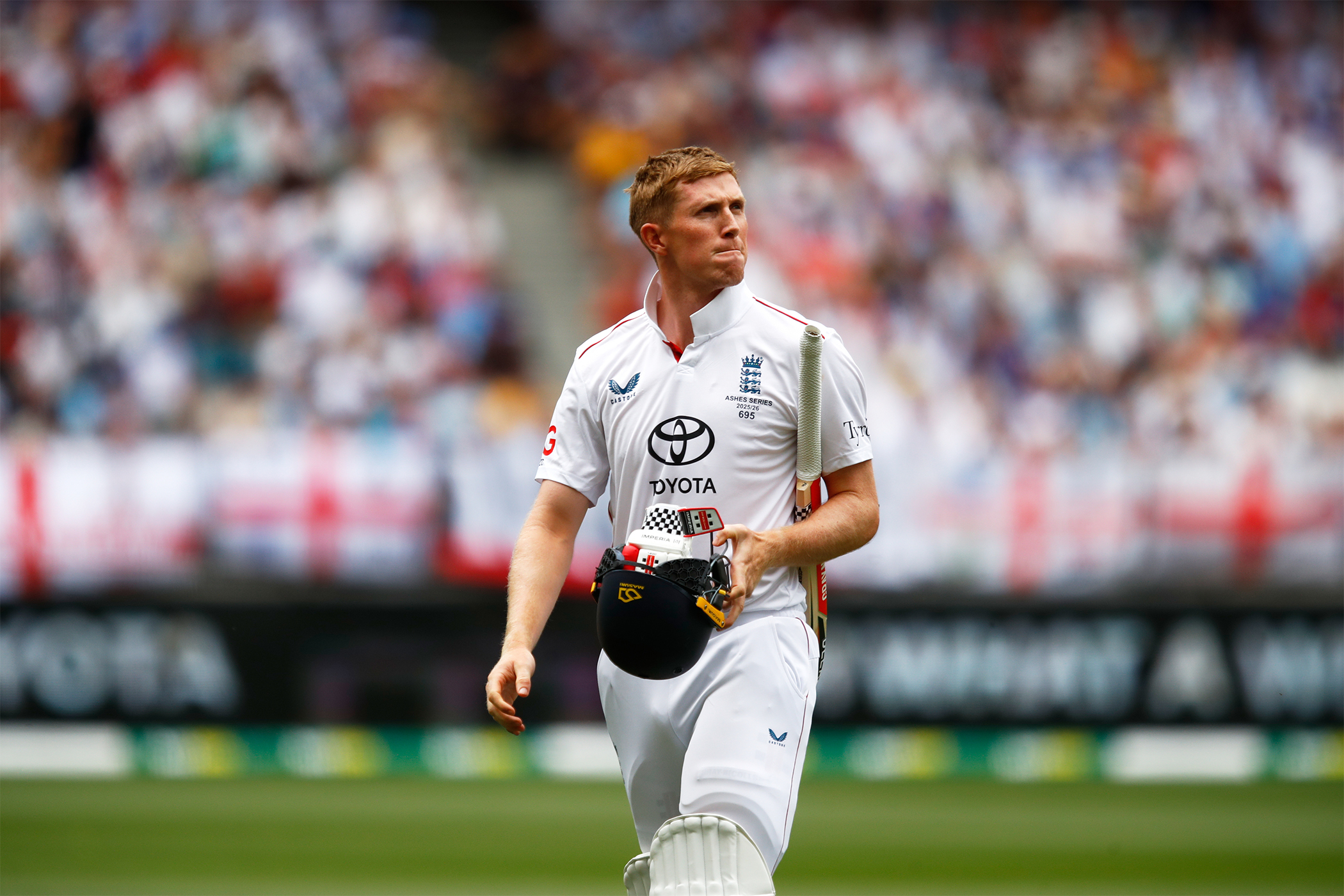

Back Zak, and don’t crack. That has been Brendon McCullum’s and Ben Stokes’s attitude towards their opening batter ever since they took over this England team, and even the ignominy of a pair in Perth will not throw them off course. Zak Crawley has been an automatic pick (injury permitting) in the past three and a half years and there is no question as to whether he will walk out alongside Ben Duckett in Brisbane on Thursday. It is not like England have a choice: they have retained Crawley specifically with this tour in mind, to the extent that they have not brought a viable alternative to Australia. They are past the point of no return.
Crawley’s record is extraordinary. After his miserable weekend in Perth – he failed to make it past Mitchell Starc’s first over two days in a row – no man in Test history has opened the batting so often (96 innings) and averaged less (30.22) in the role, yet McCullum refuses to budge.
“We believe he is a quality player, particularly in these conditions, against this sort of opposition,” said England’s head coach after his side’s two-day defeat. “Sometimes you get out early, right? It would have been nice if he hadn’t, but that’s life. If he can get going, he can do some damage.” It is a big “if”: two times out of five, he does not even make it to double figures. Crawley’s 77 at Sydney four years ago has long been held up as evidence of his suitability to Australian pitches, but he has scored only 89 runs in his other seven innings in this country.
Why, then, do England persist with him? The answer is simple enough: Crawley has long been seen as an outlier, with the rare traits of a player whose performance improves with the quality of opposition. As a teenager, he tailored his training to meet the demands of international cricket, working with the renowned Australian batting coach Neil “Noddy” Holder at his academy in, ironically, Perth, and attending spin camps in India. At 21, he was plucked out of county cricket and thrown into a Test squad despite – not because of – his first-class record. He immediately showcased his talent against fast bowling when facing Kagiso Rabada in South Africa, then peeled off 267 against Pakistan the following summer.
After two quiet years, he finally looked to have cracked Test cricket in 2023-24: he was England’s leading run-scorer in consecutive series against Australia (at home) and India (away), thriving against two of the world’s best bowlers in Pat Cummins and Jasprit Bumrah. His freewheeling 189 off 182 balls at Old Trafford in the 2023 Ashes underlined his ability to take down fast bowling, and to transform the tempo of a Test match almost single-handedly. Highly unusually, Crawley averages significantly more against balls above 85mph (36.06) than below (28.70) when facing seamers, according to analysts CricViz. I asked him why after the last Ashes: “You’re just trying to react,” he told me. “I don’t have to think as much.”
The two-day finish in Perth has left an 11-day gap between Tests, which must seem interminable for a player who said this summer: “I always play my best when I’m really relaxed.” Perhaps that sentiment explains why he has struggled quite so much away from home, where he averages 25.54. Since that India tour, Crawley has reverted to type: in the past 18 months, he has averaged 26, with his only hundred coming against a poor Zimbabwe side. The obvious fear is that his Ashes tour will go the same way for him as last year’s series in New Zealand, when he managed just 52 runs and was dismissed by Matt Henry in six innings out of six. Starc is the king of the pink ball – he has taken 81 wickets at 17.08 in day/night Tests – and will be lining him up again in Brisbane.
Crawley’s decision to skip the two-day tour match against a Prime Minister’s XI in Canberra this weekend was understandable: he will have far greater control over his preparation in the relative privacy of the Gabba nets than in a match situation against a substandard attack led by a 41-year-old Peter Siddle. Yet to many, it adds to the impression that Crawley embodies the worst excesses of Bazball. Before travelling to Australia, Crawley recounted that after a skittish 18 off 43 balls against India at Lord’s this summer, he had been praised by McCullum for his attacking intent: “It’s more about how we play and what we’re trying to do in terms of impact [than runs],” he told The Times. Which other team would indulge an underperforming player for quite so long, and find such tenuous justifications for his retention?
The two spare batters in the squad, Jacob Bethell and Will Jacks, have both opened in white-ball cricket but history shows that Crawley will not be dropped, at least not while the series remains live. Instead, England must hope that he can repay the unwavering faith that they have placed in him, in spite of so much evidence to the contrary. There is recent precedent for Crawley to follow, from the first Test against India at Headingley this summer: he edged Jasprit Bumrah’s sixth ball to slip in the first innings but batted without ego in the second, eschewing his trademark cover drive in a 188-run opening stand with Ben Duckett that put England on course for a five-wicket win. But will he replicate that template in Brisbane, or simply write Perth off as bad luck, continue to drive on the up, and hope that the same method brings a different outcome?
Clearly, there are benefits to consistency of selection: England’s approach has enabled Crawley to form a strong dynamic with Duckett, based around their complementary attributes, while Australia have cycled through eight different opening pairs since David Warner’s retirement early last year. But there comes a point when consistency becomes blind faith: Crawley is often described as a match-winner, yet in a six-year Test career has only twice scored centuries in England victories.
“That’s the thing with this Ashes. It may end up being like a referendum on this era,” Crawley said last month. The series could turn into one on him, too – and the early polls are not promising.
Newsletters
Choose the newsletters you want to receive
View more
For information about how The Observer protects your data, read our Privacy Policy
Photograph by AP Photo/Gary Day