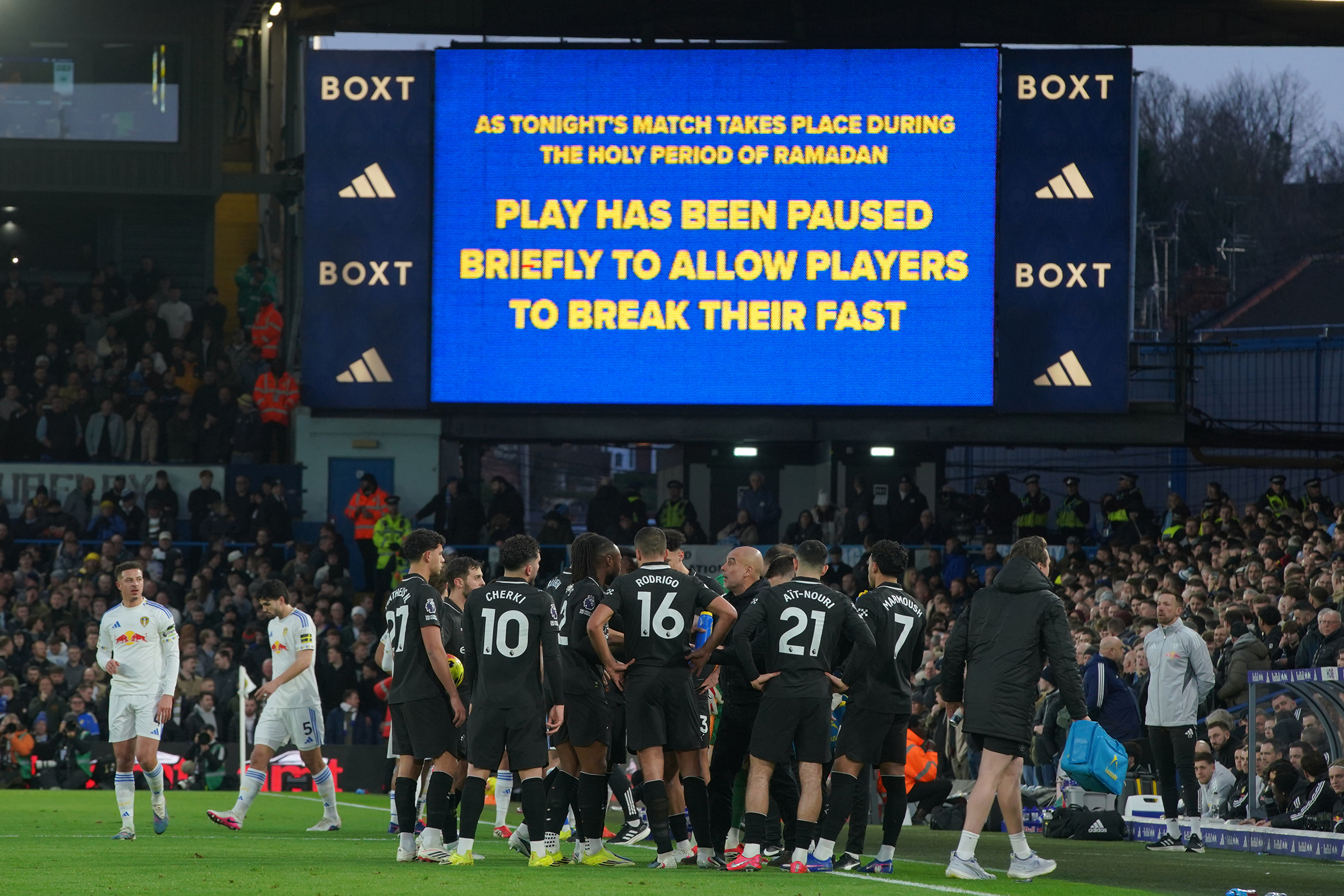

The boos started as soon as Peter Bankes blew his whistle, and both sets of players started to stroll to the touchline. They bounced and echoed across all four corners of Elland Road; a sign appeared on the big screen, at the corner of the South Stand, explaining that the brief pause was to allow those players keeping Ramadan to break their fast. It did not help. The jeers did not stop.
It was not everyone. It never is. In front of the press box – at the back of the West Stand, the prime spot for tracking the body language of a passing visiting manager – a handful of squabbles broke out, supporters taking their neighbours to task for joining in with the abuse. That does not make the fact that it happened any less shameful, any less appalling. “It’s the modern world,” Pep Guardiola said after the game, wearily, sadly, angrily. “You’ve seen what’s happened in the world again today. Respect religion, respect diversity. That’s the point.”
Leeds responded as quickly, and as imperfectly, as they could. The message on the big screen changed almost immediately, reminding fans that tragedy chanting, use of pyrotechnics and discriminatory behaviour are all criminal offences. That made little difference, too. The boos only stopped when the impromptu iftar was over, when the reserves of vitriol had been emptied.
The whole thing lasted maybe a minute; 90 seconds at most. There were three players on the pitch who had not eaten all day, all of them in the black of Manchester City – Rayan Cherki, Rayan Aït-Nouri and Omar Marmoush – as well as Abdukodir Khusanov, the centre-back, who was among Guardiola’s substitutes.
They each guzzled down some sort of energy gel, took a quick gulp of water. Their team-mates used the opportunity to grab a drink, too; their managers hurriedly passed on some instructions. It took less time than even a relatively obvious video assistant referee check, or for Arsenal to prepare themselves for the ritualistic theatre of a long throw. Not that it should matter, not that it does matter, but it should be stressed nonetheless: respecting the players’ religion – understanding their wellbeing, in fact – was no great imposition on the football-watching public.
Even that, though, was too much for some in the crowd. The defence, trotted out with suspicious speed online, was that this was proof that faith and football should not mix. That was the euphemism, anyway. Nobody is quite so zealous about that principle when a player lifts their shirt to reveal a vest committing themselves to Jesus. No, what too many – however many it was – in Elland Road appeared to find intolerable was the sight of Islam happening in public.
Elland Road has, for much of this season, been a raucous island in the sea of tranquility of the Premier League. Whole studies could be written on why the atmosphere at most of the competition’s stadiums – something that used to be its great selling point, a whole section in the pitch deck – has diminished over the last couple of years.
Ticket prices play a part; the dislocation of most of England’s clubs, too, the unavoidable sense that most clubs would prefer customers to fans. The generalised dissatisfaction that appears to be the resting state of most crowds now might be not only the most complex factor but the most crucial; it can be hard to escape the feeling that this is not quite as much fun as it is supposed to be.
Leeds, though, have been an exception; only Sunderland supporters, just as joyous at their club’s return to the elite, have been so persistently buoyant. There is a reason that Daniel Farke’s side had, until the visit of Manchester City on Saturday, been quite so indomitable at night. Leeds had not lost an evening game all season; they have not, in fact, lost any of their last 25 league or play-off matches at home – stretching back to 2023 – when they have kicked off after 5pm. It is not that Farke’s players are, like their manager, night owls. It is that Elland Road is a bearpit.
There has understandably been a desire to celebrate that, to emphasise the hostility that visitors face here, to fetishise the noise and the passion. It is what made this game so appealing, the sense that it would be a genuine test of Manchester City’s mettle. It is not a place for the faint-hearted; cosseted modern players, after all, wilt when faced with a throwback.
Newsletters
Choose the newsletters you want to receive
View more
For information about how The Observer protects your data, read our Privacy Policy
The game lived up to that reputation; City were outplayed for almost all of the first half and had to cling on for dear life as Leeds threw all they had at their illustrious guests in the final few minutes. Guardiola will know that this slender, slightly fortuitous victory represented the clearing of a major hurdle; he seemed to take particular relish in gesturing to the Leeds fans at the final whistle.
That minute, those 90 seconds, though, overshadowed all of that. It will doubtless be presented as a football problem, a Leeds problem, in the days to come. It is, of course, nothing of the sort; football’s power has always been that it is a lens through which we see ourselves. The image that it cast was not a pleasant one.
How it would have felt for the players, for the Muslims in the crowd, for the Muslims watching elsewhere is not something that should be approximated by others. But the impact should be profound on everyone else, too: the feeling of sorrow, of despair, of shame that follows in the wake of bile. It was not everyone. It never is. But it is some, and that is a problem, for us all.
Photograph by Ian Hodgson/AP