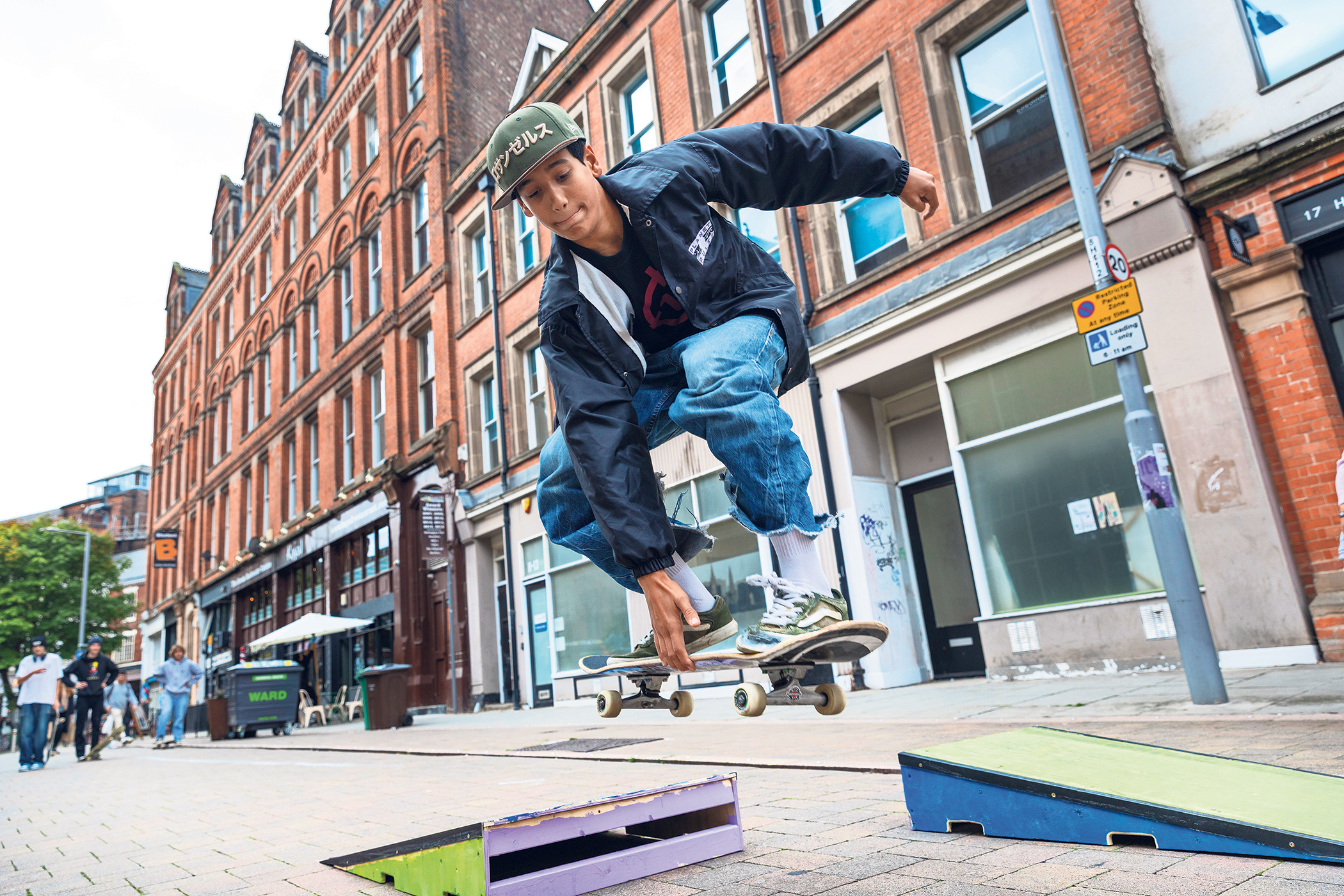


With just two years to go until skateboarding’s return to its mythical home of Los Angeles as a fully fledged Olympic Sport, Team GB look in good shape to win a medal through their star skater, Sky Brown. In a rain-soaked São Paulo, Brown has just won her second World Championship, adding to her bronze medals from the Olympics in Tokyo and Paris.
But while UK skateboarding continues to be a force on the global stage, new research commissioned by Skateboard GB and funded by Sport England highlights significant gaps in infrastructure back home.
Surveying more than 2,000 skateable spaces in the UK, researchers – led by Dr Esther Sayers from Goldsmiths, University of London, and Stuart Maclure from specialist design and construction firm Betongpark – found that, as well as lacking any Olympic standard skate parks, there are significant regional disparities in provision of skate parks of any kind. Of the spaces surveyed, more than 50% were deemed not fit for purpose.
Brown lives and trains in California. As do her fellow Team GB skaters Andy Macdonald and Tommy Calvert. Macdonald explains the challenge. “Skaters based in the UK are at a distinct disadvantage simply because the skateboard infrastructure is 20 to 30 years behind what it is in places like the US, Brazil and Australia,” he says.
A key contributor to the confused state of skate park provision in the UK is arguably the ambiguity of what exactly skateboarding is. Despite its recent status as an Olympic sport, skateboarding maintains an identity that it is decidedly not a sport. Outside of elite competition, there are no rules.
The length of a cricket pitch, the width of a football goal, the height of a tennis net. These are familiar measurements – or, at least, approximations of them. This makes the design and provision of them pretty standard. It’s difficult to get, say, a tennis court drastically wrong. But what should a skate park look like? That, it turns out, has been much easier to screw up.
Each time a new skate park is built it is an act of negotiation – or rather compromise. Fears of noise pollution have led many local authorities to allocate space for skate parks away from other areas, inadvertently making them less accessible and feel less safe for users. The cost is almost always limited and has meant that, particularly in the late 1990s to early 2000s, local authorities would often select cheap off-the-shelf metal ramps that they dropped on a patch of asphalt. Pre-cast concrete parks, designed by companies that usually build play areas, sometimes end up more closely resembling a child’s drawing or AI hallucination of what a skate park should look like.
‘New and inspired skaters need a place to learn, progress and build community’
‘New and inspired skaters need a place to learn, progress and build community’
Skateboarder Andy Macdonald
There have been significant improvements in quality in the past five to 10 years, with more knowledge sharing among experts and more specialist skate park builders delivering hand-finished, free-form concrete parks. But the commissioning and building of skate parks has still been haphazard.
The new study, Skateboard GB hopes, is a significant step in rectifying this. It is not looking to introduce a formula or standardise provision. There is no one-size-fits-all skate park. But, for the first time, it is able to provide evidence and guidance on best practice for what can make a skateable space flourish. Not just the design of the ramps, but whether it’s easy to get to, affordable to access and feels safe for all users.
The influence of the Olympics could incentivise the construction of more advanced skate parks, but Olympic-sized ramps aren’t necessarily accessible to the average skater. “We have found that there isn’t enough, or any, provision for elite level stuff,” says Sayers. “But equally, you can’t just provide elite level facilities. People have to get to that level. So we need spaces that give the opportunity for progression at all stages.”
Newsletters
Choose the newsletters you want to receive
View more
For information about how The Observer protects your data, read our Privacy Policy
With limited funds, there’s a potential tension between where to focus efforts between the elite and the grassroots level. For Team GB’s Macdonald, the UK needs to find a way to do both.
“Sky Brown needs a place to continue her Olympic journey while inspiring the next generation,” he says. “At the same time, new and inspired skaters need a place to learn, progress and build community.”
Bella Warley, Skateable Spaces Development Officer at Skateboard GB, says that, beyond the size and quality of ramps or ledges, the biggest takeaway from the new research is the vital importance of an active community.
“This shines a light on the need for longer-term funding,” says Warley. “Grassroots communities that take ownership of skateable spaces positively impact those spaces in lots of ways.”
Investment in skate parks most often spikes at the point of construction but then flatlines when it comes to activating or sustaining the space. As well as involving communities in the design and planning stage, the research shows the benefits in supporting them to run skate lessons, competitions and jams. This helps maintain the space, draw in new users and get the most value for money out of the skate park, yet historically this has been harder to get funding for.
While those with their sights on skateboarding gold for Team GB pursue spending on Olympic quality facilities, something local authorities can do right now at relatively low cost is invest in communities and bring skate parks up to a good standard across the UK. This would benefit the highest number of people. It might just also create the very space needed to nurture the next Sky Brown.
Photography by Gary Calton for The Observer