
The first time Sharon Mitchell left EastEnders, it was meant to be forever. The actor who portrayed her, Letitia Dean, had been playing the role for a decade, since the show’s first episode. She wanted a change. Having gained revenge on her former husband, Grant, Sharon climbed into a black cab on Albert Square. She was not coming back.
The second time she left, as Sharon Rickman, she was going even further. This time there had been something to do with a murder. She was pregnant, and for reasons that probably made sense if you followed them, her former brother-in-law and also lover, Phil, was helping her to flee to America for her own protection. She would be gone for good.
The third time she left, last year, everyone was sensible enough to leave the door ajar; Dean’s most recent departure was characterised, instead, as an extended break. The scriptwriters and showrunners at EastEnders know, now, that there will eventually come a point when they reach for the giant emergency cord marked “Sharon.”
The relationship between soap and character, between writer and actor, is so well-established it has become symbiotic. They will always find their way back to each other, no matter how hard they pretend otherwise. There are, after all, only so many ideas in the world. It’s inevitable that, sooner or later, you are going to start playing the hits.
In a similar vein: last week, it emerged that Real Madrid have identified their preferred candidate to take over as manager at the end of the season. The post is currently occupied by Álvaro Arbeloa, the youth coach who was promoted to the role after Xabi Alonso was dismissed just a few months into the job late last year.
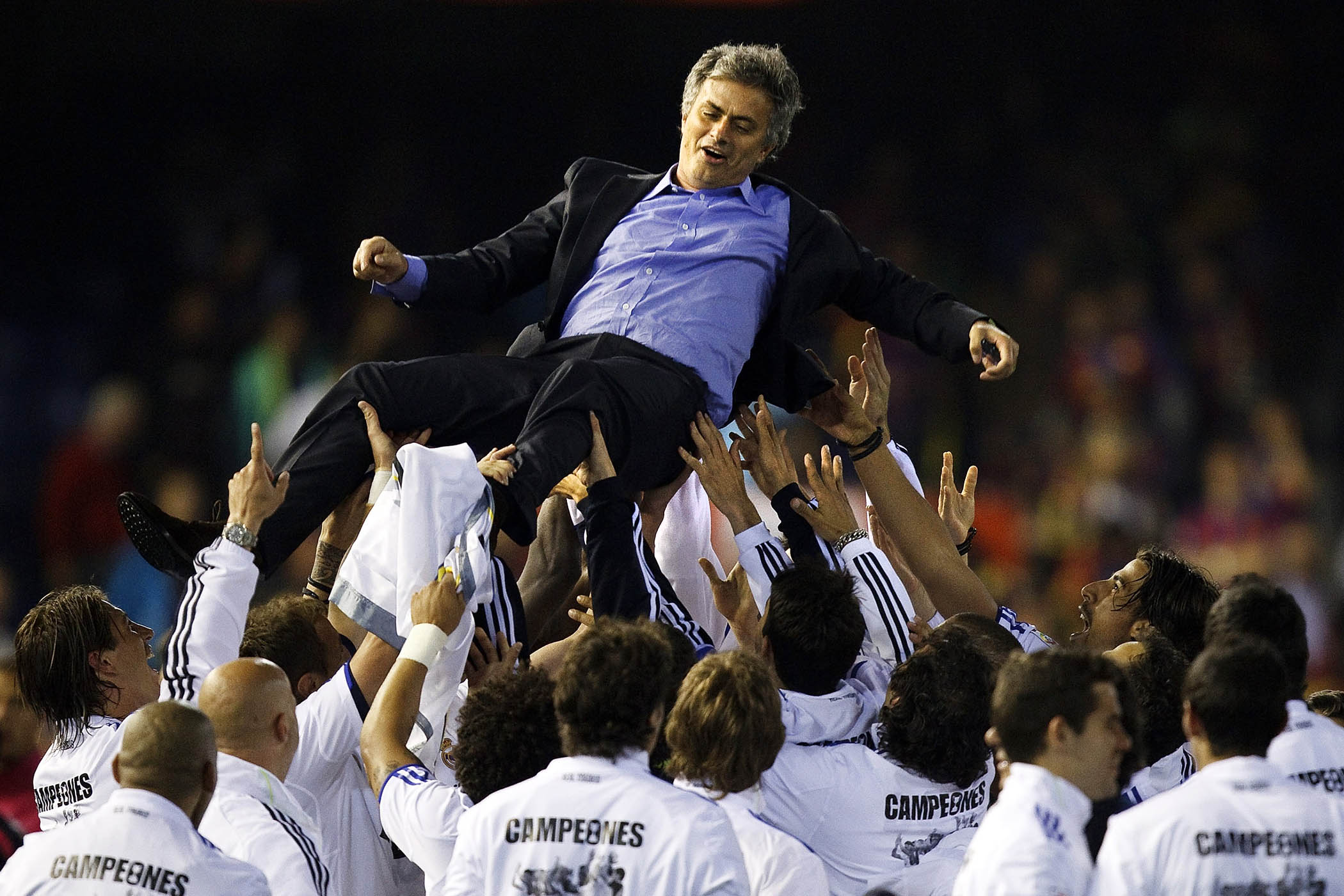
Like the EastEnders scriptwriters, Real’s all-powerful president, Florentino Pérez, has decided that the time is right for the dramatic return of another old favourite. José Mourinho left Real Madrid 13 years ago. He is now 63. His career was, it seemed, starting to wind down. There is a very good chance, though, that he will soon be strolling back into the dressing room at the Santiago Bernabéu. “I bet you never thought you’d see me again,” as Sharon once said to Peggy. (Her mother-in-law and… employee, maybe? It’s very confusing.)
There is no point pretending that anything Mourinho has done in recent years has made him the obvious appointment for the world’s grandest club. He won the Europa League at Manchester United, and the Conference League at Roma. That was his last major honour – for a given value of the word major – and it was in 2022.
That will not change this season. Mourinho returned to Benfica, the club where he first became a manager, last summer, after a tumultuous spell at Fenerbahce. They are currently unbeaten in the league, but they are scrapping for the sort of relative prize that Mourinho, in his pomp, so openly scorned. Porto won the league easily; Benfica’s task, now, is to beat Sporting into second.
Indeed, perhaps the most high-profile incident in his recent past was one that seemed to rule him out of ever returning to Madrid. It was Mourinho, after all, who initially seemed to quibble with the idea that Vinicius Junior had been racially abused by Benfica’s Gianluca Prestianni during a Champions League game between the two teams earlier this year. Uefa has subsequently decided that Prestianni was guilty of homophobia; either way, Mourinho’s handling of the incident infuriated his former employers.
Why, then, should Pérez have decided to overlook that and summon him back to the Spanish capital? This is where we come to what we may as well call the Sharon Mitchell Conundrum. First of all: if there is only a limited supply of ideas in the world, very few of them seem to reach Pérez.
His basic belief appears to be that the single criterion that qualifies someone to manage Real Madrid is already having managed Real Madrid; that is the only valid experience. He has already appointed Carlo Ancelotti and Zinedine Zidane twice. Having attempted to appoint a modern, systems-focused manager like Alonso and aborted the experiment at the first sign of trouble, his natural instinct is to draw from the ever-reliable well of history once more.
Second: sometimes, in the entertainment industry, you have to give the people what they want. All soap operas continually recycle characters not out of laziness – well, not always – but because they know that the audience has an emotional bond to them. They crave the familiarity, and to some extent the closure; they are automatically invested.
Football is not a soap opera, of course, but it is also not not a soap opera. The dynamics are the same. Pérez has to give his public what they want. In this case, that appears to be not an up-and-coming young manager who can mold Vinicius and Kylian Mbappé into a sleek, cutting-edge strategic shape, and more the guy who seems to mirror their own sense of self-importance. Real Madrid is the biggest club in the world. And Mourinho, by sheer virtue of his swagger and his fame, is the biggest manager. They are going to find their way back to each other, sooner or later.
It is that fame, more than anything, that connects Mourinho to Mitchell (née Watts). The reason Sharon returned, again and again, was not just because of Dean’s undoubted talent as an actor, but because she was redolent of a time when EastEnders was a sort of national obsession, when 18 million people might tune in for an episode, when it was at its most potent, its most significant. Her presence, even years on, was a distant echo of that.
And so it is with Mourinho. His departure from Real Madrid, back in 2013, probably heralded the end of his heyday; his peak had probably started a decade beforehand, with FC Porto’s victory in the Uefa Cup against Celtic in Seville.
The dates of modern football’s imperial phase map on to that period almost exactly: the years after the game had become a truly global phenomenon but before the media that surrounded it had been fractured by algorithms. Football has never really broken its addiction to the characters of that period, as any glance at the punditry line-ups for any television network or nascent podcast empire would indicate.
They still loom so large in our imaginations that quite often the importance of a win or a loss is mediated through their reactions. (“Gary Neville BLASTS Liverpool” etc.) They are still, even now, the biggest show in town; their fame, in many ways, overshadows even that of those players who have succeeded them. Mourinho sits at the pinnacle of that. He remains one of the game’s main characters. And Pérez knows that, sometimes, you just have to play the hits.
Photograph by Victor Carretero/Real Madrid
Newsletters
Choose the newsletters you want to receive
View more
For information about how The Observer protects your data, read our Privacy Policy