
Here, Tottenham Hotspur, is what you could have won. It has taken Michael Carrick, with his immaculately trimmed beard and his immaculately cut coat and his air of beatific calm, precisely 25 days to make Manchester United whole again.
Four games, four wins, the club’s ever-troublesome squadron of umarelli quieted: Carrick has become a compelling advert for the benefits of sacking a beleaguered manager.
Spending yesterday lunchtime standing 10 yards away from him, then, would have been just about the last thing Thomas Frank needed. Spurs have thus far resisted the temptation to follow United’s lead, even as first performances, then results and finally the club’s fans turned on the Dane. Whether that is evidence of sincere belief, institutional aimlessness or just a lack of available options is not, at this stage, entirely clear.
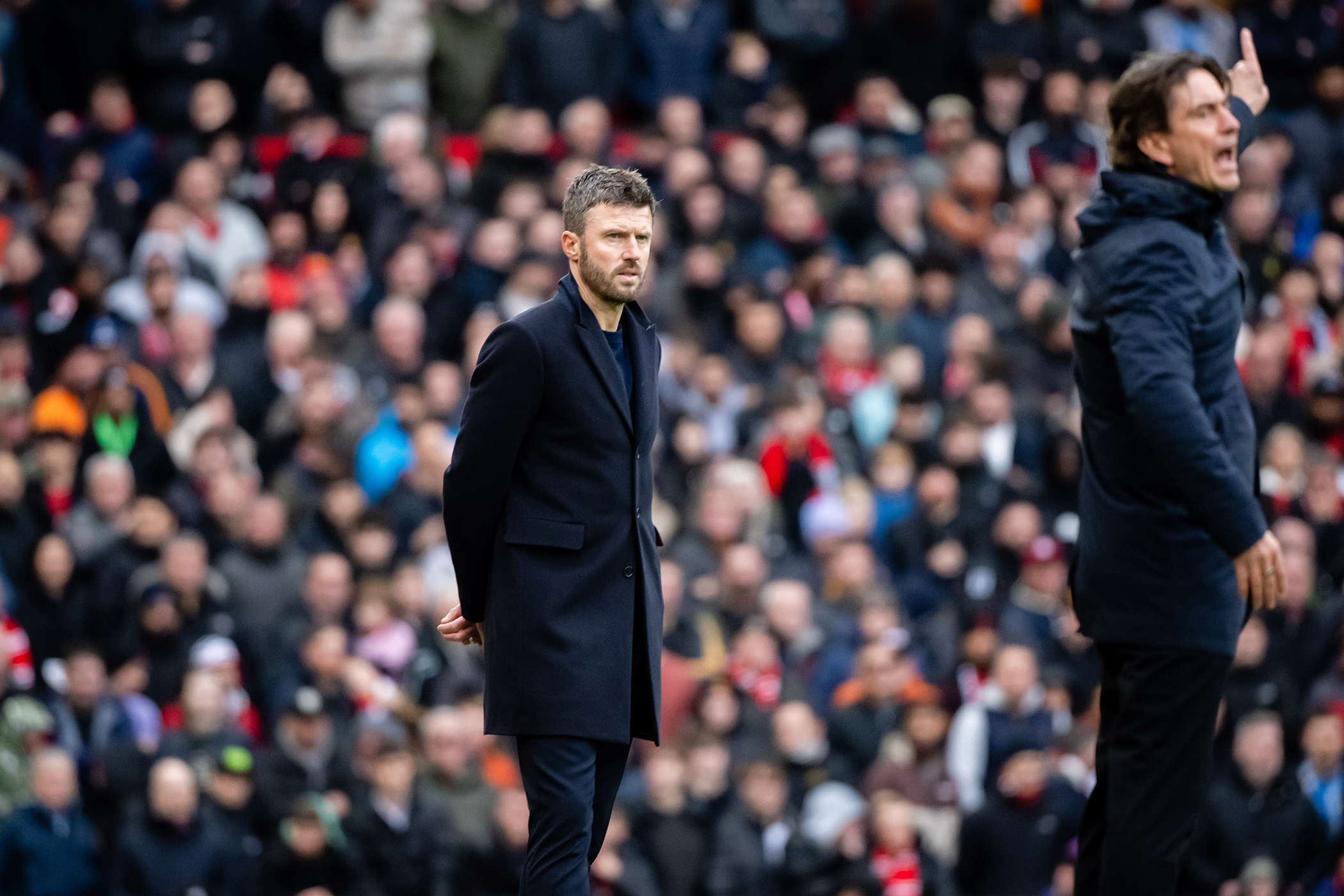
The contrast between the two, certainly, did not play in Frank’s favour. On the touchline, Spurs’ current manager is a bundle of anxious energy: chewing furiously, pacing nervously, remonstrating furiously. His hands are, by turns, planted in despair on his head, raised to the skies in prayer, or drawn tight across his chest.
Carrick, on the other hand, is almost pathologically unruffled. His gestures are slow, deliberate and only very occasional. For long stretches of time, he barely moves at all, like a man dutifully waiting for his wife outside an M&S changing room. It would not have entirely been a surprise to glance up and see him checking the scores on his phone.
That is not deliberate. Carrick’s poise is not an act, workshopped with a phalanx of PR advisers, the consequence of hours spent with expensive body-language experts.
“It’s not a performance from me,” he said. “I’m not thinking I need to look a certain way, I’m not into that. There’s an emotional side – I’ve made myself look a bit silly with some of the celebrations after some of the goals we’ve scored – and you have to enjoy it at certain times. I think it helps to make clear decisions, and to understand what’s happening in the game. I’m just trying to be calm and thoughtful.”
While it may not be on purpose, it does create an effect; watching them both side by side, it was hard not to feel as though this all comes more naturally, more easily to one of the two than it does to the other; that on some fundamental level, Carrick is ultimately just a little bit better at this than Frank.
As tempting as that sort of delineation can be, it is not entirely helpful. Management is too mercurial a career, too elusive a skill to be plotted on a straightforward spectrum; judging its exponents as either good or bad is reductive. Both of these managers are, in their own way, testament to that. Carrick’s time at Middlesbrough offered few clues that he would start quite so well at Old Trafford; Frank’s tenure at Brentford did little to suggest that he would struggle so much at Tottenham.
Quite why it has played out like that is rooted less in some ineffable, inherent ability than it is in context. This game is as good an example as any. It will be lost, given not just the result but the rancour swirling around Tottenham’s season, but Frank was not wrong when he said his team played well for 30 minutes.
Newsletters
Choose the newsletters you want to receive
View more
For information about how The Observer protects your data, read our Privacy Policy
That they went on to lose owed far more to the (not uncharacteristic) recklessness of Cristian Romero than it did any of Frank’s tactical choices or his strategic shortcomings. Had the Argentine resisted the urge to lunge in on Casemiro, half an hour in, perhaps Carrick’s calm might have been made to look like a lack of decisiveness; perhaps Frank’s energy might, after a creditable draw, have been deemed contagious, even inspirational.
Carrick has been uplifted by the scale of his job, he seems at home with the scrutiny and pressure
Carrick has been uplifted by the scale of his job, he seems at home with the scrutiny and pressure
And then, of course, there is the broader backdrop. It is not meant as a criticism of Carrick – whose primary obstacle to being granted his post on a full-time basis is the somewhat flawed logic that it did not work out, long term, when Ole Gunnar Solskjær made the switch from stopgap to permanent – to say that it is a considerable advantage to United that they now have nothing to distract them from the Premier League.
For the game’s elite, the most relevant factor in performance is now fatigue, how their players cope with an ever-increasing workload. United are not in Europe and, to their chagrin, have been eliminated from both domestic cups. Carrick and his staff, led by Steve Holland, have the rare privilege of being able to coach their players during the week, rather than simply patching them up and sending them back into battle.
That is not to say that Frank, with the same luxury, would be able to obtain the same results. The identity of a manager, the nature of a manager, is not irrelevant; it is just that it is not an absolute. It changes depending on the circumstances in which they find themselves: the difference between success and failure is, in effect, how their strengths interact with their setting.
It is here, perhaps, that the direct contrast is least flattering for Frank. Where Carrick has been uplifted by the scale of his job, by the grandeur of Manchester United, where he seems completely at home with the scrutiny and the pressure and the expectation, Frank has been almost visibly diminished by his experience at Tottenham.
The last six months, the sight of Spurs six points above the relegation zone, do not mean he is a bad manager; they do not, or should not, undo the reputation he built at Brentford. Nor does the immediate success of Carrick mean that Tottenham’s hierarchy should be scouring their archives for a beloved midfield playmaker to draft in. But it is hard, watching them, not to feel as though one is in very much the right place, at the right time, and the other is not.
Carrick was a picture of cool on the touchline.
Photograph by Ash Donelon/Manchester United/Getty