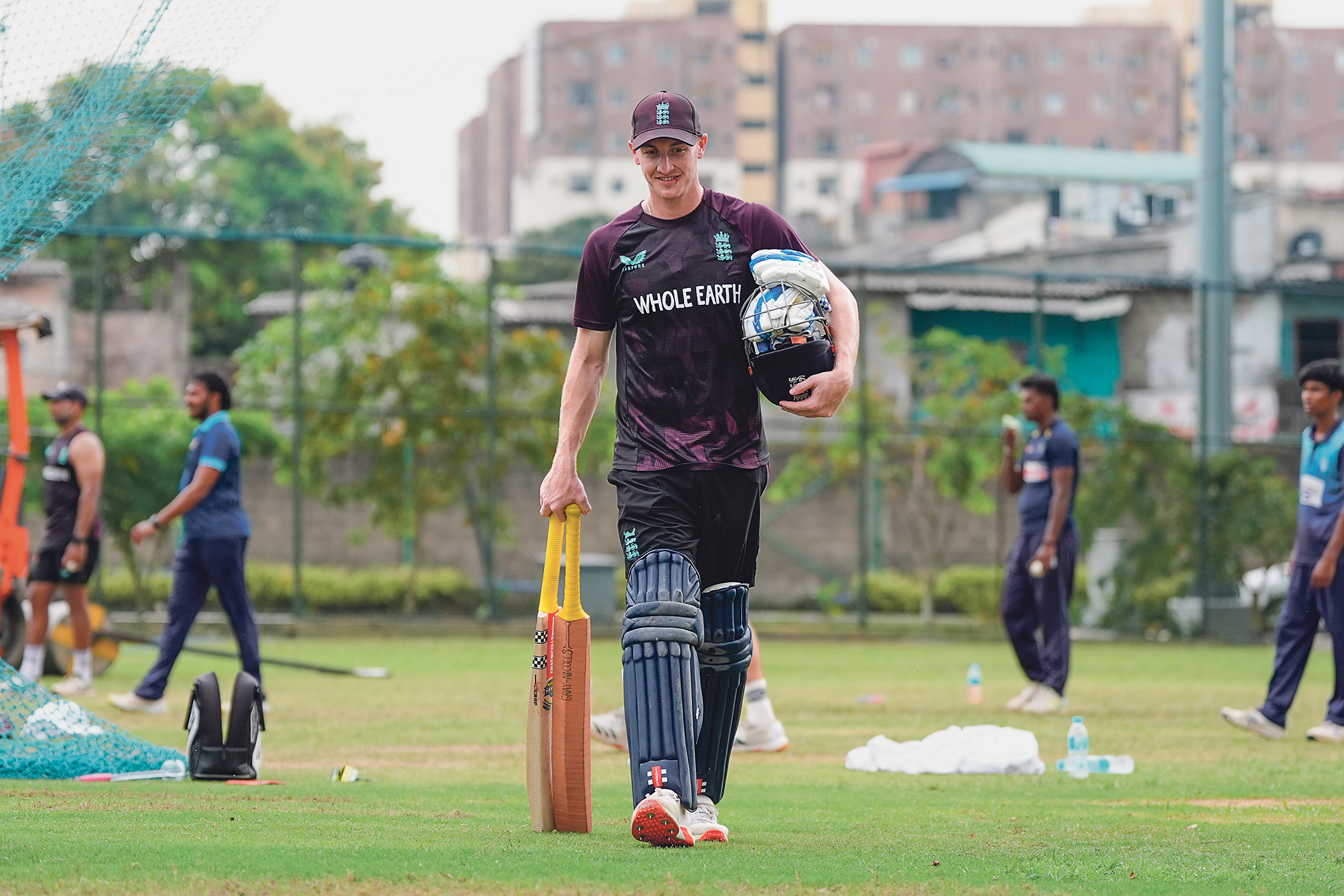

For all his overwhelming numbers and unfathomable talent, English cricket has always seemed somewhat suspicious of Harry Brook, a genius too gaudy and insolent, too comfortable and confident in its brilliance. And in the post-Ashes absence of any bloodletting or sackings, of Brendon McCullum and Rob Key taking responsibility, white-ball captain Brook has become the willing face of a failing regime.
Yet Brook is symptom rather than cause of Bazball’s rejection of accountability and proper preparation, of its deep unseriousness. He has only ever really played under McCullum and Ben Stokes, only ever been the boy king told to act on instinct and trust himself. What do they know of Bazball who only Bazball know?
To recap: Brook informed England management he had been “clocked” by a nightclub bouncer the night before the third ODI against New Zealand on 1 November. He was fined the maximum possible £30,000 and given a final warning, informed that he had been close to losing the captaincy, all revealed in suitably sensationalist fashion in the hours after the final Ashes Test. Although Brook first claimed he was out alone, it was later revealed he was with Jacob Bethell and Josh Tongue, all three now being investigated by the vaunted Cricket Regulator for “bringing the game into disrepute”, something the sport does a perfectly good job of alone.
And yes, to make the obvious point, Brook should not have been in a position to be “clocked” by a bouncer the night before a match. Though Tongue feels like the real victim of this particularly clumsy inquest, persecuted for being out before midnight on Halloween ahead of a match he was not in the squad for.
The reaction has been as reasonable as you would expect, with one article saying the incident proves Brook lacks key leadership qualities “such as integrity and personal credibility”. It started out on the piss, how did it end up like this? Speaking for the first time since Sydney this week, McCullum called it “quite annoying that we keep going on and on about it”, an understatement at best. The English sporting media machine have always loved being boozehounds in the streets and puritans in the broadsheets.
It bears saying that for all the ECB attempted to pass off the third ODI as the last throes of their carefully curated Ashes warm-up, in reality this was a dead-rubber match in a format only tangentially related to Test cricket. Personal and professional pride should have kicked in, but Brook in particular must be so numb to these inconsequential products of a bloated schedule that he finds it hard to take them that seriously.
But alcohol has always been inseparable from English cricket at every level, from the university fresher waterboarded with vodka to the Test quick still bought a jug as their reward for a five-for. It has been quite so hard to care about Brook’s big night out because so little about these revelations have been surprising. This remains a sport that venerates Shane Warne, Freddie Flintoff, Ian Botham and David Boon. Flintoff said the 2006 Ashes tour became a “booze cruise”. In 2017, after three alcohol-related incidents around that winter’s Ashes tour, Steven Finn said the victorious 2010-11 tour featured “lots of going out”. Four years ago, after police intervened in a post-Ashes Test drinking session including Joe Root and James Anderson, Monty Panesar wrote in the Telegraph that “Andy Flower understood the importance of England cricketers having a drink”. Particularly on foreign tours, this is expected.
Stuart Broad believes England “do not have a drinking culture”, while Matt Prior says we need to have a “much bigger conversation” about the sport’s drinking culture. And yet no one has bothered to define what a drinking culture actually is, or at what point it becomes problematic. Should all international players be tee-total as a blanket rule? Would this have been acceptable were it two nights before a match? What about three? What if he had been rat-arsed at 5pm but in bed by 10? There is plenty of evidence about alcohol’s negative impact on athletic performance, especially in a sport dependent on focus and reflexes, on fine margins and minutiae. Brook said he was “not leathered” but had had “one too many”, suggesting there is an acceptable threshold for pre-match pints, a science you suspect the players consider themselves professorial in.
And so we do this sordid dance every four years, moralise and judge and decry, but nothing ever changes, because no one involved actually wants to change. Really Brook’s crime is getting caught. Had Brook and co considered trying to get into a nightclub the night before a match particularly risky or revolutionary, they would not have done it.
There are suggestions that the money involved means this should not be happening as it has before, but increased salaries do not instil heightened professionalism by osmosis. Those awarded central contracts earn anywhere between £130,000 and £1m – without franchise deals – but the vast majority of professional cricketers across the county game earn less than £60,000 per year.
Newsletters
Choose the newsletters you want to receive
View more
For information about how The Observer protects your data, read our Privacy Policy
There has to be a coordinated effort to alter standards at the elite level, encouraged by senior staff. But not only did McCullum book the mid-Ashes Noosa trip a year in advance, he also organised a drinks session at his house in Matamata during the New Zealand series. None of this happened in a vacuum.
As much as English cricket would prefer everyone is Joe Root, you cannot have one part of Brook without the other. Nothing clarified this like his 136 from 66 balls in the third ODI victory against Sri Lanka, his century celebrated with wrestler “Stone Cold” Steve Austin’s beer smash celebration. We should want athletes to have this depth of personality and willingness to stand up for themselves.
England begin their T20 World Cup against Nepal this morning, a tournament doubling as a referendum on Brook and McCullum. McCullum is not going to resign, so is challenging the ECB to either trust him or pay him his £1m severance.
The T20 World Cup squad have been given a midnight curfew, a clumsy overstep designed to cater to the sport’s most infantilising instincts. Perhaps by the next tour it will be lifted, trust supposedly restored. We can start this whole futile process again and convince ourselves something has changed, until we are reminded once more that in cricket, it never does. Everyone is much happier that way.
Photograph by Sameera Peiris/Getty