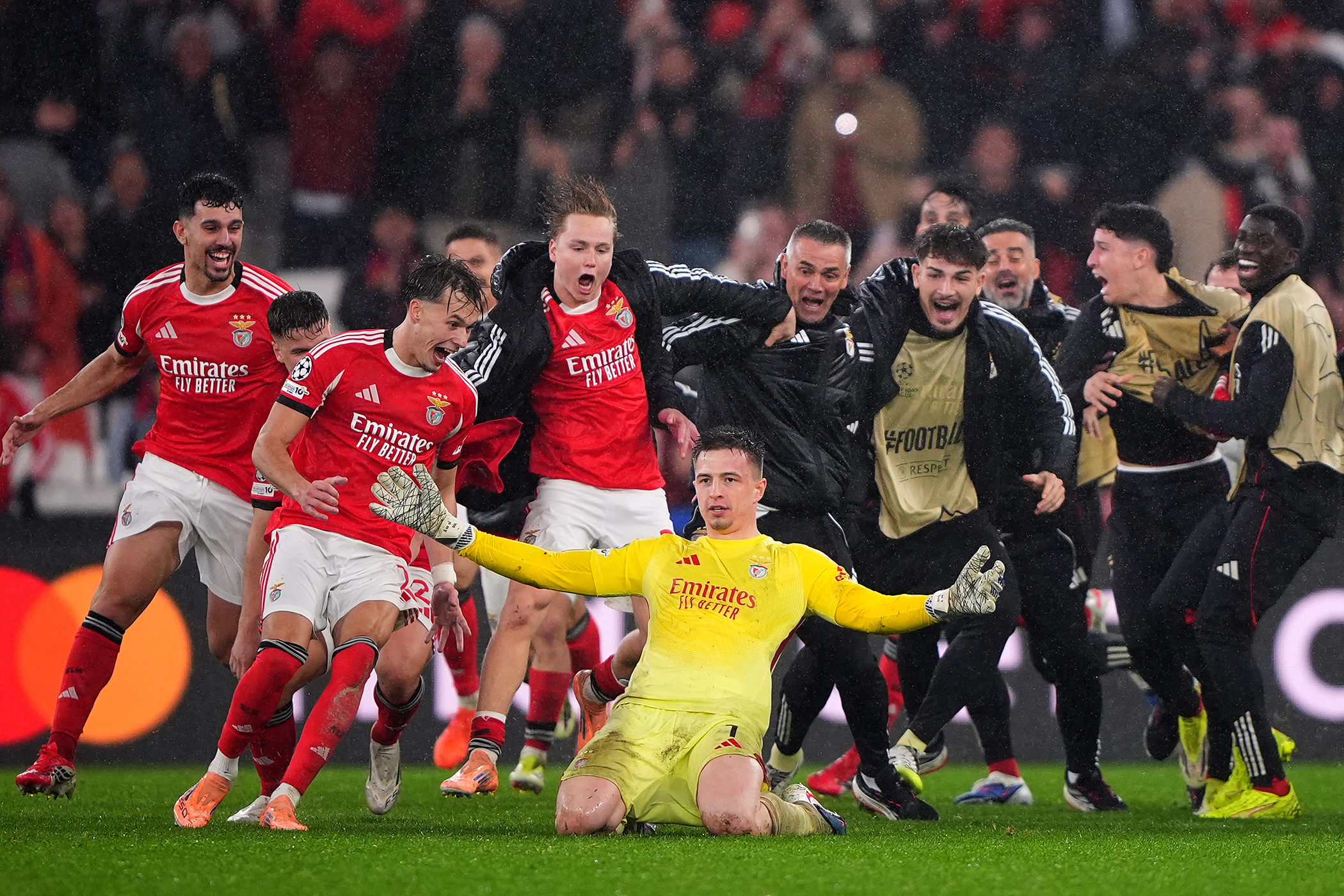


José Mourinho stood in the driving rain, soaked to the skin, and rolled the dice. Five minutes of injury time had been allotted; seven had already been played. His Benfica team needed a goal, and had one chance to score it: a free-kick, midway into Real Madrid’s half. He signalled frantically to his goalkeeper, Anatoliy Trubin, to go up and join the fray.
You will, by this stage, almost certainly have seen what happened next. It was, after all, perfect social media fodder, 20 to 40 seconds of original viral material: Fredrik Aursnes’s whipped cross, Trubin’s brilliant header, the Stadium of Light slipping into delirium. Or you may have seen its consequences: television studios in tumult, priests left in a state of disbelief.
The glee in Lisbon will, in all likelihood, have been matched in Nyon, the sleepy Swiss town that is only ever mentioned as home to the headquarters of Uefa. European football’s governing body, the creators and custodians of the Champions League, could not have asked for a better crescendo to the tournament’s group phase.
That goal, that moment, was everything Uefa wanted: the outcome of 144 games spread across five months boiled down to the final kick of the last match. Every other game had finished. There were still two matters to settle: the identity of the last team to qualify for the last 16, and that of the final side to squeeze into the punishment round. Both hinged on what happened in Lisbon.
That is the selling point of Matchday Mayhem, Matchday Madness or simply the portentous Matchday 8, depending on which advertising slogan you prefer. It is football in its most modern form, football for the content era: games reduced to a neverending series of clips and highlights and moments. Each match does not have a defined meaning; everything exists only in relation to everything else. It is sport that has to be mediated; an event that can best – perhaps can only – be understood through, or at least with the assistance of, a screen.
Trubin’s goal encapsulated that perfectly. It did not just send Benfica through, it eliminated Marseille, who had collapsed to a 3-0 defeat in Bruges a few minutes earlier. Conversely, had Real managed to conjure an equaliser, they would have pushed Manchester City out of the final place in the last 16. Both of those teams did not know what their result meant until long after their games had finished.
This format seems to work best for the continent’s middleweights
This format seems to work best for the continent’s middleweights
Even the most ardent conservative would struggle to build a cogent argument that Wednesday night, as a whole, was anything less than fabulous drama, thanks largely to the contributions of the Champions League’s Portuguese contingent: Sporting, Benfica’s great rival, scored an injury time goal, too, ensuring they finished above Real, Inter Milan and Paris St-Germain.
More convincing is the allegation that the road to this point is rather too long and much too winding, as though the Champions League has a finite resource of drama and most of it is now reserved for the last matchday. Its jeopardy diminished and its tension diluted, much of the group phase is now composed of glorified friendlies, in which the result scarcely matters. There will, after all, be plenty of second chances. There are too many ladders, and not nearly enough snakes.
That is by no means an absurd position to hold, and yet it feels like it is very much one side of the story. There should be absolutely no doubt about the primary motives behind revamping the Champions League: creating more games to satisfy the bottomless hunger of the television networks who bankroll the whole enterprise; engineering more meetings between Europe’s elite but stripping them of their stakes; generating as much money as possible to ensure that the continent’s biggest clubs do not decide, for example, to start experimenting with breakaway super leagues.
But after two years, it is also apparent that they have not been the only – and may not even have been the primary – beneficiaries of the changes. Paris St-Germain and Real Madrid have now failed, on both occasions, to qualify automatically for the last 16. Both, once again, must take the (admittedly minimal) risk of the playoff round. City avoided the same fate only thanks to PSG’s failure to beat Newcastle, or vice versa.
Newsletters
Choose the newsletters you want to receive
View more
For information about how The Observer protects your data, read our Privacy Policy
Instead, this format seems to work best for the continent’s middleweights. Benfica provides as good an example as any: Mourinho’s team lost their first four games in the competition this season. That would, in the old model, have been that, and deservedly so. But they, too, were granted a second chance; their interest in Europe lasted substantially longer than it might have done otherwise.
They were not alone. There was something riding on 17 of the 18 games on Wednesday night; only four of 36 teams had been eliminated when the fixtures started. True, in some cases the prize was a minor one – finishing 14th rather than 16th, say – but the vast majority were playing, and watching, either for a spot in the last 16 or a place in the playoffs.
For all of those teams, particularly those scrambling to qualify, there has been no shortage of jeopardy in the Champions League this season. The fact that there are no English teams among their number is not insignificant; too often, we view the Champions League through the prism of its Premier League contingent. When we say that it is boring, that it feels like a procession, we mean that it feels that way for us, and perhaps at a push for the handful of continental sides who attract our attention.
But the Champions League does not exist exclusively for those teams, for those fans, certainly not at this stage. The Premier League’s wealth, after all, means that those clubs should qualify with ease, whatever the format; if they are not sufficiently enthralled by the product, perhaps they might consider not buying all of the best players from the teams they are facing.
The English experience is not and can never be indicative of how the rest of the continent, the sides locked out of the latter stages of the competition by the raw economics of their television markets, understands it. It was fitting that the Portuguese sides delivered the two finest moments of the evening, and of the group phase as a whole, on Wednesday night. Nobody in Lisbon, it is fair to say, will be fretting that the new Champions League does not deliver enough drama.
Photograph by Jose Manuel Alvarez Rey/Getty Images