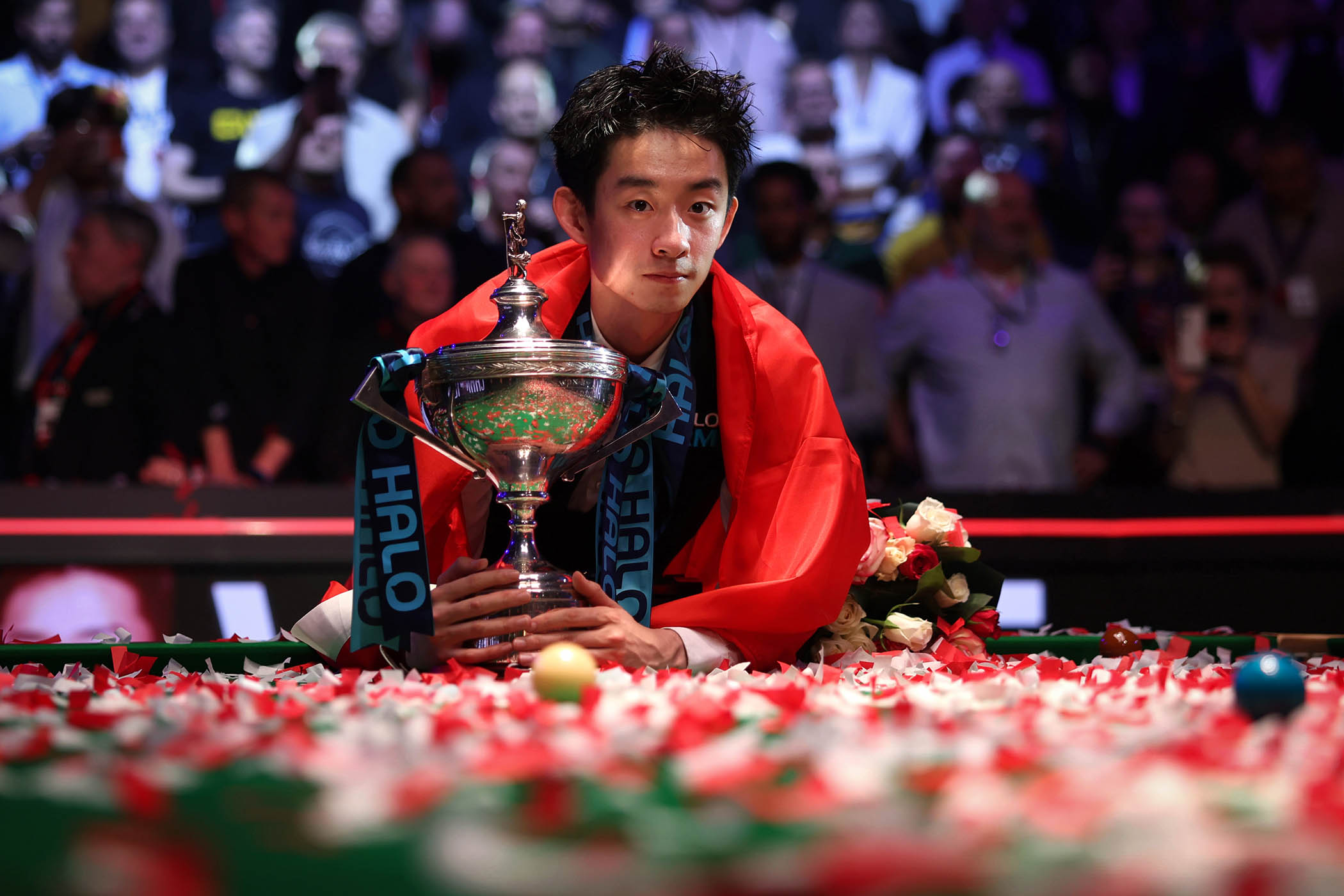


Imagine you are Wu Yize. At 22, you have just become the second-youngest world snooker champion ever, winning the first final to go to a deciding frame since 2002. You are also the second Chinese champion ever, a once unfathomable deluge of attention and sponsorship impending.
Your victory has not only vindicated your father’s decision to sell his antiques business in Lanzhou and move with you to Sheffield six years ago, sharing a single bed in a windowless room while speaking no English, but also his decision to leave your seriously ill mother behind. Both are hugging you, in perfect health, as the Crucible rises in rapture. As a bonus, you have just won £500,000, taking your two-year earnings above £1.1m. What’s next for a life which could go anywhere, be anything? “I think I will buy a house or an apartment in Sheffield”.
Wu’s 18-17 triumph is expected to have been watched by upwards of 150 million people in China, as Zhao Xintong’s was last year, despite finishing around 5am CST. The World Professional Snooker and Billiards Association claims snooker is now the most watched sport on China’s main state sports broadcaster. Wu was congratulated by the official Communist Party newspaper, while Ding Junhui – the grinning godfather of Chinese snooker – declared on Weibo, “our era is approaching now”. If anything, it is already here.
Two of the top four players are now Chinese for the first time – a year ago, the top five were all British – while Chinese players won eight events this season, up from three in 2024-25. Ronnie O’Sullivan, John Higgins and Mark Williams are all over 50; Shaun Murphy, Mark Allen, Mark Selby and Barry Hawkins topping 40. The highest-ranked British player under 30 is world No 36 Jackson Page, trailing seven Chinese 20-somethings. Stan Moody (19, although he looks 14 at a push) and Liam Pullen (20) both made the main draw at the Crucible before losing in the first round, but are falling behind their Chinese peers.
“I just think kids from the UK don’t want to work as hard,” World No 1 Judd Trump said last year, the sport’s enduring Thatcherism breaking containment. “A lot of kids nowadays probably, their lifestyle is too luxurious. They are not willing to lock themselves in a room for five or six hours a day, which many of the Chinese players do.”
Of course, Trump ignores that children predominantly play sport out of love rather than fear or need, overlooks the fact that, really, snooker’s cardinal sin to the British public is being deeply uncool, alongside isolating and infuriating. You still have to wear a waistcoat, the dress code specifying shirts “must be clean and ironed”. Tables are expensive and massive, while the few remaining clubs are crumbling into irrelevance (China has around 300,000 snooker clubs, compared to an estimated 650 in the UK). More people play snooker in China than live in England. It represents the death rattle of a repressed and depressed England gone, one which only endures as stereotype and tourist trap, as an excuse to sell period dramas.
Watching Wu lift the trophy while drowned in a Chinese flag, as Zhao had before him, the tendency was to talk of a sport which has lost control of itself, another lost British tradition. “China’s emergence as a snooker superpower is a small sign that the country is beginning to develop ‘soft power’,” wrote Gideon Rachman in the Financial Times. And yet this feels far more like a success of British soft power in China than the inverse. Basically every sport has attempted to break China over the past 30 years, but really the only three to manage are basketball, football and snooker.
Having first been taken to the far east by Barry Hearn in the 90s, Stephen Hendry is more likely to be recognised in Shanghai than Southampton. The Chinese government wants snooker in the 2032 Olympics. But for all the discussion of moving the World Championship to Saudi Arabia (which recently pulled its biggest tournament two years into a 10-year contract) or China, government funding guarantees it will remain at the Crucible until 2045. Of the sport’s 18 ranking events, 11 are still based in the UK.
“Sheffield has become my home in the UK and it is famous around the world as the home of snooker,” Zhao has said. “[The Crucible] is a very special place and all Chinese players want to play there.” Still world No 15, Ding runs one of the two major snooker academies in Sheffield, with the other operated by Victoria Shi, a former journalist turned manager. Wu is one of Ding’s projects, while Zhao has described Shi as like a second mother, particularly as she supported him through his match-fixing ban.
In 2022, O’Sullivan predicted that within a decade “every snooker player will probably be from Asia”, potentially raising the sport to a technical standard and popularity previously unimaginable, just not in the UK. But this new generation will still make pilgrimages to the South Yorkshire holy land, will call their own fouls out of a sense of duty drawn from a long-lost source, will continue dressing like Parisian waiters, boldly embarking on what O’Sullivan has repeatedly called “a waste of a life”. And maybe in 2026 this is all Britain, that great aircraft hangar for the world’s sport and money, can ask.
Photograph by George Wood/Getty Images
Newsletters
Choose the newsletters you want to receive
View more
For information about how The Observer protects your data, read our Privacy Policy