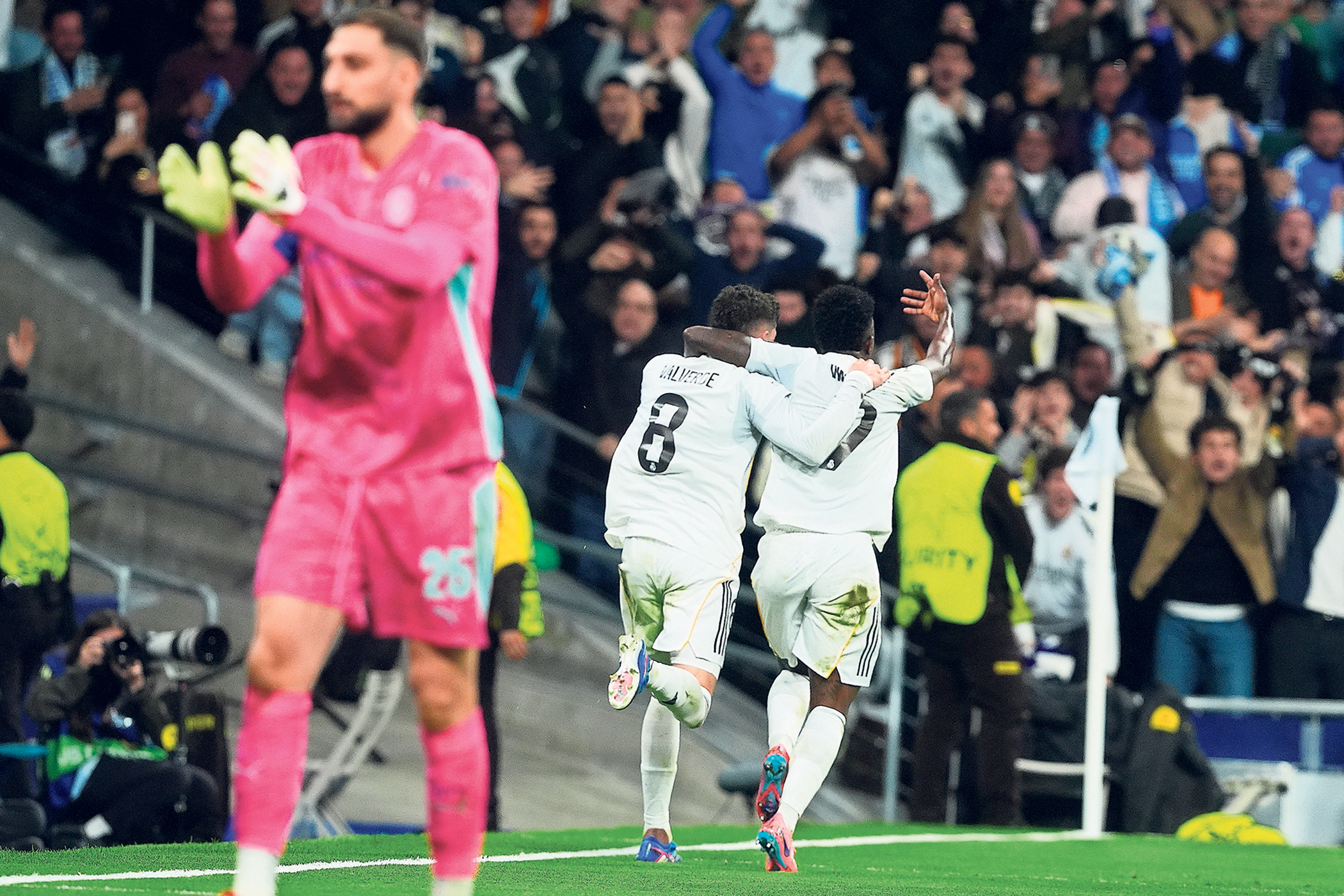


Let’s start with the caveats. Each episode of English failure in the Champions League this week was a story in its own right, one ringfenced by its own boundaries and underpinned by a bespoke inner logic. Antonín Kinský’s nightmare in Madrid was simply the great unravelling of Tottenham Hotspur made manifest. Liverpool have been in a state of slow-motion collapse for months.
Chelsea’s neophyte head coach decided that a visit to the European champions might be a good time to replace his error-prone first-choice goalkeeper with his error-prone second-choice one. Pep Guardiola, the only manager who has the privilege of losing games because he is simply too clever, was not the first to be fooled into thinking that Real Madrid must be as bad as they had previously looked.
Newcastle and Arsenal, meanwhile, did not actually fail. It might not have felt like that when Dani Olmo flummoxed Malick Thiaw to deny Eddie Howe’s side a stirring win against an anaemic Barcelona, or when the runaway Premier League leaders mustered just six shots against a team sitting sixth in the Bundesliga.
But we should not ask too much. Newcastle created enough chances at St James’ Park to believe they can pose a threat to Barcelona on the break in the return leg next week. Arsenal should remember that – no matter how much the Champions League changes – some old truths remain. A draw in an away leg of a knockout tie is still a job well done.
They are not the only ones who can nurse some faint hope. Liverpool, at least among people who have not watched them this season, will be expected to overturn a single-goal deficit against Galatasaray at Anfield. Spurs, City and Chelsea have steeper gradients to climb, but curves flatten with early goals. The remontada is a staple of the modern Champions League. Guardiola and Liam Rosenior, certainly, will have seen glimmers of light amid the ruins.
Still, this was a chastening week for the Premier League, an impression that is likely to be reinforced over the coming days. England’s top flight sees itself as the strongest, richest and best domestic tournament in the world. That is how it is seen, too: everyone from Giorgio Chiellini to Javier Tebas, the president of La Liga, regards it as a sort of de facto Super League.
The league phase of this season’s Champions League reinforced that view. England entered six representatives, itself a record. They played 48 games, and lost only nine. Among their collective victims were Bayern Munich, Barcelona, Inter Milan and Real Madrid, twice. All six made it through, five of them automatically.
As things stand, only Arsenal are favourites to take their interest any further. Liverpool and/or Newcastle might join them. The others all require some sort of miracle. Given the wealth at their disposal, and the inbuilt advantages it brings, it is hard to see that as anything other than a pricking of the Premier League’s ego.
Whether that self-regard was rooted in reality, rather than marketing spiel, is a different matter. Europe’s worst fears, of an untouchable Premier League bestriding the Champions League, has never quite materialised. Only three English teams have been crowned European champions since 2012. Only five have made the final. The Premier League has only taken 10 of the last 40 available quarter-final slots.
That is not a bad record; it is just not one that quite fits with the idea that the rest of the continent cannot compete with the English sides. Admittedly, that figure is skewed slightly: occasionally, as Manchester City found in 2018 and 2019, the Premier League teams get in each other’s way.
Newsletters
Choose the newsletters you want to receive
View more
For information about how The Observer protects your data, read our Privacy Policy
That alone does not explain the phenomenon. The traditional analysis – trotted out again this week – is that England’s clubs are hamstrung by the unique intensity of the Premier League. It is a rationale partly rooted in self-criticism: England does not allow its teams a winter break; it refuses to arrange its schedule to allow teams competing in Europe as much rest as possible. That is, as Michel Platini used to say, what makes the English lions in winter, and lambs in spring.
It contains, though, more than a grain of old-fashioned disdain for foreigners, too: it rests essentially on the assumption that Celta Vigo and Bologna and Auxerre and the rest are little more than Potemkin opponents for the continent’s grandees in a way that Brentford and Everton are not. The Premier League is, essentially, too tough for its own good.
That might well have played a part this week, of course: Newcastle’s game with Barcelona was their 27th since the start of December; they have played once every 3.7 days for three months. Chelsea, City and Arsenal have managed 26 in the same period.
But it is likely not the whole story.
It felt significant that referees in all six games featuring English teams seemed to take great delight in signalling for fouls from set-pieces; the siege weapon that has become the cornerstone of domestic combat will not, it seems, be quite so readily available to them in Europe.
It was tempting to wonder, indeed, whether England’s increasing attachment to an attritional style means its teams now struggle a little when faced with opponents who want to outplay, rather than out-push, them. “In the Premier League, there is no [Desiré] Doué, no Ousmane Dembélé, no Khvicha Kvaratskhelia,” as Liam Rosenior said after defeat in Paris.
For fans of a certain generation, that brings back memories: English teams venturing on to the continent and struggling to cope with a more technical, more sophisticated style was an almost weekly event in the 1990s. That the Premier League’s reversion to type might have had unintended consequences is a tempting theory, if somewhat undercut by the fact that it does not apply to Arsenal.
Besides, it makes sense for Premier League teams to focus on domestic requirements; that is, after all, where the money and the interest is. Nottingham Forest had to cut ticket prices for their Europa League game against Midtjylland. Most other leagues alter their schedules to allow teams competing in Europe extra rest. Not in England. The Premier League always comes first.
That is a more telling difference than it may appear. PSG, Real Madrid and Barcelona, three of the sides hoping to vanquish the Premier League ogres, are among the four richest in Europe, according to Deloitte. Much of their wealth, and their appeal, is built on their presence in the Champions League. This is the competition that defines them all. They save themselves, design themselves, for this. More and more, England’s eyes drift elsewhere.
Photograph by Avalon