Illustration by Andy Bunday
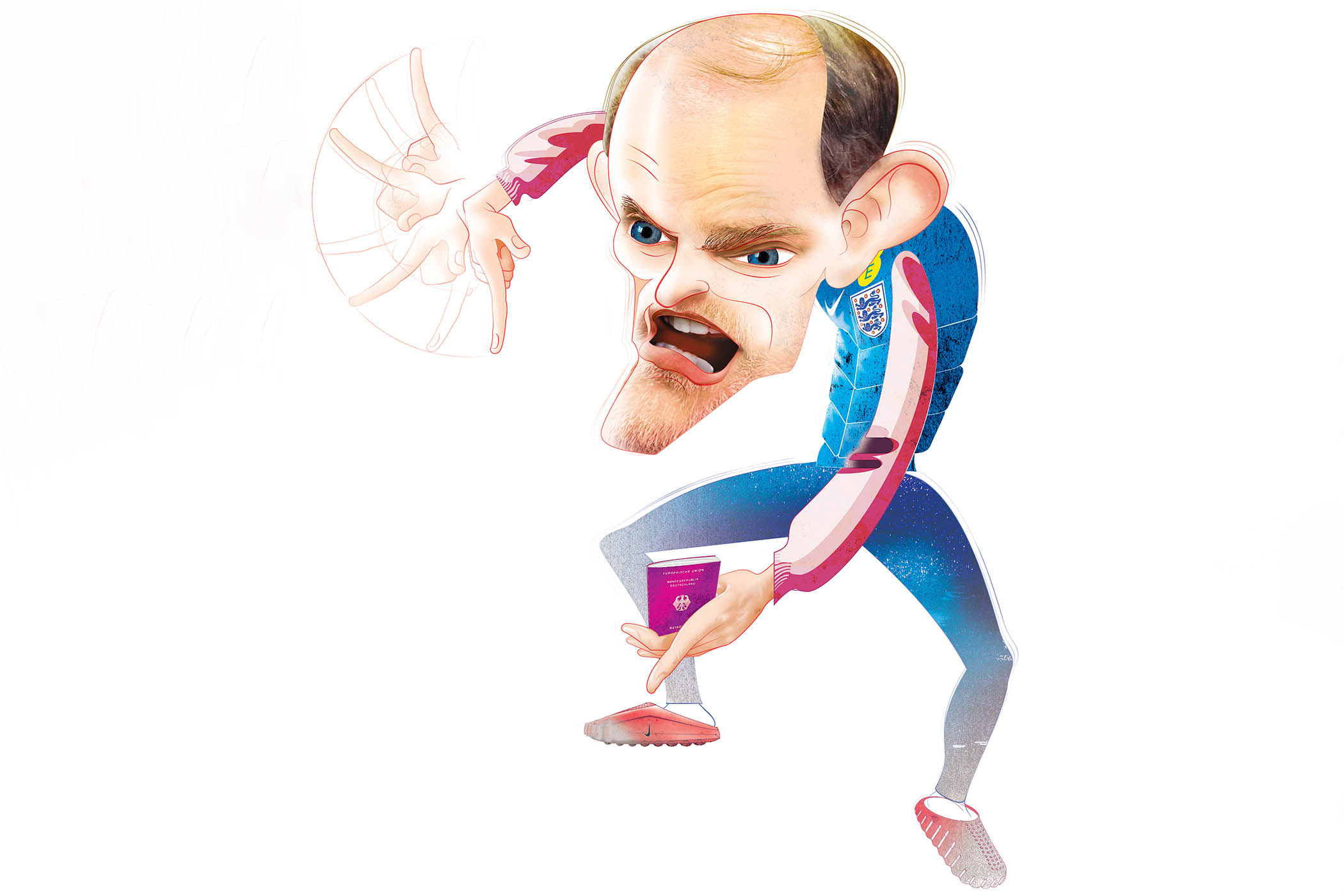
It is a sign of the baffling priorities of some parts of the media that when Thomas Tuchel was appointed in 2024 as the man to take England to this summer’s football World Cup, the German manager was asked whether he would sing God Save the King before matches.
As befits someone with a reputation for deep analysis, Tuchel asked for time to think about it. Three months later, he had an answer. “Because it is that meaningful and that emotional and so powerful, I have to earn my right to sing it,” he said. “I will earn it with results, with building a group, with doing my job properly and by creating a feeling where maybe even you guys say: ‘Now it’s time that you sing it. You’re a proper English guy now!”
Despite qualifying for the World Cup last year with eight wins from eight and no goals conceded, Tuchel has still not sung the anthem. That may reflect a sensible view that getting to the sharp end is just the beginning: he will have earned the right to sing, as well as his reported £5m annual salary, only if he takes England deep into the tournament and perhaps to their first World Cup final since 1966.
His appointment achieved that rare feat of uniting Nigel Farage and Gary Neville. “Why can’t we have an English manager?” the Reform UK leader asked, while Neville, a former player and pundit whose politics are far from Farage’s, said he was “shocked” that the FA had looked overseas. “A dark day for England,” was the Daily Mail’s headline.
Sven-Göran Eriksson was the first foreign England manager, in 2001. Tony Blair once sympathised with him about who had the hardest job of pleasing the public and press. The Swede took England to three quarter-finals in consecutive international tournaments. The Italian Fabio Capello was handed the reins in 2007 and resigned after a poor 2010 World Cup. Can Tuchel do any better?
He came with a glittering CV, having won silverware with some of Europe’s biggest clubs, including the Champions League with Chelsea. Perhaps just as important, he already had a good relationship with the England captain and record goal-scorer. He was the manager who in 2023 brought Harry Kane to Bayern Munich from Tottenham Hotspur, where he has thrived.
Thomas Tuchel was born in 1973 in Krumbach, a Bavarian town of 14,000 inhabitants. He was a tall, talented defender in the team that surprisingly won the German schools championship, coached by his father, Rudolf, and is remembered by teachers as having a sharp tactical mind and iron discipline. He seldom drank, then or now, and regularly went to church. Tuchel has said that he learned from his mother, Gabriele, who worked with disabled people, the importance of treating everyone equally.
His high standards and assertiveness sometimes rubbed teammates up the wrong way and he didn’t have a long playing career. He was in the Augsburg academy until he was 19 but the highest level at which he played was a handful of second-division games for Stuttgart Kickers. In 1998, he retired early because of a cartilage injury in his knee.
After two years of working in bars and studying economics, Tuchel was given a job coaching VfB Stuttgart’s youth team. They won Germany’s under-19s title, after which he went back to Augsburg and got his Uefa coaching licence. He had a reputation there for arguing with referees and was often fined.
Newsletters
Choose the newsletters you want to receive
View more
For information about how The Observer protects your data, read our Privacy Policy
In 2009, he moved to Mainz, initially to run the youth side, where he showed his skill for motivation by taking the squad on a bicycle ride up a 2,000-metre high mountain. At the summit, he told them that his aim was to win the national under-19s title. He then took a Mainz badge, covered it in a Snickers wrapper and buried it, promising that if they succeeded, he would return to retrieve it. They did – and so did he. Jürgen Klopp, manager of Borussia Dortmund’s senior side and later of Liverpool, remarked that while their under-19s had 10 better players than Mainz, they lost to a better team.
Promoted to manage Mainz’s senior side, Tuchel showed his inventiveness and attention to detail. At a camp in Austria, he was seen measuring the height of the grass and sniffing it approvingly before asking if they could poach the groundsman. He cut the corners off their training pitch to improve passing and told the players to hold tennis balls to stop them grappling with opponents. He banned players from getting up from the dining table until everyone had finished eating. In five years at Mainz, he qualified for Europe twice.
Then the big teams began to call. He succeeded Klopp at Dortmund in 2015. The team came second in the German league and won the domestic cup. In 2018, he moved to Paris Saint-Germain, where they won all four domestic trophies and reached their first Champions League final. He then joined Chelsea, where they won the 2021 Champions League and had an astonishing run of 14 matches in which they conceded only two goals. He was dismissed by the club’s new chairman in 2022 and joined Bayern the following year, winning the league in his first season.
In all, Tuchel won 11 trophies with four of Europe’s biggest clubs, yet he did not stay more than two years at any. He still had a reputation for being prickly and overly assertive, especially with officials and administrators. Despite that, the FA decided Tuchel had the vision and nous to end England’s long wait for glory. After success in World Cup qualifying, his contract was extended this February to 2028.
Teams coached by Tuchel, who was known at Chelsea as “Tommy Tactics”, are always hard to beat. He has spoken of the importance of ensuring that everyone respects his decisions, even when he rejects players who are liked by fans but are not a good fit for his system. “A little bit of fear is always good,” he said when accused of being a dictator, but he criticised previous England sides for being more afraid of losing than hungry to win.
Nine men have managed England at a World Cup in the 80 years since Walter Winterbottom became the first. Only Alf Ramsey has won a trophy. Other than that it has been – to update the Euro 96 song – 60 years of hurt. Might Tuchel be the man to ensure that, as he might put it, Fußball kommt nach Hause?