
This is not the trip to Paris that Steve Borthwick envisioned before the Six Nations began when – in perhaps the most un-Borthwick comment of his three-year tenure – he said: “We want to be in a position in that game to get what we all want to achieve. We want English fans flooding across the channel to get there and watch that game.”
It seemed out of character because with Borthwick the attention is always in the detail, on the next task. Here, he was dreaming big. Supporters will certainly travel to watch England take on title-chasing France, but given recent events they will be hoping merely that the scoreline remains respectable.
There were no massive proclamations from Borthwick this week during the team’s training camp in Verona. “England v France is one of the great rivalries in international rugby and we’re looking forward to the occasion” is the coaching soundbite equivalent of a batter hunkering down and electing to play a forward defensive.
What a wild tournament. Before the Six Nations began it felt as though England were the team with the fewest concerns. A few injuries to their props, sure, but their performances in the autumn – defeating Australia, Fiji, New Zealand and Argentina – suggested they had figured out who they were as a side. Now their head coach may not see out the rest of the year, having been given the dreaded vote of confidence by the RFU’s chief executive, Bill Sweeney, after England lost to Italy for the first time in their history in Rome.
The last five weeks, in a way, have produced a consistent pattern; listening in midweek to coaches and players talk about what England want to do – move the ball, keep their discipline – before then watching them fail to back up those words on the field. The repetitive nature of their shortcomings has meant two things. First, it becomes harder to believe what they’re saying. And second, it makes you wonder whether the messages from Borthwick and his coaches are actually getting through to the squad.
Before Rome Borthwick spoke about England “tightening up” in the red zone, when they get into an opponent’s 22. England have scored seven tries from 34 entries which, frankly, is not great. He then added: “I’ve talked to you a lot about pushing players to give that extra pass. Maybe the team has tightened up and not thrown it. I want us to get back to playing the way we want to play and being willing to throw that pass, be willing to move that ball a little bit more. I’ll be encouraging the team to do that this weekend.”
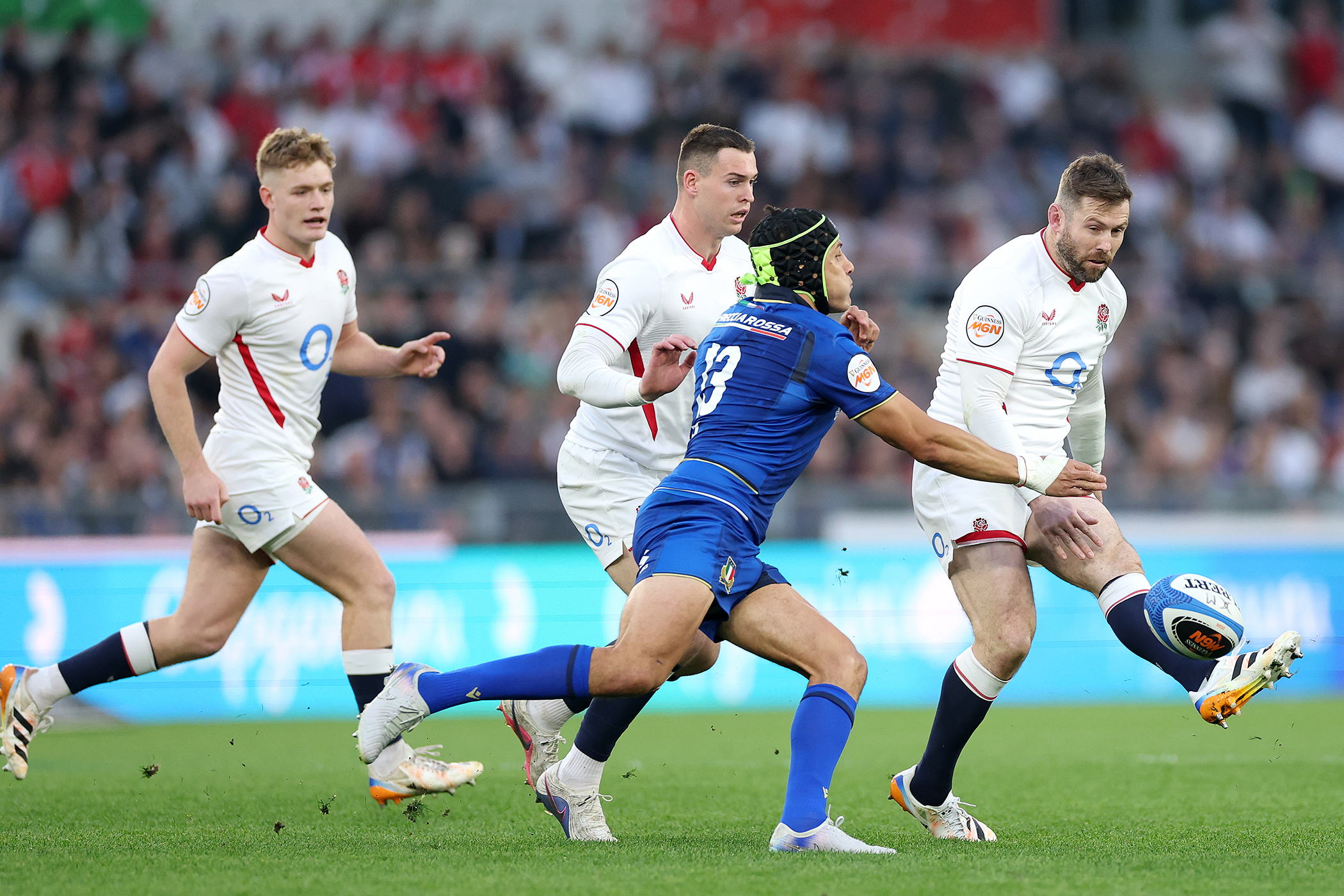
Sounds great, doesn’t it? Except when watching the game against Italy live in Rome and then back again on the flight home, you could see countless moments where England didn’t throw that pass. Elliot Daly, the England full-back, said afterwards that England had targeted “edge kicking, putting the ball in behind”. Watching Seb Atkinson, a threatening runner and good passer for Gloucester, forcing a kick in behind in the second half when England had space on the outside was particularly glaring. That is not Atkinson at his best. Not the Atkinson who impressed in Argentina in the summer. The fact that Cadan Murley, the England wing, can be seen calling for the kick behind reiterated that it was a pre-planned tactic. Not exactly free will to move the ball around.
England have spent much of this tournament playing attacking whack-a-mole, with a different issue rearing its head each week. For a team who thrive off box-kicking and winning the territory battle, they were bad in the air against Scotland. At home to Ireland their work at the breakdown, clearing out bodies for quick ball, was shockingly poor. They were frequently blasted off the ball by Irish opponents and looked flat and slow in the 22 before Ireland counter-attacked and scored to go 22-0 up after half an hour.
In Rome they essentially shut up shop, doubling down on the kicking strategy with Ben Spencer’s box-kicks, or trying chips in behind to the wings. When that tactic did secure valuable territory – England had 96 per cent in the first 10 minutes – they did very little with it. The lineout, Borthwick’s calling card, has barely looked a threat. Maybe their maul becomes more effective by picking three locks in Paris with the addition in the back row of Ollie Chessum. At least the scrum, churning out penalties, has been a success.
As for their discipline, England have given away a yellow card in every game so far and two in each of the last three. Trying to win a Test match is hard. Doing so down to 13, as England have been occasionally, even more so. The variety of offenders and offences means there is no single cause. Sam Underhill tackled well against Italy until getting one shot wrong on Michele Lamaro, hitting him high. Maro Itoje’s swipe for the ball at the back of an Italian maul was basic, and bad. It tarnished an otherwise decent performance by the England captain, who has not always looked at the races in this championship, partly for personal reasons following the loss of his mother. Up until the two cards in Rome, England led 18-10 and while it wasn’t exactly a riveting performance, victory was in their hands. And they threw it away.
Newsletters
Choose the newsletters you want to receive
View more
For information about how The Observer protects your data, read our Privacy Policy
Borthwick famously is not the world’s greatest motivator in terms of rousing speeches. The key to his success is data, explaining that to the players, building an effective plan with a route to victory that the team then buy into. “Steve gives us a game plan where I honestly have complete, supreme confidence that we'll win every game,” said Ben Earl after Rome. Richard Wigglesworth, Kevin Sinfield and Lee Blackett are among the assistants in place to rouse and put an arm round the shoulder. Until recently that formula was working. Now, it isn’t.
The good vibes from England’s 12-Test winning run are long gone. A real humiliation in Paris – a distinct possibility with France chasing the title and ticked off with how things went at Murrayfield – would make it hard to imagine Borthwick’s position being tenable and easy for the RFU to move him on, should it wish. One win out of five would make 2026 their worst-ever Six Nations. One they began as title contenders. Think about that.
Scotland, if they can end their Irish hoodoo earlier on Saturday – having not beaten Ireland since 2017 – would need the auld enemy to then do them a favour, with an England win over France potentially securing a first Scottish title since 1999.
If you had said after round one, when Scotland lost in Rome and England easily dealt with Wales, that Gregor Townsend’s future would look secure and Borthwick would be at risk, few would have believed you. It has been a wild championship. One that, even if England somehow win in Paris, has blown Borthwick’s side completely off course.
Photography by Dan Mullan - RFU