
The videos from Lisbon came out in the days after Arsenal’s 1-0 win over Sporting in the Champions League quarter-final first leg. Portuguese police in riot gear threatening away fans with batons as they queued to get on to the metro, ready to lash out at the tiniest imagined infraction.
Meanwhile, Liverpool’s Help account on X was advising fans to avoid certain areas of Paris prior to their match against Paris Saint-Germain. “DO NOT travel on Metro line 10 this is for the PSG Ultras” they wrote, specifying which line fans should get.
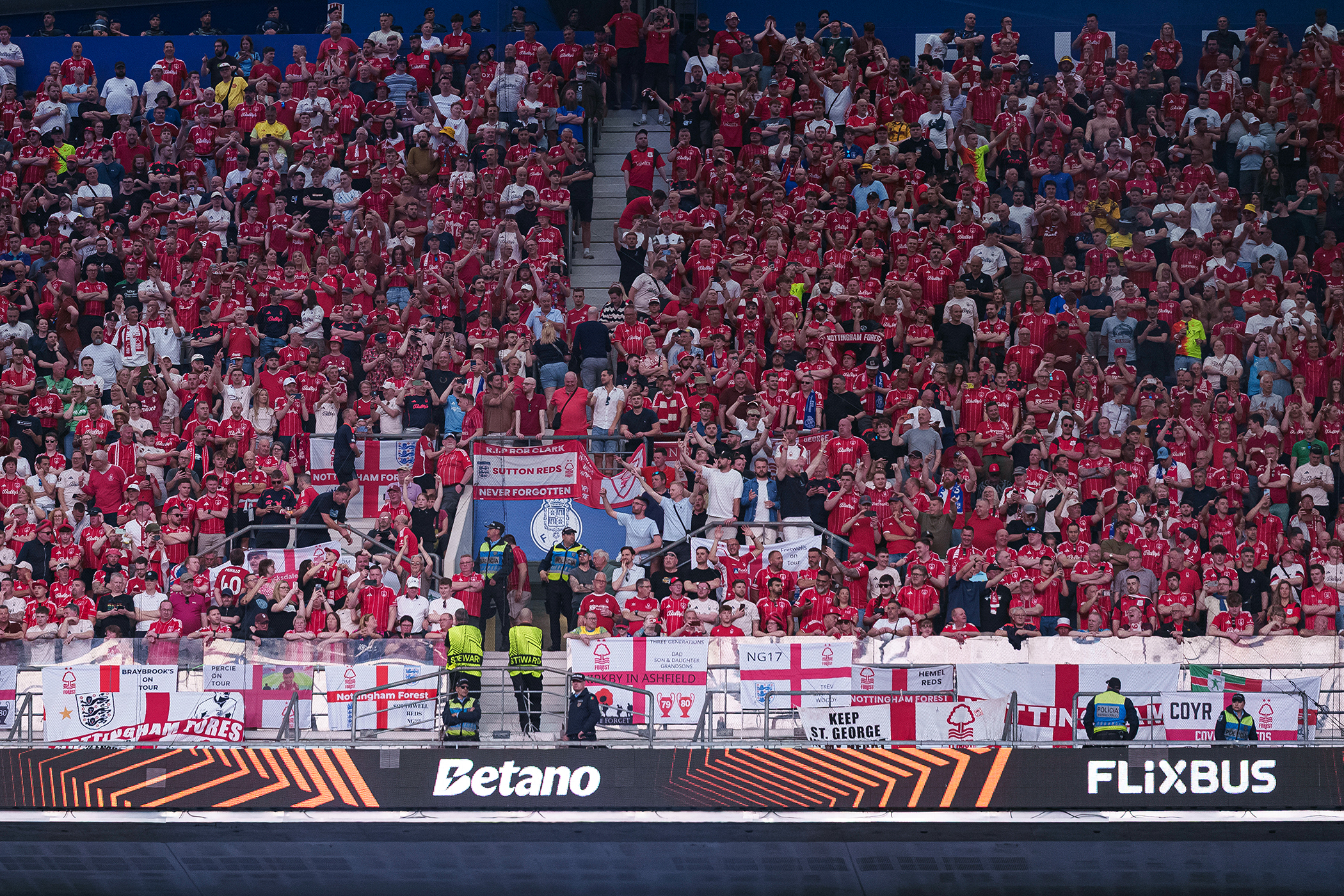
In Porto, there were reports on X of police in the city centre using tear gas on Nottingham Forest supporters.
All in all, another week for English away fans travelling in Europe. Despite spending hundreds of pounds following a team across the continent, away fans are regularly treated as trouble makers, subjected to hold backs, police intimidation and rules about where they should or should not go.
More English teams are involved in European competition than ever before. With six teams in the Champions League, two teams in the Europa League and one in the Conference League, close to half of the Premier League have played matches on the continent this season.
The Observer spoke to fans from all nine clubs – Arsenal, Aston Villa, Chelsea, Crystal Palace, Liverpool, Manchester City, Newcastle United, Nottingham Forest, Tottenham Hotspur – who have played European fixtures this season to find out what the experience of being an away fan in European competition is like now.
The picture painted is one of significant diversity. Fans cited countries such as Germany as being exemplary for away fans while highlighting matches in Italy, France and Turkey as far more frustrating.
Even at individual games, experiences can diverge. Mark Goodwin, an Aston Villa fan, said his experience at Lyon for their Round of 16 first leg was “really good” after he decided to arrive at the ground when the gates initially opened. But videos on X showed away fans arriving later were being met by police in riot gear and refused entry to the ground.
Many of the fans attributed
their treatment to caricatures of English fans as being “thugs” or “hooligans”, despite noting that
they had observed no trouble from any of their fellow fans in recent years.
The hooligan trope is only further exacerbated by comments of the kind made by Fifa President Gianni Infantino who said in January that it was “really special” that no England fans were arrested at the World Cup in Qatar 2022.
Newsletters
Choose the newsletters you want to receive
View more
For information about how The Observer protects your data, read our Privacy Policy
The reality is that fan experience is far more determined by where you are going than which country you are coming from.
Martin Endemann, head of policy at Football Supporters Europe, an organisation that works closely with Uefa around fan safety, says the fact that English fans are more likely than other countries to travel in big numbers can have an impact on the way they are treated.
Endemann also points to the change in format as causing a reversal in some of the progress that has been made in recent years.
“We have a bit of a problem with the missing reciprocity,” he says, referring to the fact that in the new league phase format, clubs do not play each other home and away but instead play eight different teams.
“Clubs treat away fans poorly because they know their fans don’t have to travel there.”
Yet issues do not end at the new format. Some fans’ frustration with their experience was exacerbated by the perception of how their clubs treated away fans.
Emily, a Manchester City fan, said that home fans didn’t feel safe with how many Galatasaray supporters were able to get tickets in the home end when they played them in January.
Meanwhile Fenerbahçe supporters ripped out seats and threw flares onto the pitch in their Europa League match against Nottingham Forest.
Chelsea fans reported being able to smell marijuana coming from the away end during their second-leg Round of 16 fixture against PSG, while a video on TikTok showed a Chelsea fan arguing with a PSG fan who was in the home end.
Last season the club also had significant issues during their Conference League semi-finals with large numbers of Djurgårdens fans infiltrating the home end. A report from the Chelsea Supporters’ Trust detailed intimidation, overcrowding and passive stewarding.
Chelsea have since changed their rules on membership purchases to try to avoid repeats of the issue, but the reliance of Chelsea and Manchester City on third-party ticket resale platforms means this issue is not going away. (Chelsea co-owner Todd Boehly is an investor in one such business, Vivid).
The country most cited for issues was undoubtedly Turkey, where fans reported having to be bussed to the stadium hours before the match and being held back for an indeterminate amount of time afterwards. Fans could expect to be on the bus for more than two hours without toilet facilities.
“If this is how they need to treat people to let them go to football, you probably need to be doing something else because this isn’t the solution,” says Liverpool fan Phil Blundell, who points out that fans are paying hundreds of pounds and taking annual leave in order to follow their team. Ben Joyce, a Chelsea fan, said he forgoes traditional holidays in favour of following Chelsea and England abroad.
Kat Law, a Tottenham supporter and Football Supporters Association National Council member, emphasises that not everything is in Uefa’s hands.
“Uefa are obviously in control of what happens inside the stadia. But a lot of things that happen in Europe aren’t in their jurisdiction. If it’s outside the stadium footprint, it’s with the local police.
“You’ve got an awful lot of stakeholders who are in play when it comes to delivering on a game. But in my view, there needs to be far more collective work on this.”
Yet Uefa do get to decide which countries can host finals, with Turkey continuing to be rewarded despite ongoing issues. Endemann also cited concerns about countries with human rights issues being selected.
Ultimately, for many fans, the enjoyment of getting to follow their team in Europe outweighs any of the issues that they encounter.
“The sun was hitting my face and we had cold beers,” says Norman Riley, about his recent trip to watch Newcastle place Barcelona.
“Me and Alex, the lad I was there with, recorded a podcast after the Wolves game in 2021, the final game before the takeover. At the time, we were saying that the club’s a zombie club. And within four years, we were sat in Barcelona going to watch Newcastle in the Nou Camp. The contrast was pretty spectacular.”
“I’ve been waiting basically my whole life for this to happen,” says Ben, a Nottingham Forest fan.
“I’ve tried to go to as many games as possible because I don’t know when it might happen again. I knew that different countries would have different ways of handling away fans but I’ve been pleasantly surprised.”
The problem is that this commitment from English fans means that their treatment continues to be woefully ignored by footballing authorities.
Photograph by Pedro Loureiro/Eurasia Sport Images/Getty
‘Fans know we are there for them if they need it’
By Will D'Hooghe, head of fan engagement, Nottingham Forest
The goal for our team is to ensure that fans have a safe, well-informed and memorable trip.
On Tuesday evening, we flew out to Porto. That enabled us on Wednesday morning to go down to Ribeira, an area of the city along the river which the club and local police had told us would be welcoming to Forest fans.
We familiarised ourselves with the area, speaking to managers and bar staff so they would know to expect large numbers of Forest fans.
One of the main issues was prohibited medical items. Some supporters have to carry syringes or EpiPens for medical conditions. I worked closely with Porto to create medical exemption certificates they were comfortable with, enabling five supporters to carry a syringe into the stadium.
On Wednesday evening, there was a bit of unrest in the city. It was heavily policed. Largely our fans were really well-behaved throughout that. We were there, as were Nottinghamshire police, helping to oversee the operation. There was an incident later in the evening with some Porto ultras attempting to get to Forest fans at the fan meeting point, but thankfully it all passed relatively lightly.
We had a match day operational meeting to help local authorities, Porto, us and Uefa to ensure a safe, well-planned day. These are really important – it’s a good chance to have those final conversations with our counterparts at Porto and the police.
The two hours leading up to the game present a range of challenges. We had fans bringing items that weren’t prohibited, but having them confiscated. We had two supporters lose their tickets in between the checkpoint 50m from the turnstiles and the turnstiles themselves, but we were able to create an electronic ticket and get them into the stadium.
Porto had said there would be a lift for fans who were disabled. That wasn’t the case. So there was the manual job of helping them up 80 steps to the away section.
Unfortunately, after the game, the way it was handled by Porto wasn’t consistent with what they had promised, and it led to a lot of unrest. Tensions rose but eventually we did manage to get fans out of the ground within about 40 minutes, as well as managing to return a lost wallet.
Each fixture has had its challenges; this was no different. I feel fans are able to take comfort knowing that if they need help, we are there for them.
The information sharing between Premier League clubs off the pitch is fantastic and I couldn’t speak more highly of their support as we embarked on this campaign back in Europe for the first time in 30 years. One club told us to expect the unexpected, which couldn’t be more accurate.